Stay informed with our newsletter.


EN





Thanksgiving 2026 is emerging as a major test of American consumer confidence, with 81.5 million people expected to travel and nearly 183 million planning to shop between Thanksgiving and Cyber Monday. At the same time, traditional Thanksgiving dinner costs have risen more than 6%, putting additional pressure on household budgets. Despite affordability concerns, Americans continue to travel, celebrate and shop, while becoming increasingly value-conscious, deal-focused and strategic about holiday spending decisions.
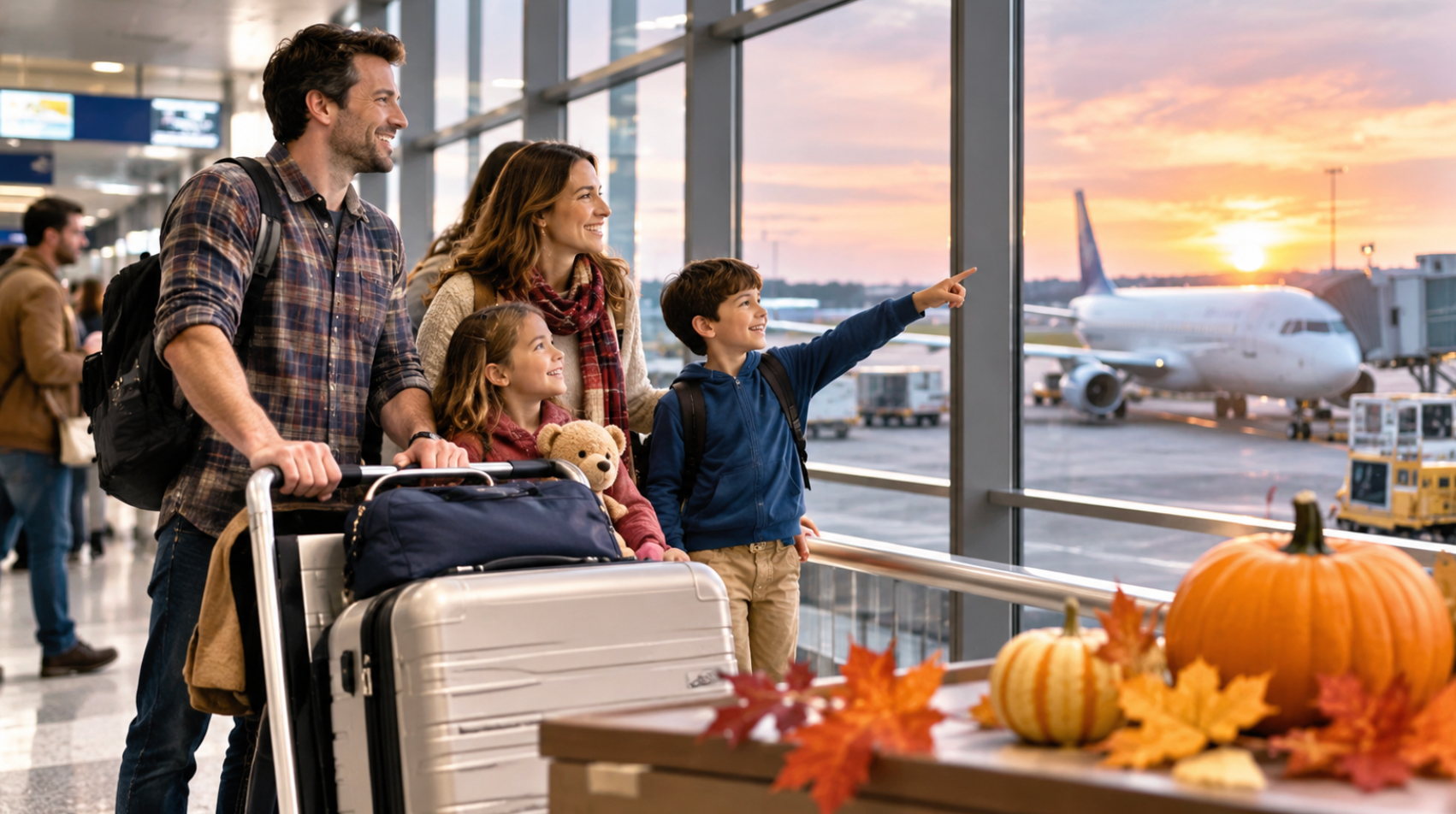
Thanksgiving has always been one of America's biggest family celebrations, but in 2026 the holiday is also offering a revealing snapshot of the American consumer.
Millions are preparing to travel, grocery bills are climbing again, and nearly 183 million people are expected to shop between Thanksgiving and Cyber Monday. Together, these trends reveal a holiday season in which Americans remain willing to spend and travel, but are increasingly conscious of prices, value and household budgets.
From crowded highways and airports to more expensive turkeys and massive Black Friday traffic, Thanksgiving 2026 is shaping up to be one of the year's most important consumer weekends.
Thanksgiving remains one of America's biggest travel periods.
AAA projects that 81.5 million Americans will travel at least 50 miles from home between Tuesday, November 24 and Monday, November 30. That is only 0.1% below the 81.6 million who travelled during the comparable period last year. The slight decline ends a three-year streak of Thanksgiving travel records beginning in 2023.
The automobile will remain the dominant form of transportation. Meanwhile, approximately 5.96 million people are expected to fly domestically during the Thanksgiving period.
But travellers are paying considerably more for those flights. AAA says the average round-trip domestic Thanksgiving airfare booked through its data was approximately $800 - 17% higher than last year.
Another 2.6 million Americans are projected to travel by buses, trains and cruises, representing a 4.1% increase from 2025.
The holiday's travel impact is also extending beyond U.S. borders. Popular international destinations booked through AAA include Budapest, Cancún, Paris, Barcelona, London, Amsterdam, Rome and Munich, illustrating how Thanksgiving week has evolved into an important international tourism period for American travellers.
Yet travel is arriving against a backdrop of heightened concern about aviation disruptions. Recent technology problems affecting U.S. air travel have added uncertainty as millions prepare to move through airports during the holiday rush.
Families staying home are encountering another challenge: the Thanksgiving table costs more this year.
The American Farm Bureau Federation's 41st annual Thanksgiving Dinner Cost Survey estimates that a traditional meal for 10 people will cost $58.63 in 2026, equivalent to approximately $5.86 per person.
That represents an increase of more than 6% compared with 2025, although the total remains 8.5% below the record $64.05 recorded in 2022.
The star of Thanksgiving dinner is responsible for much of the increase.
A 16-pound frozen turkey averages $23.68, or $1.48 per pound, according to Farm Bureau. That is 10.1% higher than last year. Increased production costs and a turkey population still recovering have contributed to higher prices.
Other Thanksgiving staples are also more expensive. Whole milk is up 8.6%, fresh cranberries 8.8%, dinner rolls 7%, sweet potatoes 5% and stuffing mix 5.4%.
Not everything has risen: vegetable trays, frozen peas, pie crusts and whipping cream are cheaper than last year.
Regional differences are substantial. The traditional meal averages $54.33 in the South, compared with $56.89 in the Midwest, $58.74 in the West and $61.57 in the Northeast.
For consumers, Thanksgiving therefore provides a highly visible reminder of something households encounter throughout the year: even when headline inflation improves, individual grocery prices can continue moving in very different directions.
Once Thanksgiving dinner is finished, another American tradition moves into full force: holiday shopping.
The National Retail Federation estimates that 182.7 million consumers plan to shop between Thanksgiving Day and Cyber Monday in 2026.
That is slightly below last year's 186.9 million but remains an extraordinarily large share of the U.S. consumer market.
Black Friday remains the main event.
Approximately 126 million people, or 69% of Thanksgiving-weekend shoppers, plan to shop on Black Friday. Among them, 67% expect to shop in physical stores while 89% plan to shop online.
Cyber Monday follows with approximately 66.1 million shoppers expected to participate.
Why are so many people shopping?
Price remains crucial.
Nearly 48% say Thanksgiving weekend deals are simply too good to pass up, while 26% cite tradition as a reason for shopping during the period.
That combination demonstrates how Black Friday has evolved. It remains a cultural event, but for many households it is increasingly a budgeting strategy, an opportunity to make planned purchases when discounts are deepest.
Perhaps the most important story behind Thanksgiving 2026 is not simply how many people are spending. It is how carefully they are spending.
NRF found that 82% of Thanksgiving-weekend shoppers are taking steps to manage holiday costs.
Some 25% plan to purchase less expensive gifts, 24% are cutting spending elsewhere, 20% will buy for fewer people, and another 20% are deliberately waiting until Thanksgiving weekend to complete most of their shopping.
That behaviour reflects broader economic concerns.
According to NRF's 2026 holiday research, 56% of holiday shoppers say the state of the economy will affect their spending plans. Nevertheless, NRF forecasts November and December retail sales will increase 4.2% from 2025 to approximately $1.013 trillion.
That creates an interesting contradiction.
Consumers are concerned about affordability, yet they have not stopped spending. Instead, many appear to be becoming more strategic, searching for discounts, comparing prices, shifting budgets and prioritising purchases.
Black Friday also no longer marks the beginning of holiday shopping.
NRF reports that 60% of consumers had already started holiday shopping by the beginning of November, compared with 56% before the pandemic.
Retailers have responded accordingly.
Promotions that were once concentrated around Black Friday increasingly begin weeks earlier, transforming what was historically a single shopping day into a long promotional season.
Consumers can now compare discounts across multiple weeks, while retailers compete for spending before shoppers exhaust their holiday budgets.
The most popular planned gifts this year include clothing and accessories, chosen by 45% of shoppers, followed by gift cards at 39% and toys at 29%.
Interestingly, gift cards have lost some ground. Only 39% plan to give them this year, the lowest level recorded in the survey's more than two-decade history, with total gift-card spending forecast at $26.8 billion.
Thanksgiving is about family, gratitude, food and tradition. But its enormous scale also makes the holiday an unusually useful window into the state of the American economy.
In a matter of days, consumers collectively make decisions about travel, groceries, fuel, restaurants, gifts, entertainment and e-commerce.
This year, those decisions point toward a consumer who remains active but increasingly value-conscious.
Americans are still travelling in extraordinary numbers. They are still preparing traditional Thanksgiving dinners despite higher food costs. And almost 183 million people still intend to participate in the holiday shopping weekend.
But beneath those numbers is a growing emphasis on affordability.
The defining story of Thanksgiving 2026 may therefore be one of resilience mixed with caution.
An estimated 81.5 million travellers, a 6% increase in the cost of a traditional Thanksgiving dinner, approximately 126 million Black Friday shoppers and 66.1 million Cyber Monday shoppers collectively demonstrate the extraordinary economic scale of America's holiday weekend.
For retailers, airlines, hotels, supermarkets, restaurants and e-commerce platforms, Thanksgiving remains a critical commercial period.
For consumers, however, the challenge is increasingly about making traditions fit within the household budget.
That may be the most revealing trend of all.
Americans are not abandoning Thanksgiving spending. They are becoming more deliberate about where, when and how they spend.
And as Thanksgiving gives way to Black Friday, Cyber Monday and the wider Christmas shopping season, that search for value could define the final weeks of 2026.
For questions or comments write to contactus@bostonbrandmedia.com