Stay informed with our newsletter.


EN





Gold has experienced a dramatic reversal in 2026, falling sharply from record highs as Federal Reserve rate-hike expectations, elevated Treasury yields and a stronger U.S. dollar pressure prices. Yet underlying demand remains resilient, with central banks continuing major purchases and global gold ETF holdings reaching record levels. While jewellery and retail demand have weakened, institutional interest remains strong, raising a crucial question: is gold entering a prolonged downturn, or simply undergoing a major correction?
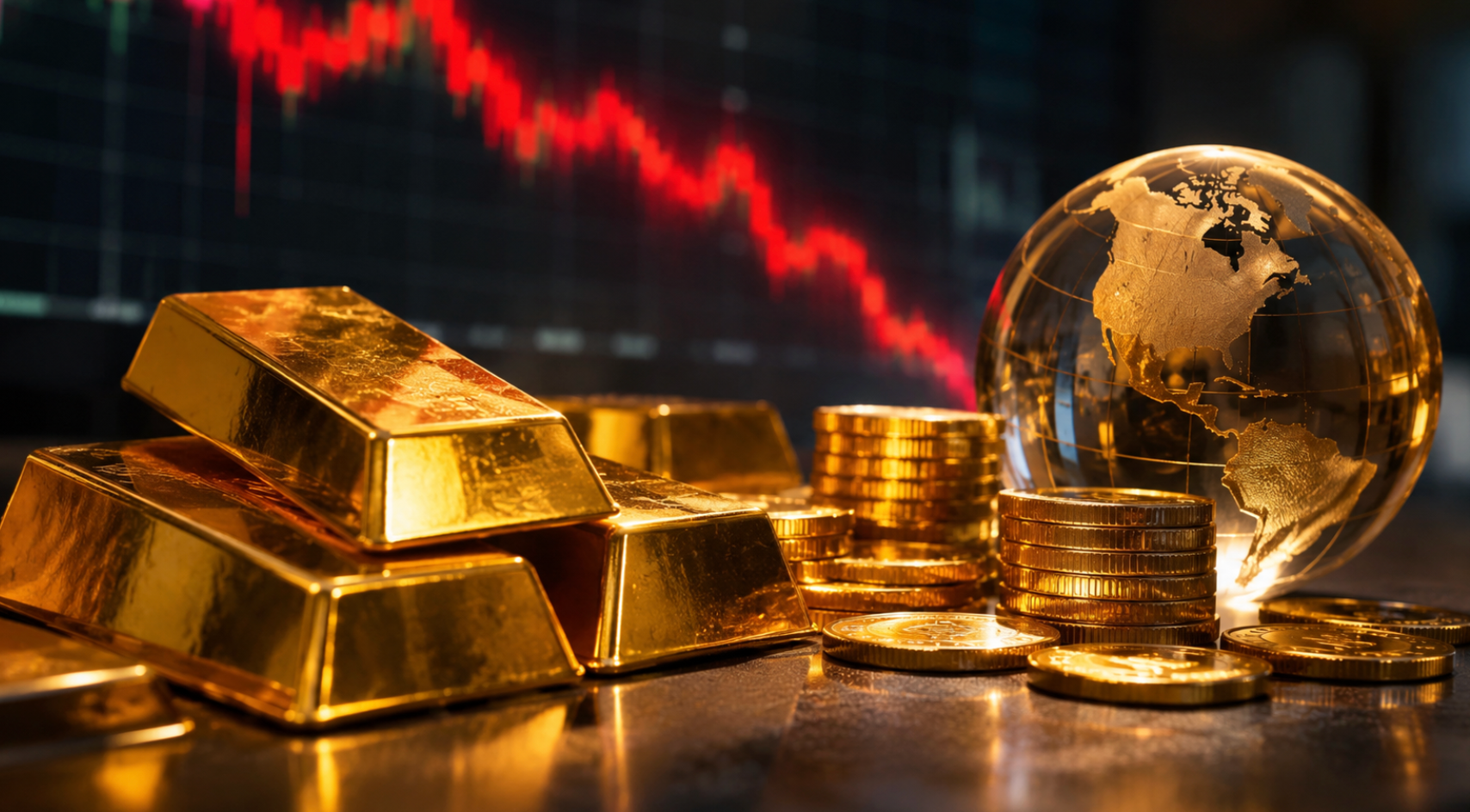
Gold entered 2026 looking almost unstoppable. After gaining 64% in 2025, its strongest annual performance since 1979, the precious metal continued surging as investors sought protection from geopolitical uncertainty, economic instability and financial-market risk. By January, gold had climbed to an extraordinary record of $5,594.82 per ounce.
Less than ten months later, the picture could hardly look more different.
On November 20, spot gold fell as much as 2.7% to around $3,525 per ounce, leaving bullion roughly 37% below its January record and down about 9.2% for the week. The decline put gold on course for its worst weekly performance in eight months and illustrated just how dramatically one of the world's most closely watched safe-haven assets has reversed direction.
Yet underneath the price collapse lies a striking contradiction: central banks continue buying hundreds of tonnes of gold, while gold-backed exchange-traded funds are holding record quantities of the metal.
That divergence may be the most important story in the gold market today.
Gold's rally did not emerge from nowhere. The metal benefited enormously during 2025 and early 2026 from safe-haven demand, monetary-policy expectations, central-bank purchases and strong investment flows.
In January 2026 alone, prices raced beyond $5,000 before ultimately reaching the record $5,594.82 level. But conditions subsequently changed.
By November 16, gold had fallen to $3,830.74, already representing a 31.5% decline from its January record. Four days later, the sell-off accelerated, pushing spot gold toward $3,525.
The scale of the correction demonstrates a fundamental reality about gold: although it is considered a defensive asset, its price remains extremely sensitive to interest rates, currencies, liquidity and investor positioning.
The most immediate pressure is coming from the United States.
Markets have rapidly increased expectations that the Federal Reserve will raise interest rates again in December as policymakers confront persistent inflation. As of November 20, markets were pricing approximately a 96.8% probability of a 25-basis-point increase, with a small probability of a larger 50-basis-point move.
This matters enormously for gold.
Unlike bonds or savings instruments, gold does not pay interest. When government bonds offer increasingly attractive yields, investors face a higher opportunity cost for holding bullion.
The pressure has been compounded by elevated U.S. Treasury yields. Earlier this week, the benchmark 10-year Treasury yield was around 5.14%, while the dollar remained close to a 19-month high.
A stronger dollar creates another problem. Because international gold is predominantly priced in dollars, a rising U.S. currency effectively makes bullion more expensive for buyers using euros, yen, rupees and other currencies.
Together, high yields, higher-rate expectations and a powerful dollar have created an unusually difficult environment for gold.
Another factor has emerged from broader financial-market volatility.
During severe market sell-offs, investors do not necessarily buy gold immediately. Sometimes they sell it.
Gold is highly liquid, which means investors can quickly convert it into cash to meet margin requirements or cover losses elsewhere. Recent turbulence in technology and AI-related equities has therefore added another source of selling pressure.
This creates an interesting paradox: gold can be a safe haven over longer periods while simultaneously becoming a source of liquidity during short-term financial stress.
That helps explain why bullion can sometimes fall alongside equities during periods of intense market liquidation.
Perhaps the strongest argument against declaring the gold boom finished comes from central banks.
According to the World Gold Council, central banks and other official institutions purchased a net 321 tonnes of gold during the third quarter of 2026, representing a 42% increase from a year earlier and the strongest quarterly total since the fourth quarter of 2024.
During the first nine months of 2026, central-bank purchases reached 675 tonnes, approximately 6% higher year-on-year.
This buying reflects structural considerations that extend far beyond short-term price movements.
For many central banks, gold provides reserve diversification, protection against currency risk and an asset that carries no direct counterparty exposure. The World Gold Council expects central-bank purchases to at least match 2025 levels following the surprisingly strong third quarter.
That means one of gold's most important long-term sources of demand has not disappeared simply because prices have fallen.
Institutional investment flows also complicate the bearish narrative.
Physically backed gold ETFs added 211 tonnes during Q3 2026, reversing the outflows seen during the previous quarter. Their combined holdings reached a then-record 4,256 tonnes.
October strengthened the trend.
Global gold ETFs attracted another $2.7 billion, marking their fourth consecutive month of inflows. Holdings increased by another 19 tonnes to a record 4,275 tonnes.
During the first ten months of 2026, global gold ETFs attracted approximately $41 billion, the third-strongest total on record, while holdings increased by 246 tonnes. European and Asian investors accounted for most of those net inflows.
So while gold's market price has fallen dramatically, large pools of investment capital have not abandoned the asset.
The situation is considerably weaker in physical consumer markets.
Global bar-and-coin demand fell 19% year-on-year to 268 tonnes during Q3, as retail investors waited for clearer price direction.
Jewellery demand was also hit by previously elevated prices. Global jewellery consumption dropped 17% year-on-year to 313 tonnes, the weakest third-quarter volume in the World Gold Council's data series. Consumers increasingly shifted toward lighter or lower-carat jewellery to control costs.
This reveals an increasingly divided gold market.
Central banks and ETF investors have remained relatively strong buyers, while jewellery consumers and some retail investors have pulled back.
Gold's supply picture provides another reason to avoid assuming that falling prices automatically signal structural oversupply.
Mine production increased 3% year-on-year to a Q3 record of 1,071 tonnes, but total gold supply actually declined around 1% year-on-year to 1,369 tonnes.
Surprisingly, recycled gold fell 8% to approximately 314 tonnes, despite historically elevated gold prices.
Meanwhile, total gold demand during the first nine months of 2026 reached 3,881 tonnes, virtually matching the record 3,884 tonnes recorded during the comparable period of 2025. In value terms, year-to-date demand reached a record $566 billion.
Those figures make the current sell-off particularly significant: gold's price has collapsed far more dramatically than underlying global demand.
Gold now faces a battle between two powerful forces.
On one side are higher interest rates, elevated Treasury yields, a strong U.S. dollar, weaker jewellery consumption and short-term liquidation pressure. These factors could continue pushing prices lower if inflation remains stubborn and the Federal Reserve maintains a hawkish policy stance.
On the other side are central-bank accumulation, record ETF holdings, geopolitical uncertainty, concerns about fiscal sustainability and gold's strategic role as a reserve asset.
That combination makes predicting the next move unusually difficult.
The World Gold Council itself describes the outlook as finely balanced, with rising interest rates presenting a significant headwind while geopolitical and financial-market risks could revive demand for stability.
Gold's extraordinary journey through 2026 therefore may not simply be a story about a bubble bursting.
It may instead represent a major repricing of gold after an extraordinary rally, with short-term monetary forces colliding against longer-term structural demand.
Whether gold eventually returns toward its January record or enters a prolonged bear market will depend heavily on Federal Reserve policy, inflation, Treasury yields, the U.S. dollar and whether central banks continue accumulating bullion at their recent pace.
For now, one conclusion is clear: gold has lost much of its record-breaking price momentum, but the global appetite for owning it has not disappeared.
For questions or comments write to contactus@bostonbrandmedia.com