Stay informed with our newsletter.
.webp)


EN





BMW has entered a defining phase in its electric transformation with the start of Neue Klasse i3 production at its Munich plant. Built on the company’s advanced electric architecture, the new i3 promises up to 900 kilometres of WLTP range, faster charging, smarter software and improved manufacturing efficiency. The launch also supports BMW’s plan to make Munich an exclusively electric-vehicle production facility from 2027, linking the brand’s heritage with a new generation of sustainable mobility.
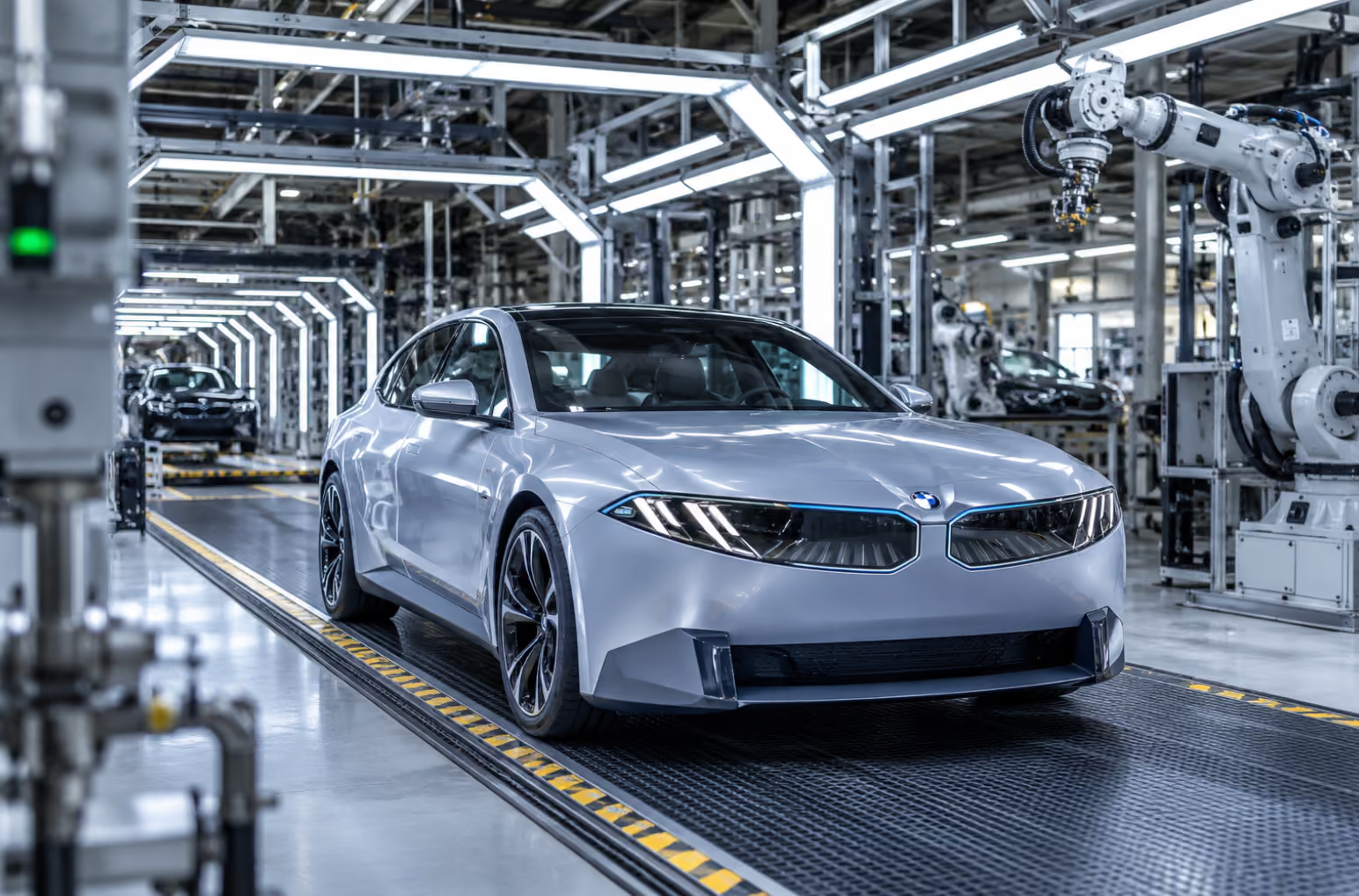
BMW is entering one of the most consequential phases in its modern history as series production of the new, fully electric BMW i3 begins at the company’s home plant in Munich in August 2026. More than the launch of another electric sedan, the event represents the industrial arrival of BMW’s Neue Klasse, a new-generation vehicle architecture intended to reshape the company’s electric drivetrains, software, digital interfaces, manufacturing processes and sustainability strategy.
The new i3 is the second production model based on the Neue Klasse architecture, following the BMW iX3. It also brings the Neue Klasse transformation directly to BMW’s historic Munich plant, which has manufactured premium vehicles for more than a century. Customer deliveries are scheduled to begin in autumn 2026, while BMW plans to convert the Munich facility to the exclusive production of fully electric vehicles from 2027.
BMW Group Plant Munich has played a defining role in the company’s manufacturing history. The facility is now undergoing one of its most extensive transformations, combining its 104-year industrial heritage with new digital, automated and electric-vehicle production systems.
Preparing the plant for the Neue Klasse has required BMW to build a new body shop, introduce state-of-the-art vehicle assembly systems and expand its logistics facilities. These new structures occupy approximately one-third of the plant’s footprint. Significantly, much of the redevelopment was completed while the facility continued producing as many as 1,000 vehicles per day, demonstrating BMW’s effort to transform a major operating factory without suspending its existing production responsibilities.
The company expects the changes to deliver measurable financial benefits. According to BMW, the start of i3 production should reduce the Munich plant’s overall production costs by a further 10%, taking them below the level associated with the current vehicle generation. The efficiencies are expected to come from improved production processes, selective automation, digitalisation and the simplified architecture of the Neue Klasse.
The i3 will not be the only Neue Klasse vehicle manufactured in Munich. BMW has confirmed that additional models will follow, including the planned BMW i3 Touring, turning the plant into an important centre for the company’s next generation of electric vehicles.
One of the most important features of the new BMW i3 is its claimed driving range. BMW says the sedan will offer a provisional range of up to 900 kilometres under the WLTP test cycle, potentially making it one of the longest-range premium electric cars in its segment.
The figure is enabled by BMW’s sixth-generation eDrive technology, known as Gen6. The system combines highly efficient electric motors, a new high-voltage battery concept, cylindrical battery cells and an 800-volt electrical architecture. BMW says Gen6 technology can provide approximately 30% faster charging and a 30% improvement in range compared with the preceding generation, although the exact benefit will vary across models.
The new cylindrical cells offer around 20% greater energy density than BMW’s previous Gen5 prismatic cells. The company has also adopted a cell-to-pack design, under which the cells are installed directly into the battery housing without being grouped into conventional intermediate modules. Through its “pack-to-open-body” approach, the battery also becomes a structural component of the vehicle architecture.
BMW has stated that the i3 will support DC charging at up to 400 kW. Under suitable conditions and using charging infrastructure capable of delivering the required power, approximately 400 kilometres of WLTP range could be added in ten minutes. The vehicle will also offer bidirectional charging functions, allowing it to supply electricity to external equipment, a home or, where regulations and infrastructure permit, the wider power grid.
The 900-kilometre WLTP range remains provisional. BMW notes that real-world range will depend on factors including driving behaviour, weather, route, vehicle load, tyre specification, battery condition and the use of systems such as air conditioning.
The Neue Klasse is not defined only by its battery. The i3 introduces a fundamentally new electronic architecture built around four high-performance computers, which BMW describes as “superbrains.”
Among them is the Heart of Joy, a central computer responsible for coordinating drivetrain, braking, energy recuperation and selected driving-dynamics functions. BMW says the system processes information up to ten times faster than previous control systems, allowing acceleration, deceleration, steering and energy recovery to operate with greater precision.
Inside the vehicle, the new BMW Panoramic iDrive represents another significant change. Its Panoramic Vision system projects information across a specially treated section at the bottom of the windscreen, extending from one A-pillar to the other. This is complemented by a 17.9-inch central display, a newly developed multifunction steering wheel and an optional 3D head-up display.
BMW is also introducing advanced Level 2 driver-assistance systems through its Symbiotic Drive concept. Rather than completely separating human driving from automated assistance, the system is designed to allow drivers to make steering, braking or acceleration inputs without immediately deactivating the assistance functions.
BMW is positioning the i3 as a vehicle designed around sustainability across its entire life cycle, rather than concentrating exclusively on tailpipe emissions. The company estimates that approximately 30% of the vehicle’s materials will come from secondary sources.
Its aluminium wheel rims contain around 70% secondary aluminium, while selected cast-aluminium components contain approximately 80% secondary material. The front bumper trim uses 30% recycled plastic, and BMW says it has increased the proportion of recyclable plastic in the relevant construction from approximately 46% in the preceding generation to about 85% in the new model.
The Gen6 battery cells incorporate secondary cobalt, lithium and nickel, while renewable energy is used in the production of their anode and cathode materials and cells. BMW estimates that these measures reduce battery-cell production emissions by around 33% per watt-hour compared with Gen5 cells. Overall product-development measures have also lowered the i3’s projected supply-chain carbon emissions by approximately one-third against the relevant industry comparison.
Depending on the drivetrain, annual distance travelled and electricity source, BMW estimates that the i3 50 xDrive could establish a lifecycle carbon advantage over a comparable combustion-engine vehicle after approximately one to two years of use.
The launch of the Neue Klasse i3 is therefore much bigger than a model change. It connects BMW’s most recognisable sports-sedan tradition with a new platform based on electric propulsion, high-speed charging, centralised computing, circular materials and digitally transformed manufacturing.
Turning the Munich plant into an all-electric facility from 2027 will make the site a visible measure of BMW’s ability to execute its transition at industrial scale. The i3 must deliver not only impressive specifications but also manufacturing efficiency, dependable software, premium quality and the driving character historically associated with the BMW 3 Series.
With a claimed range of up to 900 kilometres, charging at up to 400 kW and production in one of BMW’s most historic factories, the new i3 marks the beginning of a decisive chapter. It represents BMW’s attempt to show that its electric future can preserve the brand’s traditional identity while fundamentally changing the technology, materials and production systems beneath it.
For questions or comments write to contactus@bostonbrandmedia.com



-v3.jpg)


-v3-02.jpg)