Stay informed with our newsletter.
.webp)


EN





Scientists have confirmed that 2025 ranks among the three hottest years ever recorded, reinforcing evidence of rising global temperatures and accelerating climate change. The findings highlight the growing frequency of heat extremes, increasing climate volatility, and the long-term impact of greenhouse gas emissions. Experts warn that without stronger climate action, extreme weather events and environmental risks are likely to intensify worldwide.

Temperatures stayed unusually elevated even with La Niña in play, a natural cooling pattern in the Pacific that typically brings some relief to global weather systems. Scientists say human-driven climate change overpowered that cooling effect, pushing 2025 into the list of the three hottest years ever recorded.
For the first time, the average global temperature over a three-year period crossed the limit outlined in the 2015 Paris Agreement, which aimed to cap warming at 1.5°C above preindustrial levels. Climate experts stress that staying below this threshold could protect lives and avert widespread environmental devastation.
The findings, published by World Weather Attribution researchers in Europe, followed a year marked by relentless climate extremes that affected communities across the globe. Despite La Niña’s presence, heat levels remained high, a trend researchers linked directly to the continued use of fossil fuels such as coal, oil, and gas, which pump heat-trapping greenhouse gases into the atmosphere.
If fossil fuel use is not curtailed rapidly, meeting global warming targets will become increasingly unrealistic, warned Friederike Otto, co-founder of World Weather Attribution and a climate scientist at Imperial College London. She emphasized that the scientific evidence is no longer ambiguous.
Extreme weather now claims thousands of lives each year and causes billions of dollars in damage worldwide. WWA scientists flagged 157 extreme weather events in 2025 as particularly severe, based on criteria such as high death tolls, widespread population impact, or the declaration of emergencies. From these, they conducted in-depth analyses of 22 of the most consequential cases.
Among them were intense heat waves, which researchers identified as the deadliest climate-related events of the year. Some of these heat episodes were found to be ten times more likely than they would have been just a decade ago, driven largely by climate change. According to Otto, the heat waves seen this year have become routine in today’s climate, even though they would have been nearly impossible without human influence. She noted that this shift has profound consequences.
Elsewhere, extended drought conditions fueled devastating wildfires in Greece and Turkey. In Mexico, torrential rainfall triggered floods that killed dozens and left many missing. Super Typhoon Fung-wong battered the Philippines, forcing over a million people to flee their homes, while monsoon rains caused deadly floods and landslides across India. The report warned that the growing frequency and intensity of extreme weather are stretching societies’ ability to cope. Scientists describe this as reaching the “limits of adaptation,” where communities lack sufficient warning, time, or resources to respond effectively.
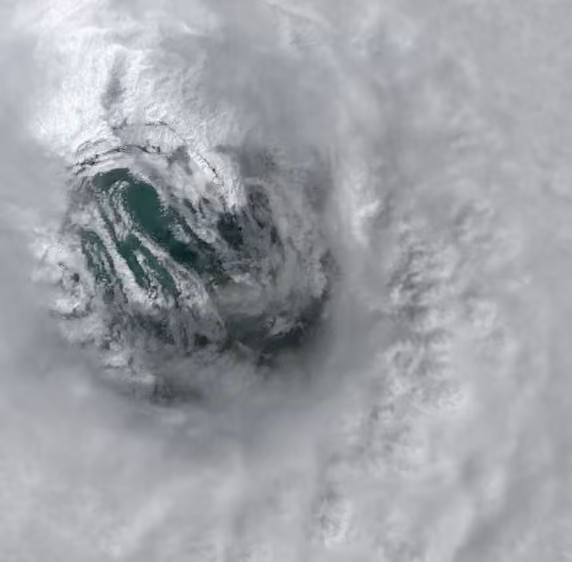
Hurricane Melissa illustrated this risk vividly. The storm strengthened so rapidly that forecasting and preparation were severely constrained, leaving Jamaica, Cuba, and Haiti overwhelmed by the scale of destruction. Global climate negotiations at the United Nations talks in Brazil ended without a clear commitment to phase out fossil fuels. While additional funding was promised to help vulnerable nations adapt, much of that support will take time to materialize.
Many officials and analysts now acknowledge that global warming will likely exceed the 1.5°C threshold, though some believe it may still be possible to reverse course over the long term.
Progress, however, varies widely by country.
China is expanding solar and wind power at remarkable speed, yet continues to invest heavily in coal. Across Europe, increasingly severe weather has intensified calls for climate action, even as some governments argue that stronger measures could slow economic growth. In the United States, recent policy shifts have favored coal, oil, and gas over clean energy. Otto described the current political climate as deeply uncertain, noting that many policymakers are prioritizing fossil fuel interests over public welfare while misinformation further complicates public understanding.
Andrew Kruczkiewicz of Columbia University’s Climate School, who was not involved in the study, observed that regions are now experiencing disasters unlike anything in their past. Events are escalating faster and becoming more complex, demanding earlier warnings and new approaches to recovery. While he acknowledged that progress is being made globally, he stressed that current efforts still fall short of what the moment demands.
For questions or comments write to contactus@bostonbrandmedia.com
Source: NDTV



-v3.jpg)


-v3-02.jpg)