Stay informed with our newsletter.


EN





Global aviation faced two dramatically different safety crises in early November 2026. Across Europe, seven passenger flights were targeted by bomb threats, triggering diversions, security searches and military fighter escorts, although no explosives were discovered. Meanwhile, a Learjet 60 crashed in Florida, killing all nine people aboard, prompting an NTSB investigation into evidence that aircraft components separated before impact. Together, the incidents highlight the continuing importance of aviation security, rapid emergency response and rigorous accident investigation.
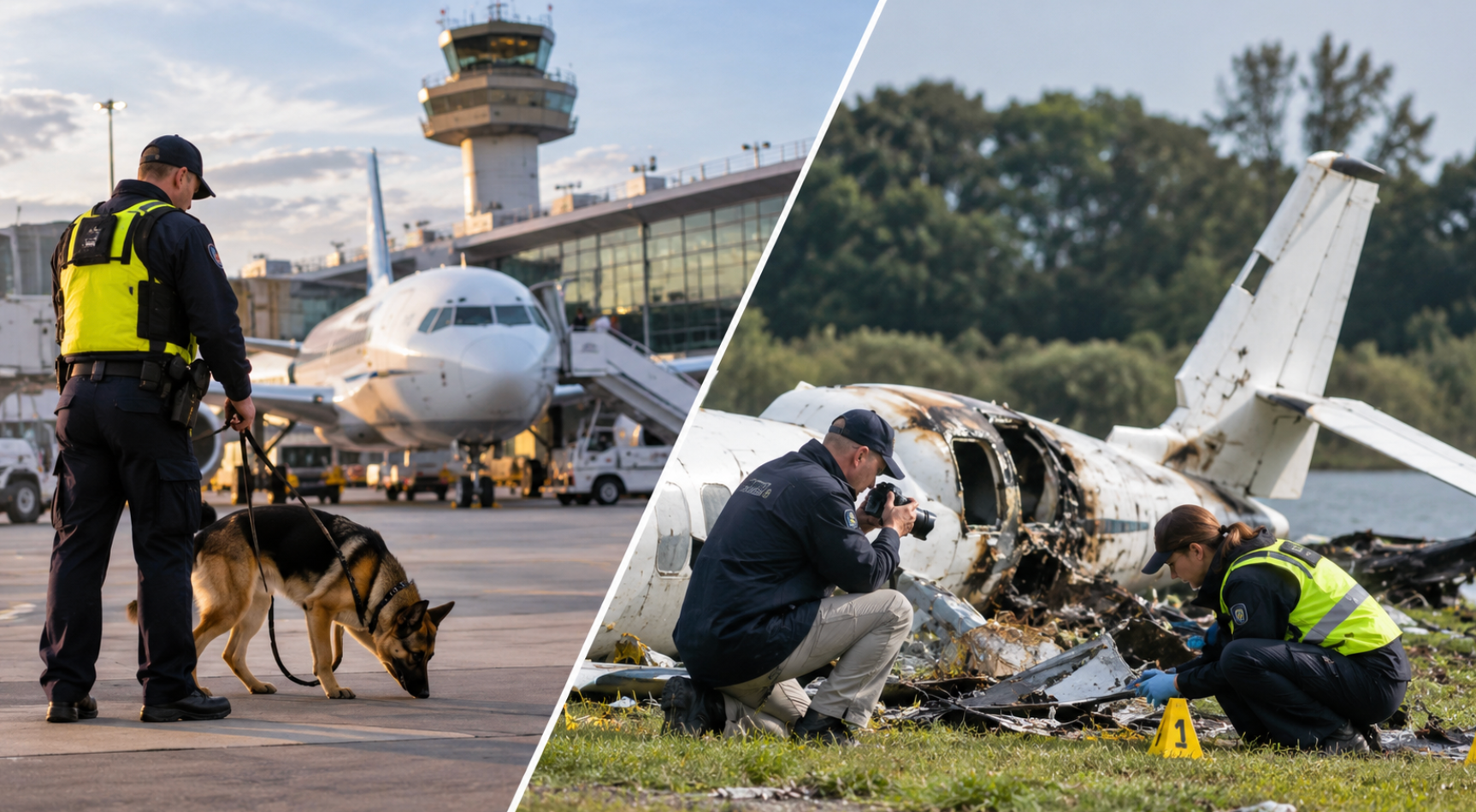
Commercial aviation is built around an extraordinary promise: transporting millions of people across borders every day while keeping risk exceptionally low. But two dramatic developments in early November 2026 have provided a stark reminder that aviation safety is challenged from very different directions.
Across Europe, a remarkable series of bomb threats targeted seven passenger flights in a single day, forcing diversions, security sweeps, an airport shutdown and even a military fighter escort. Thousands of kilometers away in Florida, a Learjet 60 carrying nine people crashed, with investigators subsequently discovering aircraft components miles from the impact site.
The events are unrelated, but together they highlight the complexity of modern aviation safety, where authorities must respond both to deliberate security disruption and to rare but potentially catastrophic aircraft emergencies.
On November 3, 2026, aviation authorities across Europe faced an unusual wave of bomb threats involving passenger aircraft operated by Ryanair, Wizz Air, LOT Polish Airlines and Scandinavian Airlines (SAS).
Seven flights were ultimately reported as targets. They included services traveling from London Heathrow, Manchester, Copenhagen, Lisbon, Dublin and Bergamo toward destinations in Poland, Spain, Italy and Bulgaria.
The threats immediately activated Europe's extensive aviation-security machinery.
A LOT Polish Airlines flight from London Heathrow to Warsaw was diverted to Warsaw-Modlin Airport. Operations there were temporarily suspended while authorities evacuated passengers and searched the Boeing 737 MAX.
Nothing suspicious was discovered.
Meanwhile, an SAS flight from Copenhagen to Warsaw was also subjected to a bomb threat. The aircraft landed safely at Warsaw Chopin Airport, where authorities conducted security checks.
In Spain, emergency procedures were activated after a threat involving a Ryanair flight from Manchester to Murcia. The 114 passengers and seven crew members disembarked while security personnel inspected the aircraft.
Again, no explosives were discovered.
Perhaps the most dramatic response occurred in Italy.
Two Ryanair aircraft arriving at Rome Fiumicino Airport, one from Lisbon and another from Dublin, were searched following potential bomb threats.
The Dublin flight was escorted to Rome by the Italian Air Force before landing. Bomb-disposal specialists subsequently searched the aircraft, baggage, passengers and crew. Authorities eventually cleared the alert.
Flights into Bulgaria were also affected. A Wizz Air flight from Bergamo to Sofia, carrying 176 passengers, and a Ryanair service from Dublin to Sofia, carrying 185 passengers, received threats but landed safely. No explosive devices were discovered during inspections.
The disruption did not begin on November 3.
A day earlier, another Wizz Air flight traveling from London Luton to Sofia was diverted to Budapest after receiving a bomb threat while airborne. Hungary scrambled Gripen fighter aircraft to escort the passenger jet safely into Budapest.
The sequence created a striking picture: civilian aircraft diverted from their routes, military fighters scrambled into the sky and airport operations interrupted, all without a bomb ultimately being found.
That may be the most important aspect of the story.
Aviation security cannot simply ignore a potentially credible threat because most threats prove false. A sufficiently specific warning can trigger an enormous response involving airlines, pilots, air-traffic controllers, airport operators, police, military forces, bomb-disposal teams and intelligence agencies.
This creates an uncomfortable asymmetry.
Making a false threat can be relatively simple. Responding safely can require enormous resources.
Authorities had not established that the November 3 incidents were coordinated, and investigators reported no immediate evidence linking them to terrorism or a hostile state. UK officials characterized the incidents affecting British departures as malicious hoaxes.
That distinction is critical. The episode should not be described as a coordinated terrorist campaign without evidence.
Yet the incidents demonstrate how information itself can disrupt aviation. A threat does not need to involve an actual explosive to close a runway, divert an aircraft, delay passengers or scramble military jets.
While Europe confronted threats that proved unfounded, investigators in the United States were examining a genuine catastrophe.
On November 1, a Learjet 60 operated by Aurora Aviation under the name Upper Jet disappeared from radar and radio contact while traveling from Austin-Bergstrom International Airport in Texas to North Eleuthera Airport in the Bahamas.
The aircraft crashed near Lake Worth Beach, Florida, killing all nine people aboard. The National Transportation Safety Board launched an investigation, designated ERA27MA026, and emphasized that information released during the early stages remains preliminary.
The tragedy became even more disturbing as investigators began examining the wreckage.
Aircraft components were discovered miles away from the main impact site. According to reporting on the investigation, pieces associated with the aircraft's left elevator were located at distances extending to approximately 3.8 miles from the crash site.
That evidence has led investigators to examine whether portions of the aircraft separated before impact.
It does not, however, establish why they separated.
The Learjet's final moments will be reconstructed through a combination of evidence: aircraft wreckage, air-traffic-control communications, weather information, maintenance records, crew records and any recoverable flight-recording data.
Investigators will need to determine the sequence of events rather than merely identify where individual components were found.
Reports indicate the aircraft encountered challenging weather conditions during its journey across Florida. But weather, structural separation and loss of control are not interchangeable explanations. Investigators must determine what happened first, what followed and why.
The NTSB has therefore not announced a probable cause.
That uncertainty matters because aviation investigations are deliberately methodical. Early evidence that appears dramatic can ultimately prove to be a consequence of an accident rather than its initiating cause.
The purpose is not simply to determine what destroyed one aircraft. It is to discover whether there is a safety lesson capable of preventing another accident.
At first glance, Europe's bomb-threat crisis and Florida's Learjet tragedy have little in common.
One involved passenger aircraft responding to threats in which no explosive devices were discovered. The other involved the loss of an aircraft and nine lives.
Yet both illustrate aviation's dependence on systems designed around an uncompromising principle: credible danger must be taken seriously even before authorities know exactly what has happened.
In Europe, that means investigating a threat even when it may ultimately prove to be a hoax.
In Florida, it means resisting premature conclusions while investigators reconstruct an extraordinarily complex accident.
Modern aviation is statistically remarkably safe partly because the industry treats unusual events with such intensity. Aircraft are diverted. Airports are temporarily closed. Military jets are scrambled. Wreckage is mapped across miles. Maintenance histories are examined. Data is reconstructed.
These measures can appear disproportionate, until the threat is real.
The events of early November 2026 therefore reveal two very different faces of aviation risk: security threats capable of disrupting an entire network without a weapon, and an aviation disaster whose cause can only be established through painstaking investigation.
For passengers, airlines and governments alike, they reinforce a fundamental truth about aviation safety: the absence of certainty can never be treated as the absence of risk.
For questions or comments write to contactus@bostonbrandmedia.com