Stay informed with our newsletter.


EN





Artificial intelligence is transforming education, automating lesson planning, personalized exercises, assessments and routine administrative tasks. Yet rather than replacing teachers, AI may make exceptional educators even more valuable. As information becomes instantly accessible, teachers will increasingly focus on critical thinking, motivation, creativity, emotional intelligence and human connection. With global teacher shortages continuing, the future is likely to combine AI-powered learning with human expertise, positioning teachers as mentors, orchestrators and guides in increasingly technology-driven classrooms.
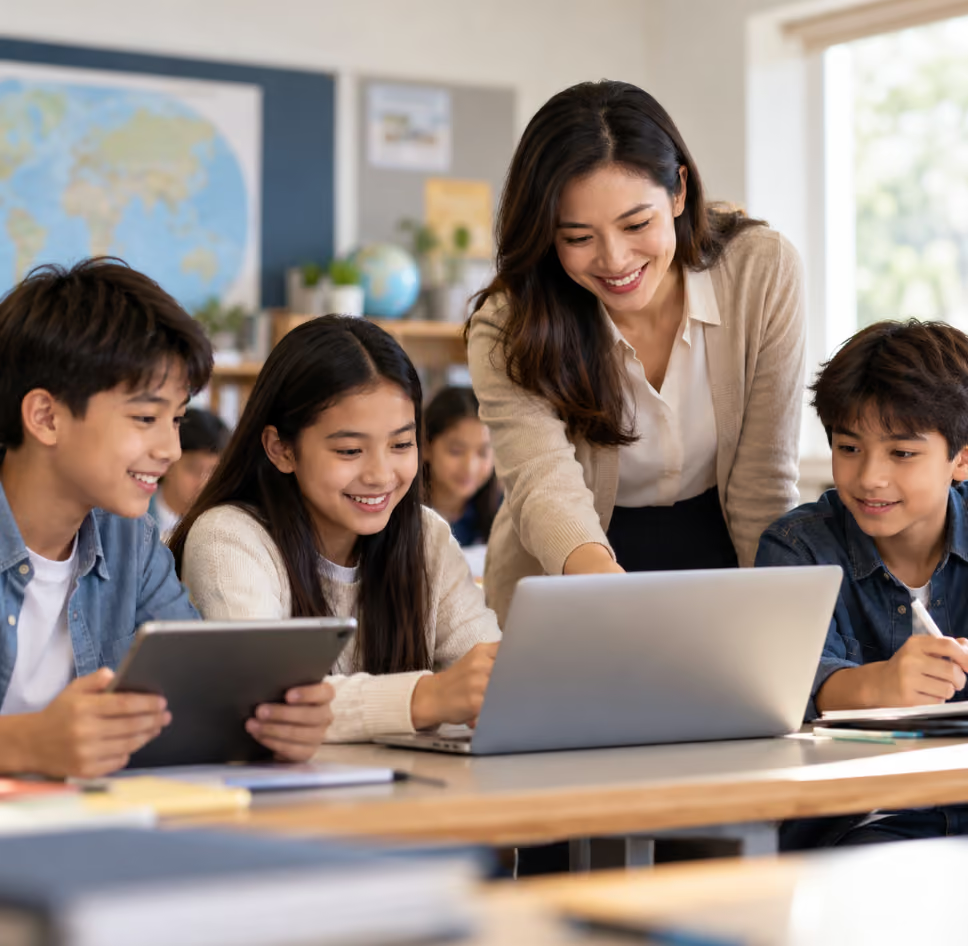
For generations, technological breakthroughs have prompted predictions that classrooms were about to change forever. Radio would bring the world's best lectures into every school. Television would transform education. Computers would make learning individualized. The internet would put virtually all human knowledge within reach.
Teachers survived every revolution.
Artificial intelligence, however, feels different.
Generative AI can explain algebra, summarize Shakespeare, translate languages, create quizzes, generate lesson plans, provide instant feedback and tutor a student at almost any hour. Tasks that once required a teacher's time can increasingly be completed by an algorithm in seconds.
That raises an uncomfortable question: if AI can teach, what happens to teachers?
The emerging evidence suggests something more complicated than mass replacement. AI is likely to automate significant portions of teachers' work, but the qualities separating an ordinary teacher from an exceptional one may become more, not less, valuable.
This is no longer a hypothetical discussion.
The OECD's TALIS 2024 survey found that around one-third of lower-secondary teachers were already using AI in their work. Among teachers using it, 68% used AI to learn about or summarize topics and 64% used it to generate lesson plans. About a quarter used AI to assess or grade student work.
Teachers are also seeing practical advantages. Around 40% said AI helps them support students individually, while roughly half agreed that it assists with creating or improving lesson plans.
Perhaps the clearest evidence concerns time.
A randomized trial involving 259 teachers across 68 secondary schools in England examined teachers using ChatGPT with guidance for lesson and resource preparation. The Education Endowment Foundation reported that teachers using the technology reduced their planning time by 31%. The study found no noticeable difference in the quality of the resources produced, although that particular finding was based on a small sample and should be interpreted cautiously.
That points toward one of AI's most immediate educational roles: not replacing teachers, but removing some of the repetitive work surrounding teaching.
Consider how much of a teacher's working week happens outside actual teaching.
Teachers create worksheets, draft quizzes, prepare examples, modify reading levels, write routine feedback, summarize materials, organize resources and perform administrative tasks. Generative AI is remarkably suited to many of these activities.
A teacher could ask an AI system to create three versions of the same mathematics exercise for different ability levels. A language teacher could generate vocabulary exercises around a student's interests. A history teacher could quickly produce discussion questions about the French Revolution.
The OECD's Digital Education Outlook 2026 describes AI's potential across three broad relationships with educators: replacement, complementarity and augmentation. Some tasks can be automated, but the more powerful possibility is AI working with teachers while teachers retain professional judgment and control.
In that world, the teacher does not disappear.
The teacher becomes the orchestrator.
AI's greatest strength also exposes its limitation.
It can provide information almost instantly. But education has never simply been the transfer of information.
A student struggling with mathematics may technically need an explanation of quadratic equations. But perhaps the real problem is embarrassment. Maybe the student stopped asking questions because classmates laughed at an earlier mistake. Perhaps they understand the formula but lack confidence.
A capable teacher notices these things.
Teachers read expressions, recognize hesitation, understand classroom relationships and decide when a student needs another explanation and when that student instead needs encouragement.
AI can generate twenty explanations.
A great teacher understands which explanation this particular student needs at this particular moment.
That distinction becomes increasingly important as information becomes abundant. When every student can generate an essay, explanation or answer instantly, education must place greater value on judgment, curiosity, critical thinking, discussion, creativity and intellectual independence.
The OECD warns that successfully completing a task with generative AI does not automatically mean learning has occurred. General-purpose AI can improve task performance without producing genuine learning gains when students outsource the cognitive work they were supposed to practise.
The teacher's role therefore shifts from delivering answers toward ensuring that students actually think.
Imagine two classrooms in which every student has access to powerful AI.
In the first, students ask AI questions, copy answers, complete assignments faster and gradually become dependent on automated assistance.
In the second, the teacher uses AI to create simulations, challenge assumptions, personalize exercises and generate competing arguments. Students must verify AI's claims, defend their reasoning and explain why an answer is credible.
Both classrooms have identical technology.
The difference is the teacher.
This may become one of education's central paradoxes: the more powerful AI becomes, the more important human judgment becomes in deciding how it should be used.
UNESCO's AI Competency Framework for Teachers reflects precisely this shift. It identifies 15 competencies across five dimensions: a human-centred mindset, AI ethics, AI foundations and applications, AI pedagogy and AI for professional learning. UNESCO argues that AI should complement rather than replace teachers' fundamental responsibilities.
The teacher of the future therefore may need to understand not only mathematics, literature or science, but also how AI produces information, where it can fail, how bias enters algorithms and when students should deliberately work without AI.
The replacement narrative also collides with a basic demographic reality.
The world does not currently have too many teachers.
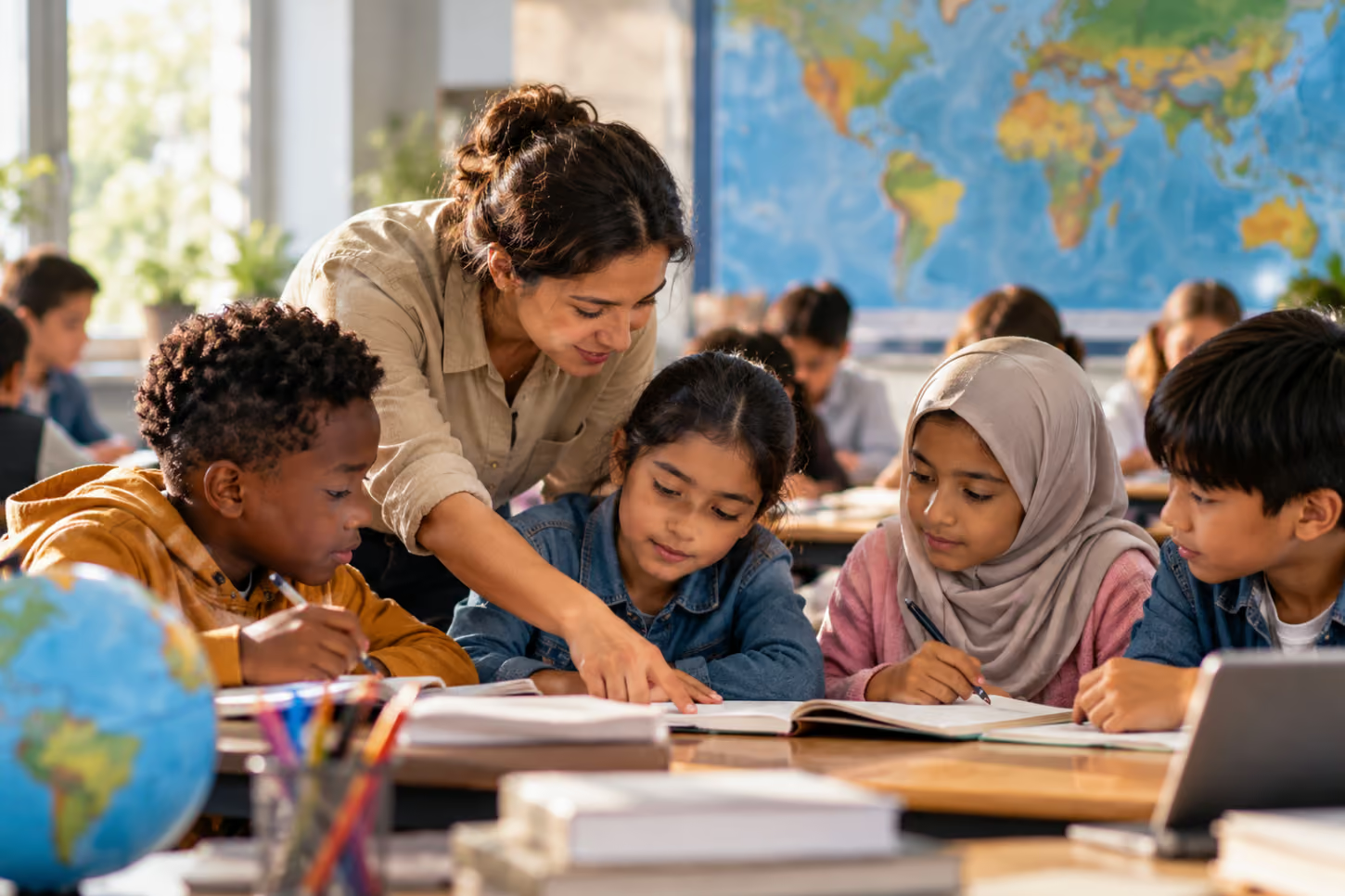
It has too few.
New UNESCO data released in October 2026 estimates that the world has about 107 million teachers but needs another 50 million by 2030 to achieve universal access to pre-primary, primary and secondary education. Significantly, 58% of those additional teachers would be needed to replace educators leaving the profession.
AI therefore arrives during a global teacher shortage.
Used intelligently, technology could help existing teachers accomplish more by reducing administrative burdens, supporting lesson preparation and extending personalized assistance to students.
But there is a dangerous alternative.
Governments could interpret AI primarily as a cost-cutting opportunity and provide disadvantaged students with automated instruction while wealthier students continue receiving intensive human teaching.
The World Bank specifically warns that poorly managed AI adoption could deepen educational inequality, potentially leaving poorer students with machine-based learning while more affluent students benefit from teacher-led, technology-enhanced education.
That would create an extraordinary educational divide: human attention itself could become a premium service.
The strongest teachers of the AI era may spend less time producing content and more time doing what humans are unusually good at.
They will motivate reluctant learners, build trust, recognize potential, resolve conflict, challenge assumptions and create communities in which students feel comfortable being wrong before learning how to be right.
They will also become increasingly important as arbiters of truth.
OECD data shows why. Around seven in ten teachers worry that AI could enable students to misrepresent others' work as their own, while roughly four in ten express concerns about bias, misconceptions or privacy and security.
Students growing up surrounded by synthetic text, images and video will need more than access to information. They will need adults who teach them how to question it.
The most valuable teacher may therefore no longer be the person who knows the most answers.
It may be the person who knows how to make students ask better questions.
The future classroom probably will not be entirely human or entirely automated.
AI may handle first-draft lesson materials, routine practice, basic explanations and some administrative work. Students may have personalized AI tutors available outside school hours. Teachers may receive AI-generated insights showing where students are struggling.
But the teacher will decide what those signals actually mean.
The OECD describes the desirable relationship as one in which the teacher remains the orchestrator of instruction, treating AI-generated recommendations as resources to evaluate rather than commands to follow.
That distinction is crucial.
Automation replaces tasks. It does not automatically replace professions.
Calculators changed mathematics education without eliminating mathematics teachers. Search engines transformed access to knowledge without eliminating universities. AI will similarly force education to reconsider which activities deserve human time.
And that could ultimately benefit teachers.
If machines take over more repetitive work, teachers may have greater opportunity to focus on mentoring, discussion, creativity, emotional support, critical thinking and individual student development—the parts of education that made exceptional teachers memorable long before AI existed.
The real question, then, is probably not "Will AI replace teachers?"
It is "What should humans still do when machines can do so much?"
Education offers one of the clearest answers.
Machines can generate explanations. They can analyze patterns, personalize exercises and produce enormous quantities of educational material.
But learning is also social. It involves confidence, identity, discipline, curiosity, disagreement, encouragement and relationships.
AI may therefore reduce the value of teachers whose role is limited to delivering information that a machine can provide faster. At the same time, it could dramatically increase the value of teachers who can do what information systems cannot easily replicate: inspire students to care about what they are learning and help them become independent thinkers.
The classroom of the future may contain more artificial intelligence than any classroom before it.
But paradoxically, that may make great human teachers more valuable than ever.
For questions or comments write to contactus@bostonbrandmedia.com