Stay informed with our newsletter.


EN





GSK and Novartis illustrate the high-risk, high-reward nature of pharmaceutical innovation. GSK is accelerating its oncology strategy, expanding clinical trials and investing billions in promising cancer therapies. Meanwhile, Novartis has taken a $1.9 billion impairment charge following a major drug-trial setback, even as strong sales from newer medicines support its outlook. Together, their experiences reveal how clinical breakthroughs, costly failures, patent pressures and aggressive R&D investment are reshaping the future of Big Pharma.
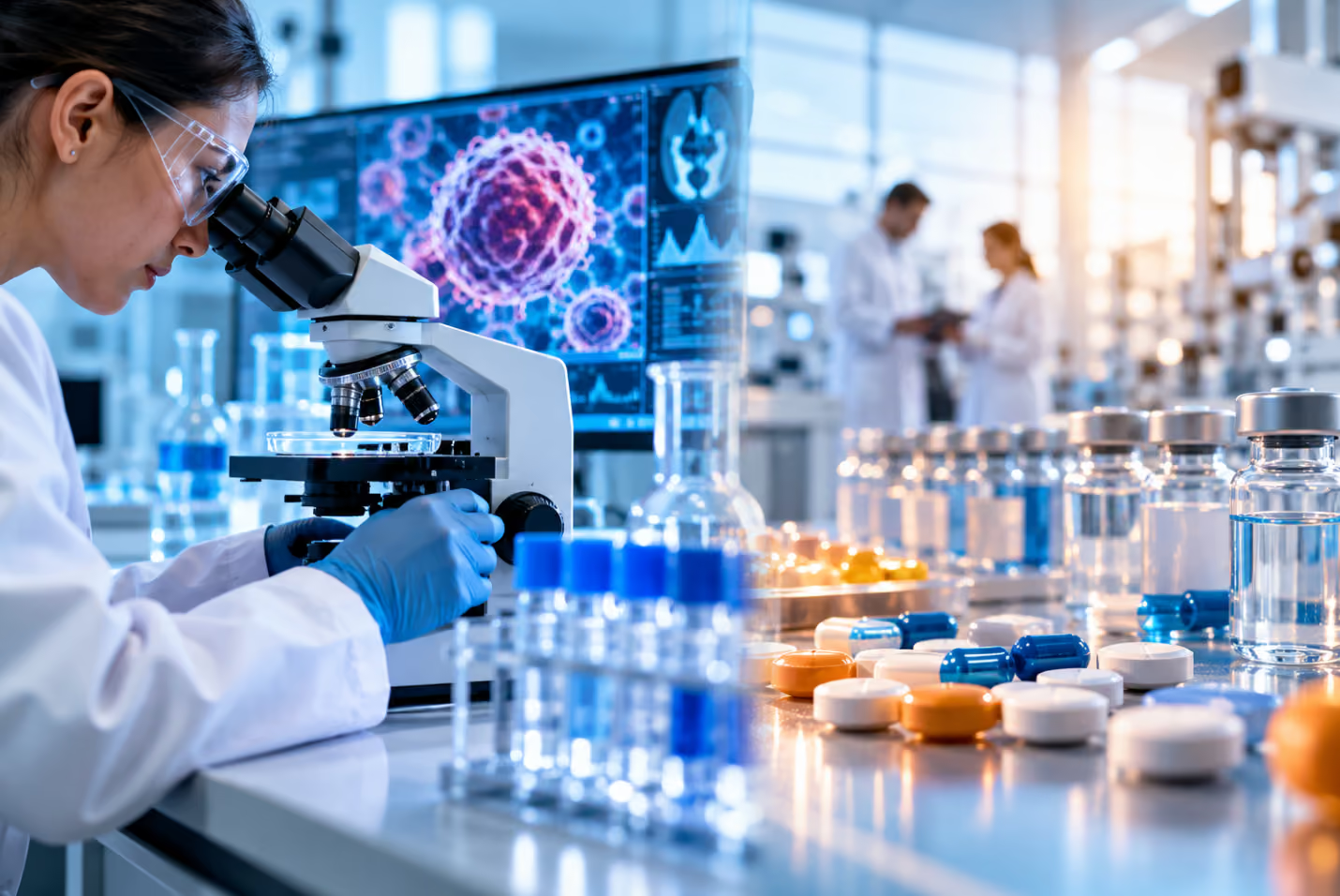
The pharmaceutical industry is built on a paradox: the medicines capable of generating billions of dollars and transforming millions of lives, often emerge from research programs where failure remains an unavoidable part of progress.
Two developments involving GSK and Novartis in October 2026 capture that reality particularly well. British pharmaceutical giant GSK is preparing to nearly double the number of cancer medicines it has in clinical trials in 2027, strengthening a major push into oncology. Meanwhile, Swiss drugmaker Novartis has recorded a $1.9 billion impairment charge following disappointing late-stage results for an experimental medicine acquired through one of its biggest recent biotechnology deals.
Yet Novartis simultaneously raised its profit outlook.
Together, the stories provide a revealing snapshot of modern Big Pharma: enormous R&D investment, expensive acquisitions, blockbuster ambitions and scientific uncertainty, all unfolding at the same time.
GSK's oncology ambitions are accelerating.
On October 27, Reuters reported that GSK expects to nearly double the number of cancer medicines it is testing in clinical trials next year, citing a Wall Street Journal interview with a company scientist.
The announcement is consistent with a broader transformation already underway inside the company.
In July, GSK announced a £1.9 billion ($2.52 billion) cost-savings program, with much of the savings expected to be reinvested into drug development. The company said it expected to initiate 25 late-stage studies by the end of 2026, more than double its previous target of 10. Seven experimental medicines had been selected for accelerated development across 18 indications, including three cancer medicines.
GSK has also been spending heavily to strengthen its oncology portfolio.
In 2026, the company completed its $10.6 billion acquisition of Nuvalent, a clinical-stage biotechnology company specializing in precisely targeted cancer therapies. The acquisition brought three lung-cancer assets into GSK's portfolio, including zidesamtinib and neladalkib, therapies targeting specific molecular forms of non-small cell lung cancer.
The strategy signals something larger: GSK wants oncology to become an increasingly important engine of future growth.
The timing is significant because GSK has also been producing encouraging clinical data.
At the 2026 European Society for Medical Oncology Congress in Madrid, GSK presented more than 20 abstracts covering its expanding solid-tumor portfolio, including research involving lung, gynecological and gastrointestinal cancers.
One experimental therapy, risvutatug rezetecan, or Ris-Rez, produced notable results in a late-stage Chinese study involving patients with relapsed osteosarcoma.
The treatment reduced the risk of disease progression or death by 67% compared with chemotherapy. Median progression-free survival reached 5.5 months, versus only 1.4 months among patients receiving the comparator treatment.
Another experimental medicine, mocertatug rezetecan, or Mo-Rez, generated a 62% confirmed objective response rate in a Phase Ib study involving platinum-resistant ovarian cancer. Median duration of response reached 12.2 months, while median progression-free survival was 11.1 months. GSK now has five pivotal Phase III studies underway across gynecological cancers involving the drug.
These results do not guarantee regulatory approval. But they illustrate why GSK is willing to commit substantially more capital to oncology.
The potential rewards are enormous, scientifically and commercially.
While GSK accelerates, Novartis is confronting the other side of pharmaceutical innovation.
On October 27, Novartis disclosed a $1.9 billion partial impairment charge associated with del-desiran, an experimental treatment being developed for myotonic dystrophy type 1, a progressive genetic neuromuscular disorder.
The drug became part of Novartis through its $12 billion acquisition of Avidity Biosciences.
But the Phase III HARBOR trial reported in September failed to meet its primary endpoint. Novartis subsequently reduced the carrying value of the del-desiran asset, although the company said clinical activity had been observed in secondary endpoints and exploratory analyses and that it would continue evaluating the data and engage regulators about the drug's future development.
The financial consequences were immediate.
Novartis reported that third-quarter operating income fell 61%, with the impairment and higher research-and-development expenses weighing heavily on reported profitability.
For investors, it was an uncomfortable demonstration of one of pharmaceutical R&D's fundamental realities: buying promising science does not eliminate clinical risk.
A molecule can appear compelling in earlier studies, attract billions of dollars in investment and still disappoint when tested in larger patient populations.
What makes the Novartis story particularly interesting is what happened elsewhere in the company.
Despite the clinical setback, its commercial portfolio remained strong enough for management to raise its 2026 core operating-income guidance from an expected low-single-digit decline to low-single-digit growth.
Third-quarter net sales reached approximately $14.5 billion, increasing 4% at constant currencies.
Several newer medicines delivered considerably faster growth.
Breast-cancer medicine Kisqali generated $1.8 billion in quarterly sales, rising 37%. Multiple-sclerosis treatment Kesimpta reached $1.5 billion, up 22% at constant currencies. Leukemia medicine Scemblix rose 67% to $593 million, while cholesterol-lowering therapy Leqvio generated $506 million, up 63%.
That growth helped counter another challenge confronting the industry: patent expiration.
Sales of heart-failure blockbuster Entresto fell 38% to $1.2 billion as generic competition intensified. Promacta sales dropped even more sharply, declining 61% to $142 million.
The numbers explain why pharmaceutical companies constantly need new medicines.
Today's blockbuster can become tomorrow's declining franchise remarkably quickly.
GSK faces similar pressures.
One reason the company is accelerating its pipeline is the approaching loss of exclusivity surrounding its major HIV medicine dolutegravir between 2028 and 2030. GSK therefore needs new medicines capable of replacing revenue that could eventually be eroded by generic competition.
This challenge extends far beyond GSK and Novartis.
Across the pharmaceutical industry, companies are racing to replenish pipelines before major products lose patent protection. That is helping drive acquisitions, licensing deals and partnerships with biotechnology companies.
China has become particularly important. The value of pharmaceutical licensing agreements involving companies in Greater China reached a record $137.7 billion in 2025, according to Pharmcube data reported by Reuters, as international drugmakers increasingly sought access to Chinese-developed experimental medicines.
The pharmaceutical innovation map is becoming increasingly global.
The contrast between GSK and Novartis reveals why pharmaceutical strategy cannot simply be judged by whether individual clinical trials succeed.
Novartis CEO Vas Narasimhan defended the company's acquisition strategy following the setbacks, arguing that clinical failures are part of drug development. Despite heightened scrutiny, the company said it did not intend to change its M&A strategy.
That position reflects the economics of modern drug development.
Pharmaceutical companies cannot know with certainty which experimental medicines will become successful products. Instead, they build portfolios containing multiple scientific bets, knowing that some will fail while a smaller number could eventually become blockbuster therapies.
The objective is not to eliminate failure.
It is to ensure that successful medicines create enough medical and commercial value to compensate for those that do not make it through development.
GSK and Novartis therefore represent two moments in the same innovation cycle.
GSK is currently expanding aggressively, adding cancer medicines, accelerating clinical trials and investing billions in oncology assets.
Novartis, meanwhile, is absorbing the financial consequences of one major scientific disappointment while benefiting from the success of medicines that survived that same uncertain development process years earlier.
Their experiences illustrate why the pharmaceutical industry's future will increasingly belong to companies capable of balancing scientific ambition, disciplined capital allocation, clinical-development speed and portfolio diversification.
Cancer, rare diseases, cardiovascular medicine, immunology and neurological disorders remain enormous areas of unmet medical need. The potential rewards for solving even a fraction of those challenges are extraordinary.
But so are the risks.
For patients, the ultimate hope is that today's increasingly aggressive investment in pharmaceutical research produces medicines capable of changing or saving, lives.
For drugmakers, the equation is less forgiving.
Billions can disappear when a clinical trial fails. Billions more can be created when one succeeds.
That tension between breakthrough and setback remains at the heart of the pharmaceutical industry and the latest moves by GSK and Novartis show just how high the stakes have become.
For questions or comments write to contactus@bostonbrandmedia.com