Stay informed with our newsletter.
.webp)


EN





The global semiconductor industry is experiencing rapid growth as demand for artificial intelligence, cloud computing, data centers, electric vehicles, and advanced consumer technologies continues to rise. Semiconductors have become the foundation of modern digital transformation, enabling faster computing, smarter devices, and breakthrough innovations across industries. With significant investments in chip manufacturing and AI infrastructure worldwide, the sector is playing a critical role in shaping the future of technology, economic growth, and global competitiveness in an increasingly digital world.
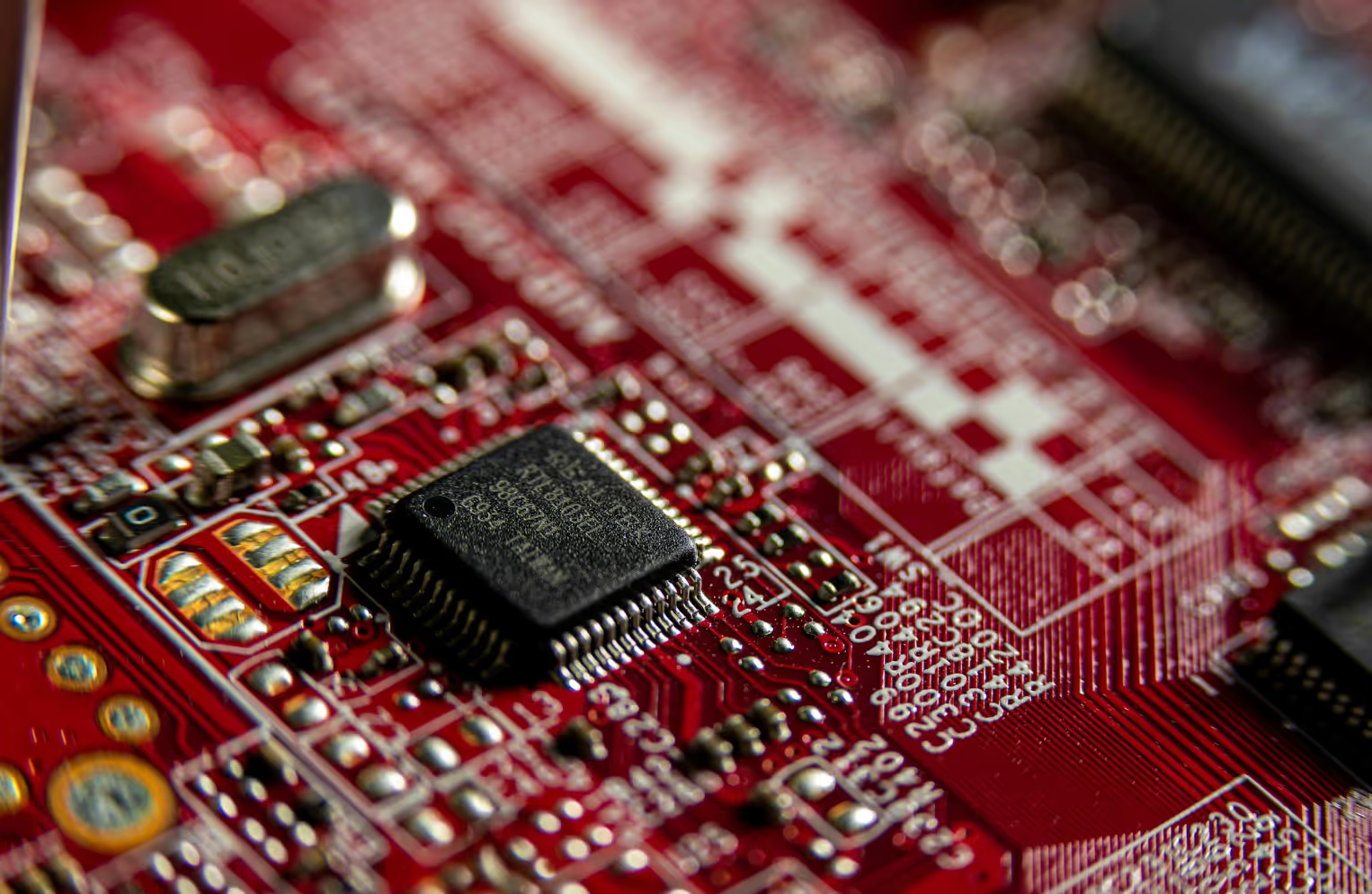
Artificial Intelligence, cloud computing, electric vehicles, 5G connectivity, and advanced consumer electronics are fueling one of the biggest growth cycles in the history of the semiconductor industry. Once viewed primarily as a foundational technology sector, semiconductors have now become the backbone of the global digital economy. From powering AI models and data centers to enabling autonomous vehicles and smart devices, chips are increasingly shaping the future of innovation, economic growth, and geopolitical strategy.
The semiconductor industry has witnessed extraordinary expansion over the last two years, driven largely by the global race for artificial intelligence leadership. According to the World Semiconductor Trade Statistics (WSTS), global semiconductor sales reached approximately $796 billion in 2025, representing one of the strongest years on record for the industry. WSTS forecasts the market will approach $975 billion in 2026, with growth exceeding 25% year-over-year.
Several industry analysts project even more aggressive growth. Research firm IDC estimates that the semiconductor market could surpass $1.29 trillion in 2026, fueled by unprecedented investment in AI infrastructure, cloud computing, and advanced memory technologies.
Artificial Intelligence has rapidly emerged as the most significant driver of semiconductor demand. Large language models, generative AI platforms, machine learning systems, and AI-powered enterprise applications require enormous computing power, creating unprecedented demand for advanced processors and memory chips.
Industry experts estimate that AI-related infrastructure spending is reshaping the entire semiconductor supply chain. IDC forecasts that data-center semiconductor revenues alone could reach nearly $477 billion in 2026, reflecting the scale of investment being made by hyperscale technology companies.
The rise of AI has transformed companies such as NVIDIA, whose advanced graphics processing units (GPUs) have become essential for training and operating modern AI systems. Demand for AI accelerators has become so strong that manufacturers are racing to expand production capacity while governments increasingly view semiconductor leadership as a national strategic priority.
According to industry forecasts, AI and high-performance computing applications could account for more than half of the global semiconductor market by the end of the decade.
One of the biggest beneficiaries of the AI boom has been the memory chip sector. High-bandwidth memory (HBM), DRAM, and NAND flash technologies have become essential for supporting advanced AI workloads.
Gartner forecasts semiconductor revenues could increase by as much as 64% in 2026, with memory revenues expected to surge dramatically due to what analysts describe as “memflation,” a period of rapidly rising memory prices caused by strong demand and supply constraints. Gartner estimates DRAM prices could rise by 125% while NAND flash prices could increase by more than 230% before supply conditions stabilize.
Companies including Samsung Electronics, SK Hynix, and Micron Technology are among the major players benefiting from this trend as hyperscale data centers continue to expand their AI infrastructure investments.
Asia continues to dominate global semiconductor manufacturing, with Taiwan, South Korea, China, and Japan serving as critical hubs within the global supply chain.
TSMC remains the world's largest contract chipmaker and is widely regarded as one of the most important companies in the technology ecosystem. The company recently projected that the global semiconductor market could exceed $1.5 trillion by 2030, significantly increasing its previous forecast due to accelerating AI demand.
Demand for AI accelerator wafers is expected to increase eleven-fold between 2022 and 2026, prompting TSMC to aggressively expand manufacturing capacity through new fabrication facilities and advanced packaging plants.
Meanwhile, South Korea has emerged as a major beneficiary of the AI-driven semiconductor boom. The country recently recorded one of its strongest export growth periods in decades, with semiconductor exports rising sharply due to surging global demand for memory and AI-related technologies.
The next phase of semiconductor growth is increasingly moving beyond data centers into personal devices. AI-powered personal computers, smartphones, industrial systems, and connected devices are creating new opportunities for chipmakers.
Recently, NVIDIA introduced its RTX Spark AI chip platform, designed to bring advanced AI processing capabilities directly to laptops and desktop computers. The technology allows AI workloads to run locally on devices rather than relying entirely on cloud infrastructure, representing a major shift in computing architecture.
Industry analysts expect edge AI, where AI processing occurs directly on devices, to become one of the fastest-growing segments of the semiconductor market. Applications include smart manufacturing, healthcare devices, autonomous vehicles, industrial automation, and intelligent consumer electronics.
Despite strong growth, the semiconductor industry faces significant challenges. Geopolitical tensions, export restrictions, trade disputes, and supply chain vulnerabilities continue to shape strategic decision-making across the sector.
Governments in the United States, Europe, China, Japan, and South Korea are investing billions of dollars to strengthen domestic semiconductor manufacturing capabilities and reduce dependence on foreign suppliers. The strategic importance of semiconductors has elevated them from commercial products to critical national assets.
Industry observers note that much of the AI revolution depends on a relatively small number of companies controlling key parts of the supply chain. Advanced chip production remains heavily concentrated among a few manufacturers, creating potential bottlenecks during periods of extreme demand.
The industry also continues to face periodic shortages. Recent reports indicate that strong AI chip demand has contributed to tighter supplies for certain consumer electronics components, affecting smartphone production and increasing hardware costs.
The semiconductor industry is entering what many analysts describe as an AI-driven supercycle. Growth is no longer being driven solely by traditional consumer electronics but increasingly by artificial intelligence, cloud computing, high-performance computing, autonomous systems, and digital infrastructure.
Deloitte projects that the semiconductor market could reach nearly $1 trillion in annual sales during 2026, while some industry forecasts suggest the sector could surpass $2 trillion within the next decade if AI adoption continues at its current pace.
As businesses, governments, and consumers become increasingly dependent on intelligent technologies, semiconductors will remain at the heart of global innovation. The companies that design, manufacture, and supply these critical components are poised to play a defining role in shaping the future of technology, economic development, and digital transformation worldwide.
For questions or comments write to contactus@bostonbrandmedia.com



-v3.jpg)


-v3-02.jpg)