Stay informed with our newsletter.
.webp)


EN




By 2030, AI agents will become central to business operations, handling complex tasks, automating workflows, supporting decisions, and delivering highly personalized customer experiences. From marketing and finance to healthcare, manufacturing, and human resources, these intelligent systems will work alongside employees to improve speed, productivity, and efficiency. However, success will depend on strong governance, cybersecurity, data quality, and human oversight. Businesses that adopt AI agents responsibly will gain a major competitive advantage in the next decade.
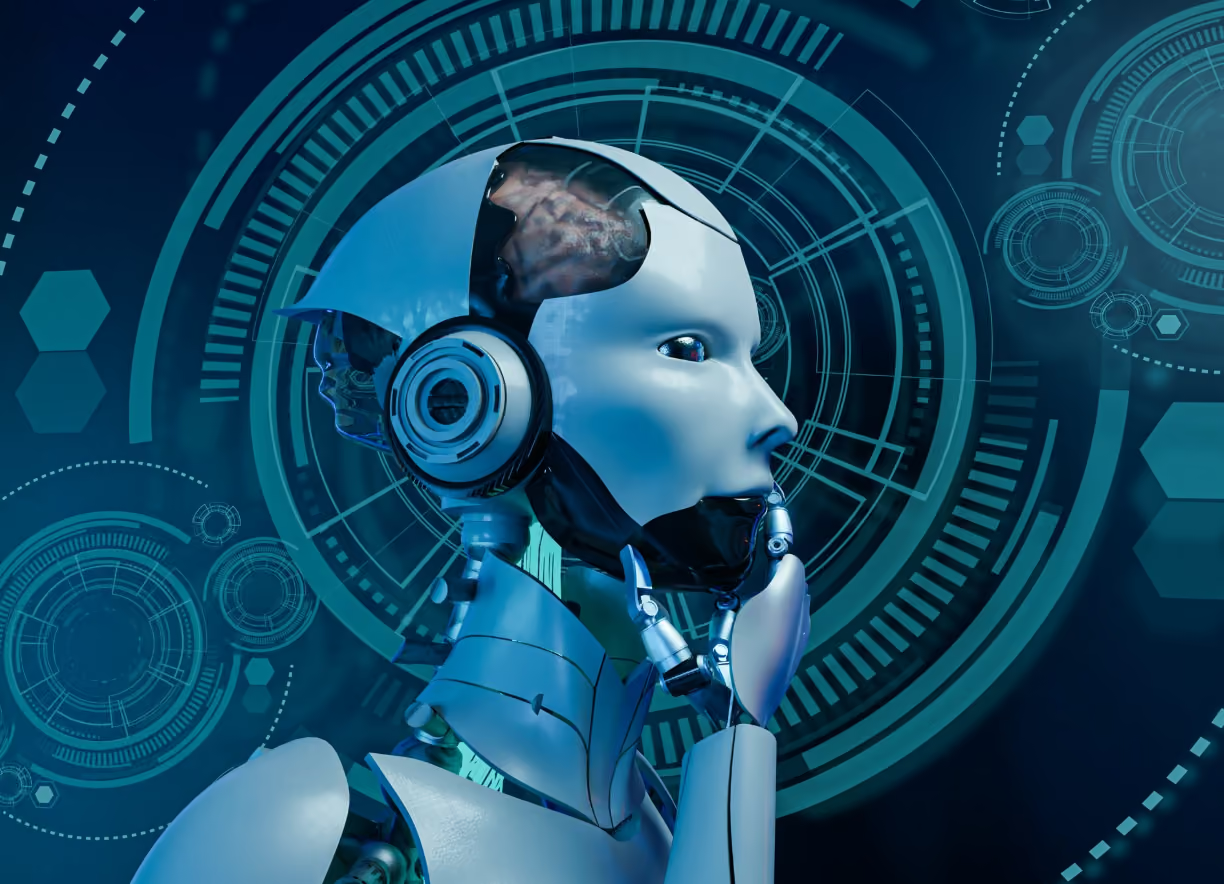
`Artificial Intelligence has already reshaped how organizations analyze data, automate workflows, and engage with customers. However, the next wave of innovation is not simply about smarter chatbots or faster automation—it is about AI agents. Unlike traditional AI tools that respond to individual prompts, AI agents can reason, plan, make decisions, execute complex tasks, collaborate with other systems, and continuously improve with minimal human intervention.
By 2030, AI agents are expected to become as common in businesses as email, cloud computing, and smartphones are today. Organizations that embrace them strategically will gain significant advantages in productivity, customer experience, operational efficiency, and innovation, while those that delay adoption risk falling behind competitors operating at machine speed.
An AI agent is an intelligent software system capable of performing tasks independently to achieve defined objectives. Rather than waiting for human instructions at every step, AI agents can analyze situations, retrieve relevant information, coordinate with multiple applications, and complete workflows from beginning to end.
For example, instead of merely drafting an email, an AI agent could identify prospective clients, personalize outreach messages, schedule meetings, update the CRM system, and generate follow-up reports, all without requiring continuous human supervision.
This represents a fundamental shift from automation to autonomous execution.
Businesses have traditionally relied on software to assist employees. AI agents change that relationship by functioning more like digital employees than digital tools.
By the end of this decade, organizations are expected to deploy specialized AI agents across virtually every department:
Rather than replacing entire departments, these systems will eliminate repetitive administrative work, allowing professionals to focus on strategy, creativity, relationship-building, and decision-making.
One of the greatest promises of AI agents lies in their ability to dramatically improve business productivity.
Employees currently spend substantial time on repetitive administrative tasks, including data entry, documentation, meeting scheduling, report generation, and information retrieval. AI agents can perform many of these functions 24 hours a day, reducing delays and improving consistency.
Instead of several employees handling a multi-step business process over several days, interconnected AI agents may complete the same work in minutes while maintaining detailed records and audit trails.
This shift could fundamentally redefine organizational productivity by allowing companies to achieve more with existing resources rather than simply increasing headcount.
Modern consumers increasingly expect businesses to understand their preferences and provide immediate, relevant responses.
AI agents will make this possible at an unprecedented scale.
By analyzing purchasing behavior, browsing history, previous interactions, customer feedback, and contextual information, AI agents will generate highly personalized recommendations, anticipate customer needs, and proactively resolve issues before they escalate.
Imagine an airline automatically detecting a delayed flight, rebooking passengers, arranging transportation, notifying hotels, updating travel insurance providers, and communicating every change instantly—all coordinated by AI agents operating behind the scenes.
Such experiences will redefine customer expectations across every industry.
The influence of AI agents will extend far beyond technology companies.
In healthcare, AI agents may assist physicians by summarizing patient histories, identifying potential diagnoses, coordinating treatment plans, and reducing administrative burdens.
In banking, intelligent agents can strengthen fraud detection, accelerate loan approvals, personalize financial advice, and improve regulatory compliance.
In manufacturing, autonomous systems will monitor equipment, predict maintenance needs, optimize production schedules, and reduce operational downtime.
In retail, AI agents will forecast demand, optimize pricing, manage inventory, and personalize shopping experiences.
In education, intelligent tutors will adapt learning materials according to each student's pace, strengths, and learning style.
Even government agencies are expected to deploy AI agents to improve citizen services, document processing, tax administration, and public resource management.
The rise of AI agents will also transform executive leadership.
Future CEOs will not simply oversee human teams; they will increasingly manage organizations where human employees and AI agents collaborate continuously.
Leaders will need new competencies, including:
Organizations will require clear accountability frameworks to determine how AI-generated decisions are reviewed, validated, and monitored.
Successful companies will view AI not as a replacement for leadership but as a force multiplier for informed decision-making.
Although AI raises concerns about job displacement, history suggests that technological revolutions create entirely new professions alongside automation.
By 2030, businesses are likely to see growing demand for roles such as:
Rather than eliminating human expertise, AI agents will increase demand for professionals capable of supervising intelligent systems, validating outputs, ensuring ethical compliance, and managing increasingly complex digital ecosystems.
As AI agents become more autonomous, trust will become one of the most valuable business assets.
Customers, employees, regulators, and investors will expect organizations to demonstrate:
Businesses that prioritize responsible AI deployment will build stronger brands and earn lasting customer confidence.
Conversely, organizations deploying AI irresponsibly risk reputational damage, regulatory penalties, and declining public trust.
Despite enormous opportunities, implementing AI agents successfully will require overcoming several challenges.
Organizations must modernize legacy systems, improve data quality, establish governance frameworks, strengthen cybersecurity defenses, and train employees to collaborate effectively with intelligent systems.
There are also broader societal questions concerning accountability, intellectual property, workforce transition, and regulatory oversight.
The most successful businesses will adopt AI incrementally, beginning with clearly defined use cases, measuring outcomes, and scaling responsibly rather than attempting wholesale transformation overnight.
By the end of this decade, AI agents are expected to become foundational infrastructure for modern enterprises. Much like cloud computing transformed information technology and smartphones revolutionized communication, AI agents are poised to redefine how businesses operate.
Competitive advantage will increasingly depend not on who has access to AI, but on who deploys it most effectively, responsibly, and strategically.
The future workplace will not be entirely human, nor entirely automated. Instead, it will be powered by collaboration between people and intelligent AI agents, where machines handle routine execution while humans focus on creativity, empathy, innovation, and strategic leadership.
Organizations that invest today in AI literacy, ethical governance, and workforce readiness will be best positioned to thrive in this new era.
By 2030, the defining question for every business will no longer be whether to adopt AI agents. It will be how effectively they can integrate them into every aspect of their operations while keeping human values at the center of technological progress.
The businesses that answer that question successfully will shape the next generation of global commerce.
For questions or comments write to contactus@bostonbrandmedia.com



-v3.jpg)


-v3-02.jpg)