Stay informed with our newsletter.
.webp)


EN





China’s rapid rise as a major automobile exporter is transforming the global car industry. Driven by competitive pricing, advanced electric vehicle technology, strong manufacturing capacity, and brands such as BYD and Geely, Chinese automakers are expanding across Europe and other international markets. Their growth is challenging established manufacturers, accelerating innovation, increasing consumer choice, and intensifying trade tensions as governments consider tariffs and new policies to protect domestic automotive industries from rising Chinese competition worldwide today.
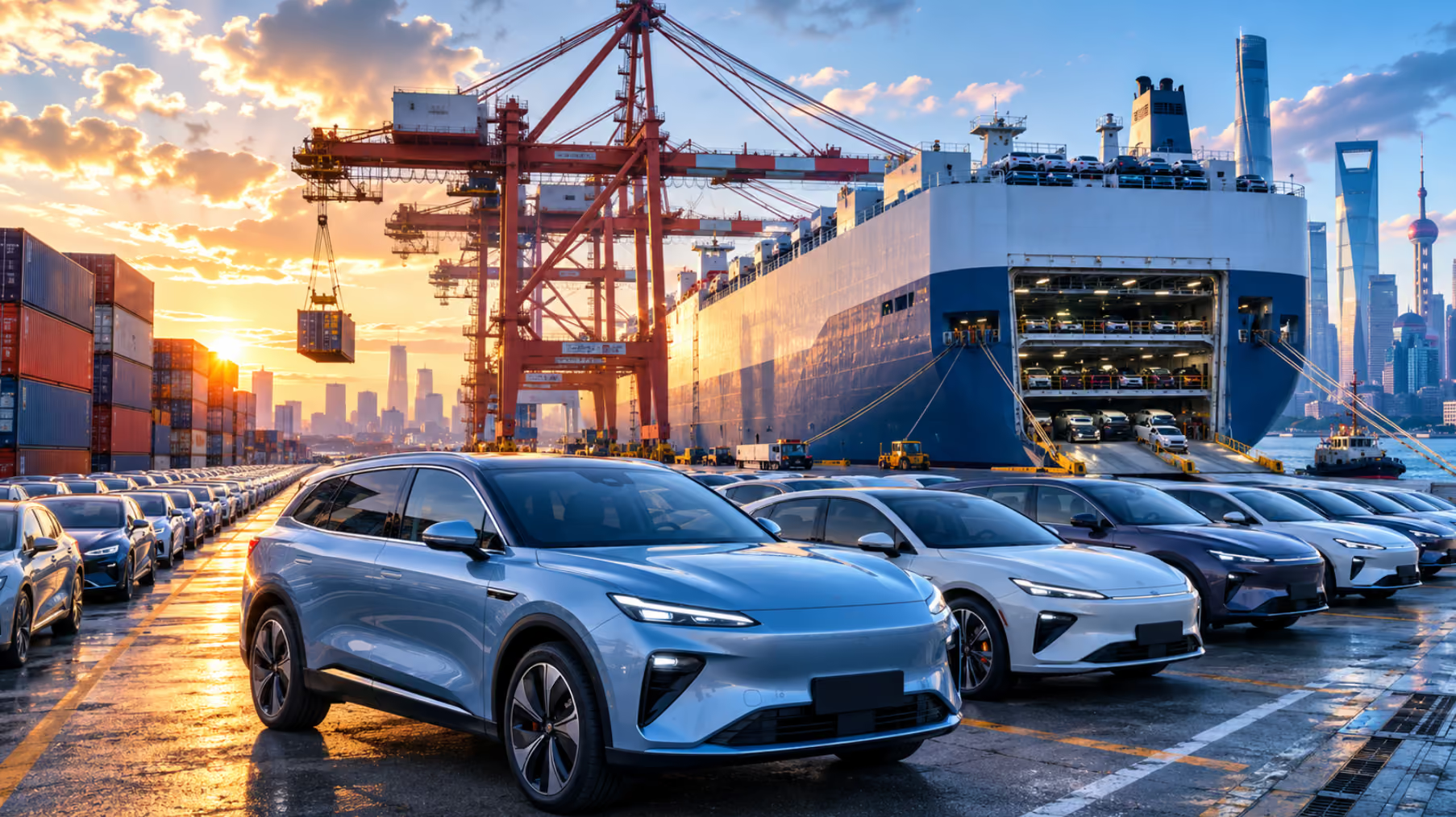
The global automotive industry is witnessing one of its biggest transformations in decades. Once known primarily as the world's largest automobile manufacturing hub, China has now become the world's fastest-growing vehicle exporter, reshaping competition across Europe, Asia, Latin America, the Middle East, and Africa. Chinese automakers are no longer producing vehicles solely for domestic buyers, they are rapidly expanding into international markets with competitive pricing, advanced electric vehicle (EV) technology, and innovative manufacturing capabilities.
Recent industry data highlights the remarkable pace of this expansion. In June 2026, China exported more than 1.1 million vehicles in a single month, the highest monthly export figure in its history and approximately 72% higher than the same month last year. This milestone reflects China's growing influence in the global automotive market and signals a significant shift in the balance of power within the industry.
Over the past decade, Chinese manufacturers have invested heavily in research and development, battery technology, smart vehicle systems, and efficient production facilities. These investments have enabled companies to build vehicles that compete directly with long-established automotive brands from Japan, Germany, South Korea, and the United States.
Leading this transformation are manufacturers such as BYD, Geely, Chery, SAIC Motor, and Great Wall Motor, all of which have expanded their presence across multiple international markets. While many of these companies initially focused on budget-friendly vehicles, today's Chinese automakers offer premium electric vehicles, hybrid SUVs, luxury sedans, and advanced smart cars equipped with modern driver-assistance technologies.
One of the primary drivers behind this growth is the increasing global demand for Electric Vehicles (EVs). Chinese manufacturers have positioned themselves as leaders in EV production by combining advanced battery technology, competitive pricing, and large-scale manufacturing.
The global transition toward cleaner transportation has significantly benefited Chinese manufacturers. Governments worldwide continue encouraging EV adoption through emissions regulations and incentives, creating new opportunities for companies specializing in electric mobility.
China has developed one of the world's most comprehensive EV supply chains, producing batteries, electric motors, semiconductors, and charging technologies domestically. This vertical integration allows manufacturers to reduce production costs while maintaining competitive pricing in overseas markets.
BYD, currently one of the world's leading EV manufacturers, has expanded rapidly across Europe, Southeast Asia, Latin America, and the Middle East. The company has also invested in overseas manufacturing, including a new production facility in Hungary, with additional European expansion under consideration.
Interestingly, China's export boom is occurring while its domestic automotive market faces increasing pressure.
China's local car market has experienced slowing consumer demand, intense pricing competition, and reduced government subsidies for electric vehicles. As a result, many manufacturers are relying more heavily on international sales to sustain production and maintain profitability.
Industry data shows that while domestic passenger vehicle sales declined, exports continued to rise sharply. During the first half of 2026, Chinese passenger vehicle exports increased dramatically, demonstrating how overseas demand is offsetting weaker conditions at home.
European automakers are among those feeling the strongest impact of China's export expansion.
Manufacturers such as Volkswagen, BMW, Mercedes-Benz, and Renault have traditionally dominated global automotive markets through strong engineering and established brand recognition. However, Chinese brands are increasingly competing in Europe by offering:
Many European consumers are now considering Chinese vehicles because they deliver high levels of technology at lower prices than comparable competitors.
As Chinese manufacturers continue expanding, several European governments are reviewing trade policies and import regulations aimed at protecting domestic manufacturers.
China's growing automotive exports have also become a significant geopolitical issue.
Several countries argue that Chinese manufacturers benefit from government support and large-scale industrial policies, allowing them to sell vehicles at highly competitive prices internationally.
In response, various governments have introduced or proposed tariffs and other trade measures targeting imported Chinese electric vehicles. Despite these actions, Chinese exports continue growing as manufacturers diversify into new regions and establish overseas production facilities. Analysts expect further discussions around trade policy and tariffs as China's global market share expands.
Price alone is no longer China's primary competitive strength.
Today's Chinese vehicles increasingly feature:
These innovations have enabled Chinese manufacturers to compete not only on affordability but also on technology and user experience.
Consumers in many international markets now recognize Chinese brands for innovation rather than simply low-cost manufacturing.
The rapid expansion of Chinese automakers is forcing traditional manufacturers to rethink their long-term strategies.
Many global companies are:
Industry experts believe competition from Chinese brands will accelerate innovation throughout the global automotive industry while benefiting consumers through better technology and more competitive pricing.
Beyond Europe, Chinese automakers are rapidly increasing their presence in:
Many of these regions are experiencing growing demand for affordable electric and hybrid vehicles. Chinese manufacturers have successfully positioned themselves by offering feature-rich vehicles at competitive prices while expanding dealership networks and after-sales service.
The Middle East, in particular, has become an increasingly important destination for Chinese vehicle exports.
Consumers worldwide stand to benefit from the changing competitive landscape.
Greater competition typically results in:
As Chinese manufacturers continue investing in quality, safety, and technology, buyers will have access to a broader range of vehicles than ever before.
China's automotive export boom is more than a short-term trend, it represents a structural transformation of the global automotive industry. With record export volumes, continued investment in electric vehicles, battery innovation, and international manufacturing, Chinese automakers are becoming major global competitors.
While established brands still enjoy strong customer loyalty and decades of engineering expertise, they now face intense competition from a new generation of Chinese manufacturers capable of delivering advanced vehicles at competitive prices.
The coming years are likely to bring continued innovation, strategic partnerships, trade negotiations, and greater consumer choice. Whether through EVs, hybrids, or smart connected vehicles, China's expanding role in the automotive sector is reshaping the industry and redefining global competition.
For consumers, businesses, and investors alike, one thing is becoming increasingly clear: China's automotive export boom is no longer an emerging story, it is a defining force shaping the future of the global car industry.
For questions or comments write to contactus@bostonbrandmedia.com



-v3.jpg)


-v3-02.jpg)