Stay informed with our newsletter.
.webp)


EN




In 2026, the most expensive mistake a brand can make is becoming forgettable. As markets grow crowded and AI makes messaging sound increasingly similar, brands must build strong memory cues through distinctive colors, sounds, slogans, and clear category ownership. Customers often choose the brand they remember first, not necessarily the best one. This makes recognition, consistency, and emotional recall essential drivers of trust, preference, visibility, and long-term business growth.
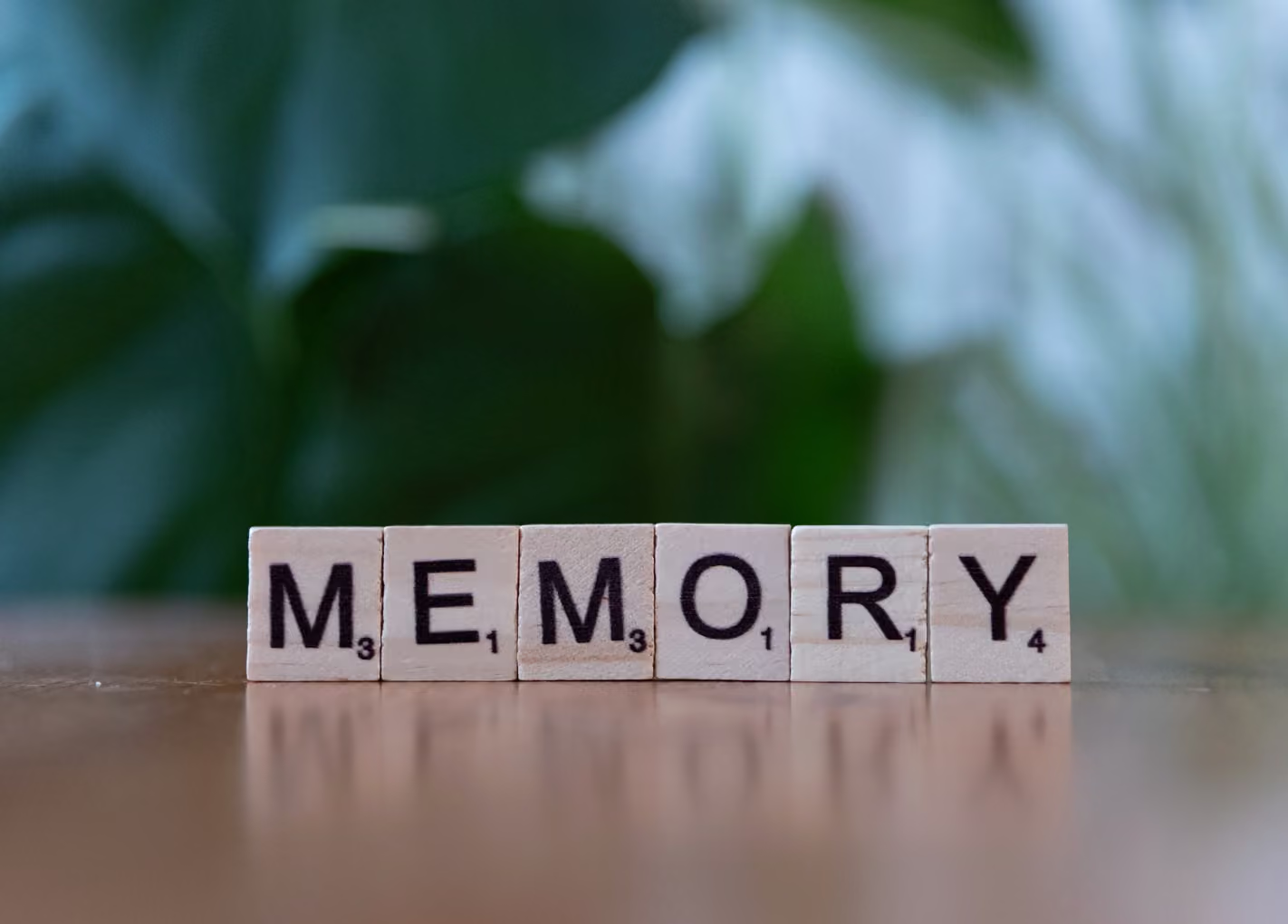
Most companies don’t have a marketing problem.
They have a memory problem.
Every year, businesses spend millions on campaigns, content, paid ads, influencer partnerships, events, product launches, and digital visibility. Yet after all that effort, many brands still fail at the most important test: when the customer is ready to buy, does the brand come to mind first?
That is where the real branding battle happens.
People do not always buy the “best” brand. They usually buy the brand they remember first, trust fastest, and recognize with the least effort. In crowded categories, being known is not enough. A brand must be easy to identify, easy to recall, and hard to confuse.
In 2026, forgettable branding is no longer a small weakness. It is a billion-dollar mistake.
Kantar’s 2026 BrandZ ranking shows that the world’s Top 100 most valuable brands are worth a record US$13.1 trillion, up 22% from the previous year. Apple remained the world’s most valuable brand at US$880 billion, followed by Google at US$578 billion and Microsoft at US$502 billion. These numbers reveal one clear truth: brand memory is not decoration; it is financial power.
The strongest brands are not just better at advertising. They are better at being remembered.
Most brands today sound strangely similar.
They use the same words: innovative, customer-centric, trusted, future-ready, sustainable, digital-first, world-class. They use the same visual language: minimalist logos, blue-and-white websites, stock-style photography, generic taglines, and safe corporate messaging.
This is especially dangerous in the AI era.
When every company uses similar prompts, similar templates, and similar brand language, the market becomes flooded with polished sameness. The content may look professional, but it does not create memory.
That is why the most important branding question for 2026 is not, “Does our brand look good?”
It is: “Can people recognize us without seeing our name?”
Or put more sharply:
“If AI can describe your brand exactly like your competitor’s, your brand doesn’t exist.”
This is not just a creative statement. It is a business warning.
A brand that cannot be distinguished becomes a commodity. And once a company becomes a commodity, price becomes the main reason to choose it.
Marketing science often refers to mental availability: the likelihood that buyers will think of a brand in buying situations. The Ehrenberg-Bass Institute describes mental availability as buyers easily thinking of a brand when buying and recognizing it quickly.
That means branding is not only about awareness. Awareness says, “I have heard of you.” Mental availability says, “I think of you when I need something.”
There is a big difference.
A person may know ten banks, five airlines, four insurance providers, and several technology platforms. But when it is time to act, only a few brands enter the mental shortlist. The brand that wins is often the one connected to the strongest memory structures: a color, a phrase, a sound, a symbol, a product shape, a category idea, or an emotional association.
This is why distinctive brand assets matter. WARC notes that distinctive brand assets use verbal, visual, auditory, and even haptic cues to anchor brands in memory and support faster recognition.
In simple terms: the easier your brand is to recognize, the less money you waste reminding people who you are.
Color is one of the fastest ways to build recognition.
Think of Tiffany & Co. The company’s robin’s-egg blue has become so strongly associated with the brand that Tiffany itself describes Tiffany Blue® as a trademarked color synonymous with the luxury house and its iconic Blue Box®.
Think of Coca-Cola. The company’s history shows that as early as 1906, Coca-Cola introduced a distinctive label to stand out from imitators, and its contour bottle later became one of the most recognizable packaging shapes in the world.
These brands did not become memorable by accident. They built visual codes and repeated them for decades.
Important point: A color is not powerful because it is beautiful. It is powerful because people learn to connect it with one brand.
This is where many businesses fail. They redesign too often. They chase trends. They change colors, typography, messaging, and campaign styles every year. Internally, it feels fresh. Externally, it resets memory.
Consistency may feel boring inside a company, but to the market it creates recognition.
Sound is becoming one of the most underused branding tools.
In audio advertising, podcasts, reels, streaming platforms, short-form video, digital payments, apps, connected cars, and AI assistants, brands are increasingly experienced without full visual attention. That makes sound a powerful memory trigger.
NielsenIQ reported in 2026 that strong audio cues such as jingles, clear brand mentions, and familiar sonic assets can help listeners “see” the brand without visuals, with radio ads in some cases activating brand associations at levels similar to TV.
A 2025 SoundOut study covered 174 brands and more than 70,000 consumers, measuring how sonic logos support brand recognition, attribution, and commercial impact.
McDonald’s is a classic example. Its “I’m lovin’ it” campaign launched in 2003 and became the company’s longest-running slogan, supported by the instantly recognizable “ba da ba ba ba” audio cue.
Important point: If your brand has a logo but no sound, you may be invisible in moments where people are listening, scrolling, driving, or multitasking.
In 2026, the strongest brands will not only ask, “What do we look like?” They will ask, “What do we sound like?”
A slogan is not just a clever line. It is a memory device.
The best slogans do not try to explain everything. They compress a brand into a repeatable idea.
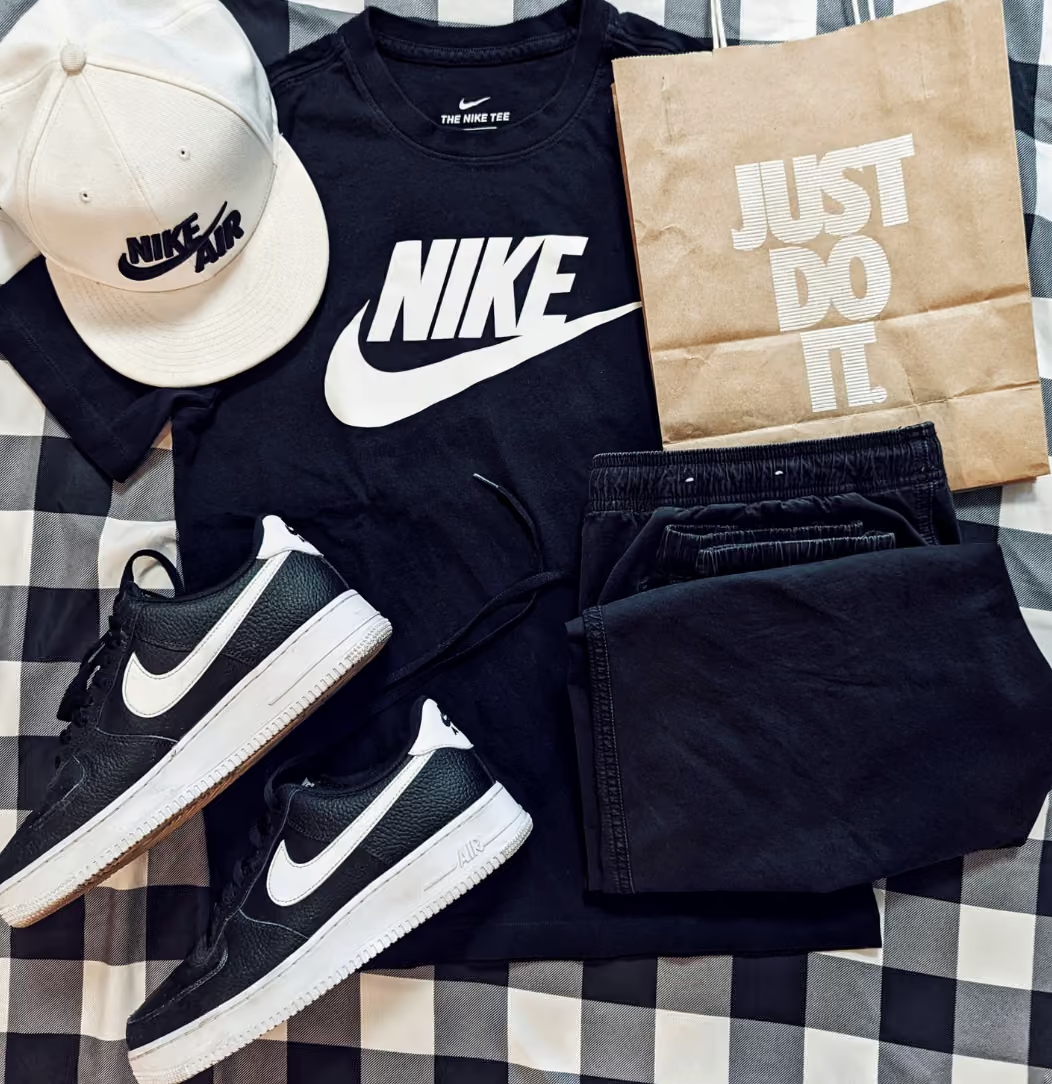
Nike has “Just Do It.” McDonald’s has “I’m lovin’ it.” Mastercard built deep recognition around “Priceless.” These lines work because they are short, repeatable, emotional, and consistently connected to the brand.
The mistake many companies make is changing their message before the market has had time to remember it.
A campaign line is used for three months. A new agency arrives. A new brand deck is created. A new slogan is approved. The company feels like it has evolved, but the customer has not caught up.
Important point: Brands get tired of their messaging long before customers remember it.
The goal is not to say something new every quarter. The goal is to say something valuable so consistently that the category starts associating it with you.
The most memorable brands do not try to stand for everything. They own a space in the customer’s mind.
Volvo has long been associated with safety. Google became synonymous with search. Zoom became shorthand for video meetings. Netflix became linked with streaming entertainment. These brands became mental shortcuts.
That is category ownership.
For growing companies, this is especially important. A smaller brand may not be able to outspend a market leader, but it can become strongly associated with a specific use case, audience, geography, problem, or outcome.
For example, a fintech company may not own “digital banking,” but it can own “instant payments for small merchants.” A healthcare brand may not own “wellness,” but it can own “preventive care for working professionals.” A media company may not own “business news,” but it can own “recognition intelligence for global brands.”
Important point: If your brand tries to mean everything, it usually becomes remembered for nothing.
Here is a simple test.
Ask an AI tool to describe your brand without using your company name. Then ask it to describe three competitors in the same category.
If the descriptions sound almost identical, your brand has a distinction problem.
This matters because AI is increasingly shaping how people discover, compare, summarize, and choose brands. Kantar notes that people are now experiencing brands through thousands of AI-shaped moments, from personalized feeds to large language models that influence what people see and choose.
That means brands must become easier not only for humans to remember, but also for machines to identify clearly.
The future will reward brands with sharp signals: clear positioning, consistent language, recognizable assets, strong proof points, and distinctive category associations.
Forgettable brands pay more for attention.
They need more impressions, more discounts, more explanations, more retargeting, more sales effort, and more persuasion. Every campaign has to start from zero because the market has not stored enough memory.
Memorable brands have an advantage before the sales conversation begins.
They are recognized faster. They are trusted sooner. They are searched more directly. They are compared more favorably. They are chosen with less friction.
That is why the most expensive thing a brand can be in 2026 is not controversial, imperfect, or niche.
It is forgettable.
Because in the end, the market does not reward the brand that says the most.
It rewards the brand that is remembered when it matters.
The lesson is simple: build memory, not just marketing. Own a color. Own a sound. Own a phrase. Own a category idea. Repeat it until the market cannot forget you.
For questions or comments write to contactus@bostonbrandmedia.com



-v3.jpg)


-v3-02.jpg)