Stay informed with our newsletter.
.webp)


EN





Mount Etna has erupted again, sending volcanic ash across eastern Sicily and forcing disruptions at Catania International Airport. Flights have been cancelled, delayed or diverted, affecting thousands of passengers during Europe’s busy summer travel season. The event highlights the ongoing aviation risks posed by volcanic ash, while putting pressure on Sicily’s tourism infrastructure and transport networks. Authorities continue monitoring Etna’s activity as travelers await safer conditions and normal airport operations to resume soon across Sicily.
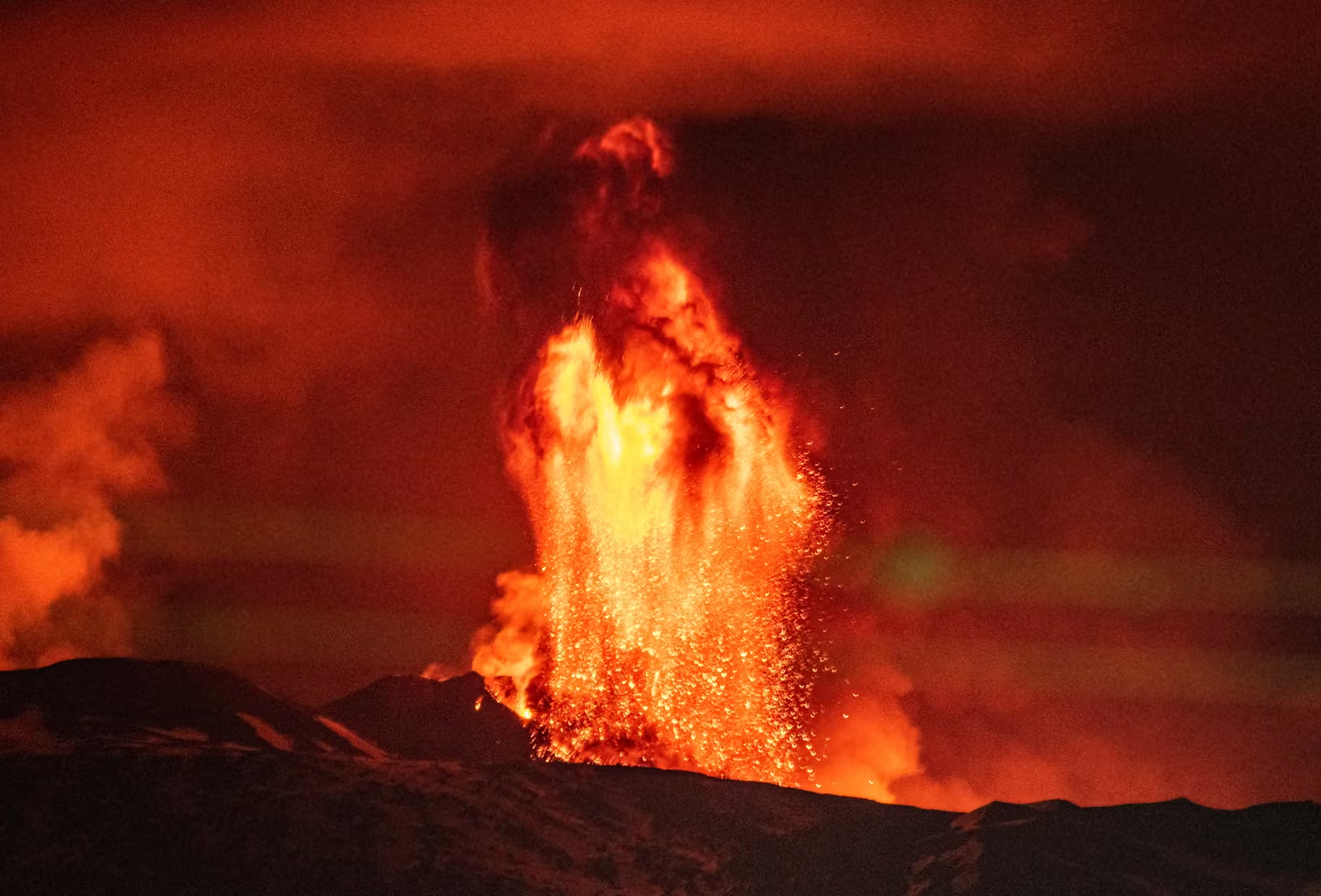
Mount Etna, Europe’s largest and one of its most active volcanoes, has once again demonstrated how quickly a natural event can disrupt one of the Mediterranean’s busiest tourism destinations. Persistent volcanic ash emissions from the Sicilian volcano have forced authorities to suspend flights at Catania International Airport, leaving thousands of travelers facing cancellations, diversions and lengthy delays during one of the busiest weeks of the European summer season.
The latest eruptive phase began on August 6, 2026, producing sustained ash emissions that have repeatedly made the airspace around eastern Sicily unsafe for commercial aircraft. As of August 15, Catania Airport was expected to remain closed to flight operations until at least 3 p.m. local time on Saturday, subject to volcanic conditions and aviation-safety assessments.
The disruption is particularly significant because Catania is Sicily’s busiest airport and Italy’s fifth-busiest by passenger traffic, serving as one of the principal gateways for millions of visitors heading to destinations across eastern and southern Sicily.
The scale of the disruption has grown considerably since the eruption began. Between August 6 and August 12, more than one-third of the nearly 2,000 flights scheduled at Catania Airport were cancelled, while approximately 630 flights were rerouted to other airports.
That means tens of thousands of individual journeys have potentially been affected either directly through cancellations or indirectly through diversions, missed connections and delays.
Airlines have redirected some services to airports including Palermo and Comiso, placing additional pressure on Sicily’s transportation infrastructure. Travelers diverted to airports on other parts of the island have then faced the challenge of finding buses, rental cars, taxis or rail connections to reach their intended destinations.
The situation has become particularly difficult because the disruption coincides with Ferragosto, the August 15 public holiday that traditionally marks the peak of Italy’s summer vacation period. Millions of Italians travel during this period, while Sicily also receives large numbers of international tourists from across Europe and beyond.
According to the Associated Press, the continuing closure represents Catania’s longest volcanic-ash emergency since 2002, illustrating how unusually persistent the current eruptive episode has become.
Although photographs of Mount Etna’s glowing lava flows can be spectacular, the principal aviation threat comes from something far less visually dramatic: volcanic ash.
Ash particles consist of extremely fine fragments of rock, minerals and volcanic glass. When aircraft encounter concentrated ash clouds, particles can enter jet engines, where the high temperatures can cause material to melt and potentially interfere with engine components. Ash can also damage aircraft surfaces, reduce visibility and affect sensors and other critical systems.
Boris Behncke, a researcher at Italy’s National Institute of Geophysics and Volcanology (INGV), explained that volcanic ash can be sucked into aircraft engines and potentially cause them to stall, which is why aviation authorities take such a cautious approach when significant ash emissions occur.
Airport closures therefore are not simply precautionary inconveniences. They are fundamental aviation-safety measures.
Catania Airport’s own flight information has continued to show services being cancelled because of volcanic ash-cloud conditions, highlighting the direct operational impact of Etna’s emissions.
The eruption has not affected Sicily alone.
On August 11, volcanic ash from Mount Etna drifted approximately 220 kilometres south toward Malta, forcing Malta International Airport to cancel 19 flights by mid-afternoon while several others experienced significant delays.
The ability of Etna’s ash to travel such distances demonstrates why an eruption can rapidly become a regional aviation problem rather than a purely local event. Wind direction, altitude, ash concentration and the intensity of volcanic activity all influence how aviation authorities respond.
For European airlines operating dense Mediterranean networks during the summer, even temporary restrictions at major holiday airports can produce knock-on effects across other destinations as aircraft and crews are displaced from their original schedules.
The timing could hardly be more challenging.
August is one of Sicily’s most important tourism months, with visitors traveling to Catania, Taormina, Syracuse, Mount Etna itself and beach destinations across the island. Prolonged flight disruption threatens hotels, restaurants, tour operators, car-rental businesses and other companies dependent on reliable tourist arrivals.
The crisis has also renewed discussion about Sicily’s transportation resilience and its reliance on an airport situated roughly 30 kilometres south of an exceptionally active volcano.
Alternative airports can absorb some traffic, but large-scale diversions create additional demand for road and rail transport, accommodation and ground services. The episode therefore highlights the need for stronger contingency planning, airport coordination and surface-transport connectivity when volcanic activity interrupts normal operations.
Mount Etna rises approximately 3,350 metres above sea level, has a base roughly 35 kilometres across and covers an area of around 1,250 square kilometres. Italy’s Civil Protection Department currently lists Etna at a yellow volcanic alert level and stresses that activity can change abruptly and that some volcanic phenomena can occur with little or no warning.
The volcano is monitored through cooperation between Italy’s Civil Protection authorities, INGV and other scientific institutions, with seismic, geochemical, deformation and visual data helping specialists assess changes in activity.
Importantly, a volcanic alert level and an aviation decision do not necessarily mean the same thing. Even when an eruption does not pose an immediate threat to populated areas, ash entering aviation corridors can still require major flight restrictions.
Passengers scheduled to fly through Catania should check their flight status directly with their airline before travelling to the airport, because conditions can change rapidly as ash concentrations and wind patterns evolve.
Under European air-passenger rules, extraordinary circumstances may mean travelers are not automatically entitled to standard cash compensation when disruption is outside an airline’s control. However, passengers affected by cancellations can still have rights involving reimbursement or rerouting, while airlines may remain responsible for appropriate meals, accommodation and assistance during prolonged disruption.
Travelers should therefore retain booking confirmations and receipts for reasonable expenses and communicate directly with their airline regarding alternative arrangements.
Mount Etna’s latest eruption is a striking reminder that even sophisticated international transport networks remain vulnerable to natural hazards.
A volcano that has shaped Sicily’s landscape for tens of thousands of years is now affecting airlines, airports, tourism businesses and travelers across multiple countries. What begins as an eruption on the slopes of Etna can within hours influence flight schedules hundreds of kilometres away.
For Sicily, the immediate priority is maintaining aviation safety while restoring connectivity as soon as conditions permit. For Europe’s tourism and aviation sectors, however, the longer-term lesson is equally important: destinations exposed to recurring natural hazards need resilient airports, effective alternative transportation networks and flexible emergency plans.
As Etna continues to be closely monitored, thousands of travelers will be watching both the volcano and their departure boards, hoping that the ash clears and one of Europe’s busiest summer travel periods can return to normal.
For questions or comments write to contactus@bostonbrandmedia.com



-v3.jpg)


-v3-02.jpg)