Stay informed with our newsletter.
.webp)


EN





Artificial intelligence is transforming the technology landscape, driving record demand for advanced semiconductors, intensifying competition among Big Tech companies, and raising new concerns over digital privacy. TSMC’s strong growth reflects the surge in AI chip demand, while Meta is expanding its open AI strategy to compete globally. At the same time, privacy-focused technologies such as adversarial patterns are emerging to challenge AI-powered surveillance, highlighting the growing tension between innovation, control, security, and individual rights worldwide.
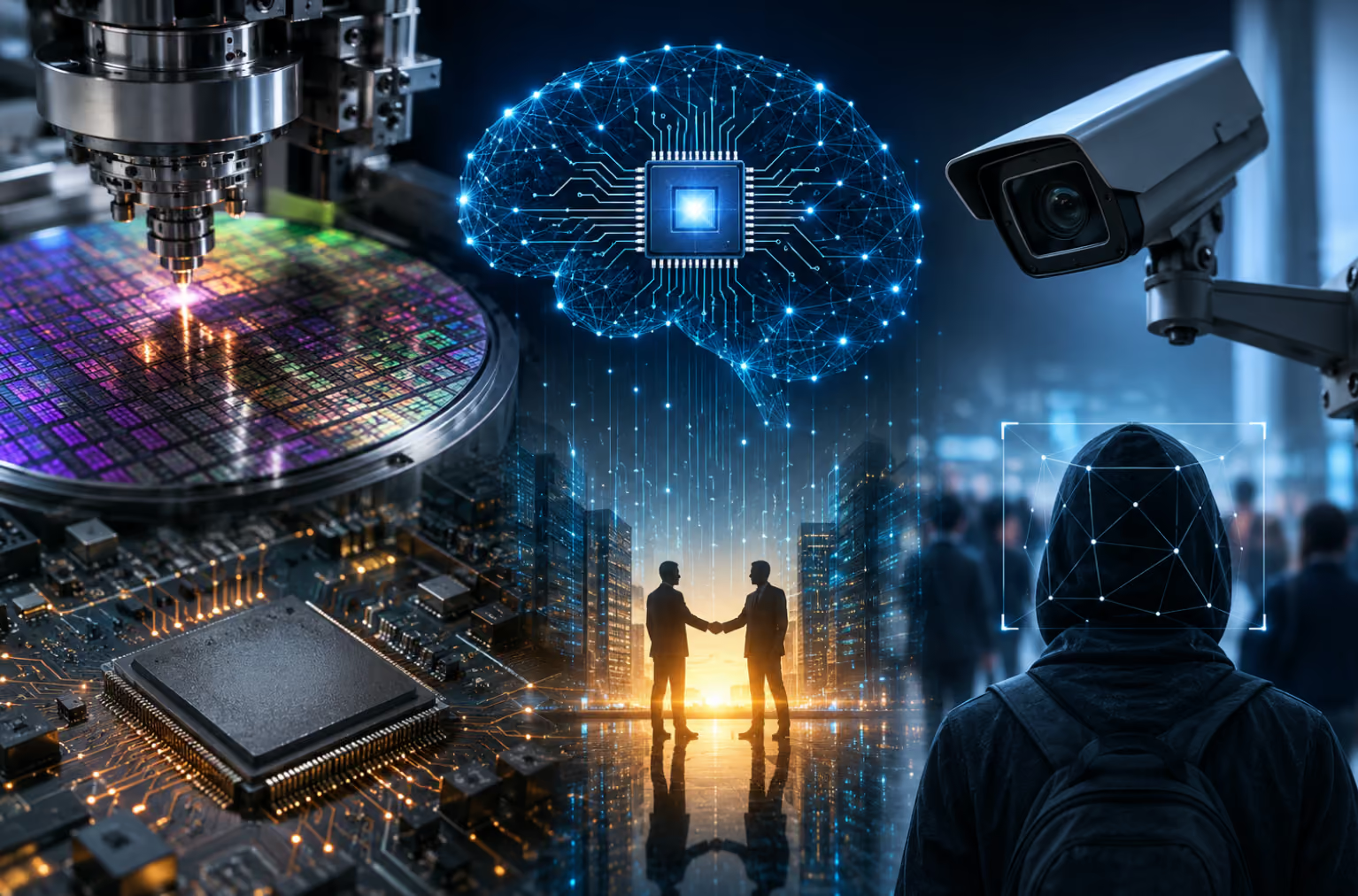
The global artificial intelligence boom is rapidly moving beyond software and chatbots. Its impact is now being felt across the semiconductor industry, corporate technology strategies, consumer devices and even the growing debate over privacy and AI-powered surveillance.
Three developments unfolding almost simultaneously illustrate just how broad that transformation has become. Taiwan Semiconductor Manufacturing Co. (TSMC) is reporting extraordinary revenue growth as demand for advanced chips accelerates; Meta is pushing a more open approach to powerful AI models as competition between American and Chinese technology companies intensifies; and cybersecurity researchers are experimenting with physical patterns designed to confuse the computer-vision systems increasingly used for surveillance.
Together, these developments reveal an AI industry expanding into virtually every layer of the technology economy.
Perhaps the clearest financial evidence of the AI boom comes from TSMC, the world's largest contract semiconductor manufacturer.
TSMC reported consolidated revenue of approximately NT$467.58 billion (around US$14.5 billion) for July 2026, representing an extraordinary 44.7% increase from July 2025 and a 5.6% rise compared with June 2026.
The momentum extends beyond a single month. From January through July 2026, TSMC generated approximately NT$2.872 trillion in revenue, up 37% year-on-year.
Those numbers demonstrate how strongly semiconductor demand is being influenced by the global race to build increasingly sophisticated AI systems.
TSMC occupies an unusually important position in that race. Rather than primarily selling chips under its own consumer brand, the Taiwanese company manufactures semiconductors designed by many of the world's largest technology businesses. Its customers include major technology companies such as NVIDIA, Apple and AMD, placing TSMC at the centre of both high-performance computing and consumer electronics supply chains.
Demand for chips capable of training and operating increasingly complex AI models has become particularly important.
TSMC's second-quarter results had already provided evidence of this momentum. The company posted a 77% year-on-year increase in second-quarter net profit, reaching a record NT$706.6 billion, as demand associated with AI processors continued to accelerate.
The July figures suggest that this demand is continuing rather than fading.
TSMC has also raised its outlook for 2026 revenue growth to more than 40% in US-dollar terms, reflecting confidence that demand for advanced semiconductor manufacturing will remain strong.
AI, therefore, is increasingly becoming not only a software revolution but an enormous infrastructure and manufacturing story.
While semiconductor companies race to supply the hardware, another battle is developing over who controls the AI models running on that infrastructure.
Meta is attempting to differentiate itself from competitors including OpenAI and Anthropic by advocating greater availability of powerful AI models.
On August 10, Meta introduced Muse Glimmer, an open-weight AI model designed to handle smaller agentic workloads on personal devices using a single graphics card. The company also announced plans around Muse Spark 1.2, described as its most advanced model yet.
The announcement forms part of CEO Mark Zuckerberg's broader argument that AI capabilities should be distributed more widely rather than concentrated within a small number of companies.
Zuckerberg has urged policymakers in the United States to reduce barriers affecting open AI development, arguing that American developers risk losing ground to increasingly competitive Chinese AI companies.
That represents an important philosophical divide emerging within the AI industry.
Some companies favour closed or tightly controlled models, arguing that restrictions can help protect intellectual property while reducing potential misuse of increasingly powerful systems. Meta, meanwhile, has positioned greater access to model weights as a way of encouraging developers to customize, study and deploy AI technology more broadly.
The distinction between open-source and open-weight AI is important. Releasing model weights does not automatically mean every component of an AI system meets traditional open-source definitions. Nevertheless, Meta's strategy represents a significantly more accessible model-distribution philosophy than completely proprietary systems.
The competition also has geopolitical implications.
Chinese developers have produced increasingly capable AI models, creating pressure on American technology companies to balance AI safety, commercial control and global competitiveness. Zuckerberg's argument is that a strong open-model ecosystem could help the United States maintain influence over how the next generation of AI applications is developed.
Yet the expansion of artificial intelligence is creating another challenge: what happens when AI systems become increasingly capable of identifying and monitoring people?
Computer-vision technologies can already analyze enormous numbers of images, identify objects and vehicles, recognize faces and assist automated surveillance systems.
Cybersecurity researcher Bill Swearingen is approaching that development from the opposite direction.
Through a project called noRecognition, Swearingen has been developing computer-generated adversarial patterns intended to interfere with the algorithms used by some surveillance and object-detection systems.
According to TechCrunch, Swearingen conducted roughly 31 million tests while developing patterns capable of interfering with several commonly deployed detection systems. The patterns can potentially be applied to clothing or objects so that certain computer-vision algorithms struggle to identify what they are observing.
This does not necessarily make someone physically invisible to a camera.
Instead, the technology exploits weaknesses in machine-learning perception. A human viewing the footage may still clearly see a person, vehicle or object, while an automated detection algorithm could have difficulty correctly classifying it.
Research into adversarial clothing is not entirely new. Academic researchers have previously demonstrated that specially designed visual patterns can reduce the effectiveness of AI-based person-identification systems, illustrating a persistent vulnerability within computer vision.
What is changing is the relevance of such technology as AI surveillance becomes more widespread.
The biggest takeaway from these developments is that the AI revolution can no longer be measured simply by which company produces the smartest chatbot.
Its economic and societal footprint is becoming considerably larger.
At one end of the ecosystem, TSMC's NT$467.58 billion July revenue demonstrates the extraordinary demand for the physical computing infrastructure required to power AI.
At another, Meta's open-model strategy highlights an escalating contest over who develops, distributes and ultimately controls advanced AI capabilities.
And projects such as noRecognition demonstrate that a parallel industry may emerge around protecting individuals from the very algorithms technology companies are making more powerful.
That combination - chips, AI models and privacy technologies, illustrates where the industry may be heading next.
Artificial intelligence is becoming more than a technology category. It is evolving into an ecosystem that influences manufacturing, global corporate competition, geopolitics, cybersecurity, consumer electronics and personal privacy.
The companies building the chips are growing rapidly. The companies building the models are competing over fundamentally different philosophies of AI access. And researchers concerned about surveillance are already developing technologies intended to resist AI systems themselves.
The next chapter of the AI boom, therefore, may not simply be about creating more powerful intelligence.
It may increasingly be about who owns it, who can access it, who supplies the infrastructure behind it and how individuals protect themselves in a world where artificial intelligence is becoming almost impossible to avoid.
For questions or comments write to contactus@bostonbrandmedia.com



-v3.jpg)


-v3-02.jpg)