Stay informed with our newsletter.
.webp)


EN





Artificial intelligence may face a surprising constraint beyond advanced chips: electricity. Global data-centre power consumption could reach around 950 TWh by 2030, driven heavily by increasingly energy-intensive AI infrastructure. As demand accelerates, power grids, renewable energy, nuclear generation, battery storage, cooling systems, transformers and transmission networks are becoming essential parts of the AI supply chain. The next phase of AI growth could therefore depend as much on energy infrastructure as computing power.
For much of the artificial intelligence boom, attention has focused on advanced semiconductors, GPUs and computing power. Companies have raced to secure the latest AI chips, build larger models and expand computing capacity. But another constraint is rapidly emerging behind the scenes: electricity.
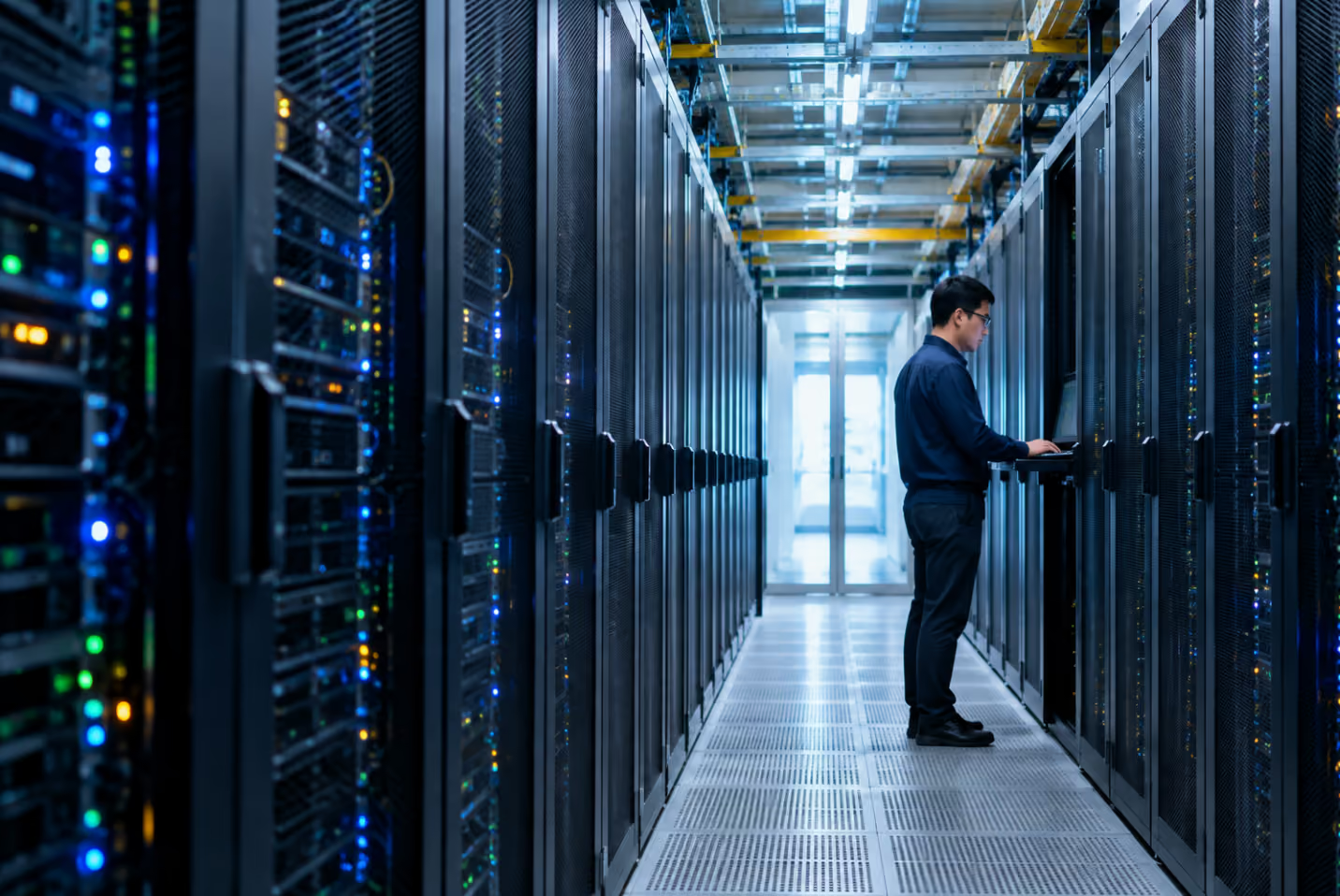
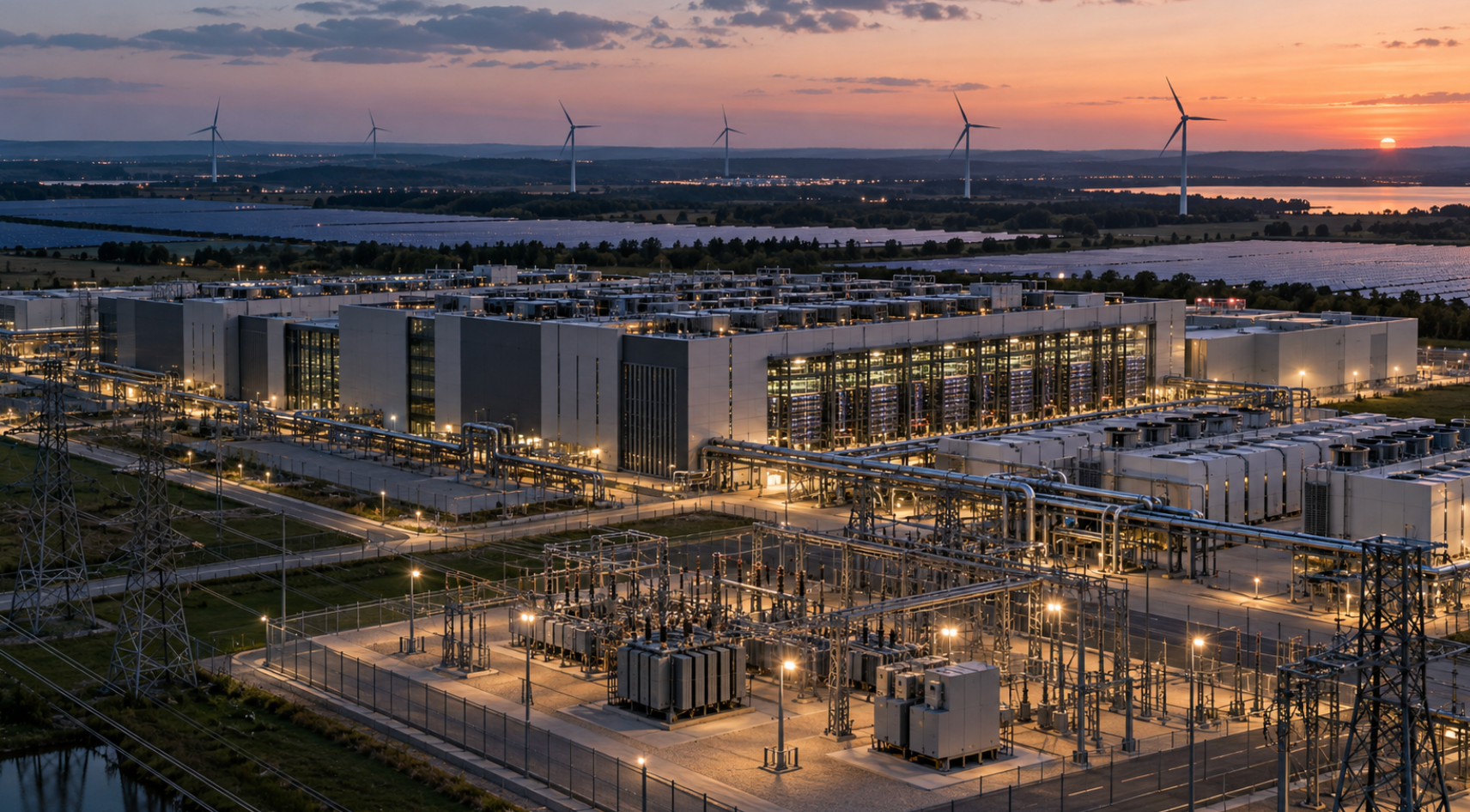
AI does not run simply on algorithms and silicon. It depends on enormous data centres that require continuous electricity, sophisticated cooling systems, transformers, transmission lines, substations, energy storage and reliable power generation. As AI infrastructure expands, these physical systems are becoming just as strategically important as the chips inside the servers.
The International Energy Agency’s latest assessment estimates that global data-centre electricity consumption could rise from roughly 485 terawatt-hours (TWh) in 2025 to around 950 TWh by 2030, almost doubling in only five years and reaching approximately 3% of global electricity demand. Electricity consumption from AI-focused data centres is expected to triple over the same period.
The AI race, in other words, is becoming an energy infrastructure race.
Traditional data centres were already major electricity consumers, but AI is changing their scale and density.
Training and operating advanced AI models requires large clusters of accelerators working simultaneously. The IEA says the power density of AI servers increased approximately 11-fold between 2020 and 2025, and could increase another fourfold by 2027. By then, a single advanced server rack—roughly the size of a large refrigerator—could have a peak electricity requirement comparable with 65 households.
The biggest AI-focused facilities can consequently resemble industrial plants rather than conventional IT buildings.
A typical traditional data centre may draw around 10–25 megawatts, while hyperscale AI facilities can exceed 100 MW. Some data centres under development are measured in gigawatts, meaning their electricity requirements can approach those of major cities or industrial complexes.
That changes the economics of AI dramatically. Having enough GPUs is no longer sufficient. Companies need to know whether they can actually connect those GPUs to enough reliable electricity.
Electricity generation is only one part of the challenge. Power must also reach the data centre.
That requires transmission lines, substations, transformers, switchgear and grid connections, many of which take considerably longer to construct than an AI data centre.
The mismatch is significant. An advanced data centre can potentially be developed within a few years, while major transmission projects frequently involve lengthy permitting, construction and regulatory processes. The IEA estimates that more than 2,500 GW of renewable, storage and large-load projects, including data centres, are stalled in grid-connection queues worldwide.
This creates a surprising AI bottleneck: a technology company may have land, financing, servers and customers but still be unable to obtain enough electrical capacity.
Transformer and power-equipment supply chains are also under pressure. The IEA reported in 2026 that bottlenecks involving transformers, power electronics, gas turbines and other energy technologies were tightening alongside constraints in advanced semiconductor manufacturing.
The future geography of AI could therefore increasingly be determined by where electricity and grid capacity are available, not simply where technology companies prefer to build.
The extraordinary growth in electricity demand is pushing technology companies deeper into energy procurement.
Renewable energy is expected to play a major role. The IEA projects that renewables could meet nearly half of the additional electricity required by data centres over the coming years, supported by solar, wind, hydropower, energy storage and corporate power-purchase agreements.
Solar and wind are attractive partly because they can often be deployed faster than large conventional power stations. Their economics have also improved considerably.
But AI data centres operate 24 hours a day, while solar and wind generation varies with weather and time of day.
That means renewables alone cannot solve the reliability challenge. AI infrastructure increasingly requires a combination of renewable generation, batteries, grid electricity and firm power sources.
Energy storage is consequently becoming another component of AI infrastructure. The IEA estimates that data centres could install around 20–25 GW of battery storage globally by 2030, helping facilities manage rapid changes in AI workloads while potentially providing flexibility to electricity grids.
Perhaps one of the most important consequences of AI’s electricity appetite has been renewed technology-sector interest in nuclear power.
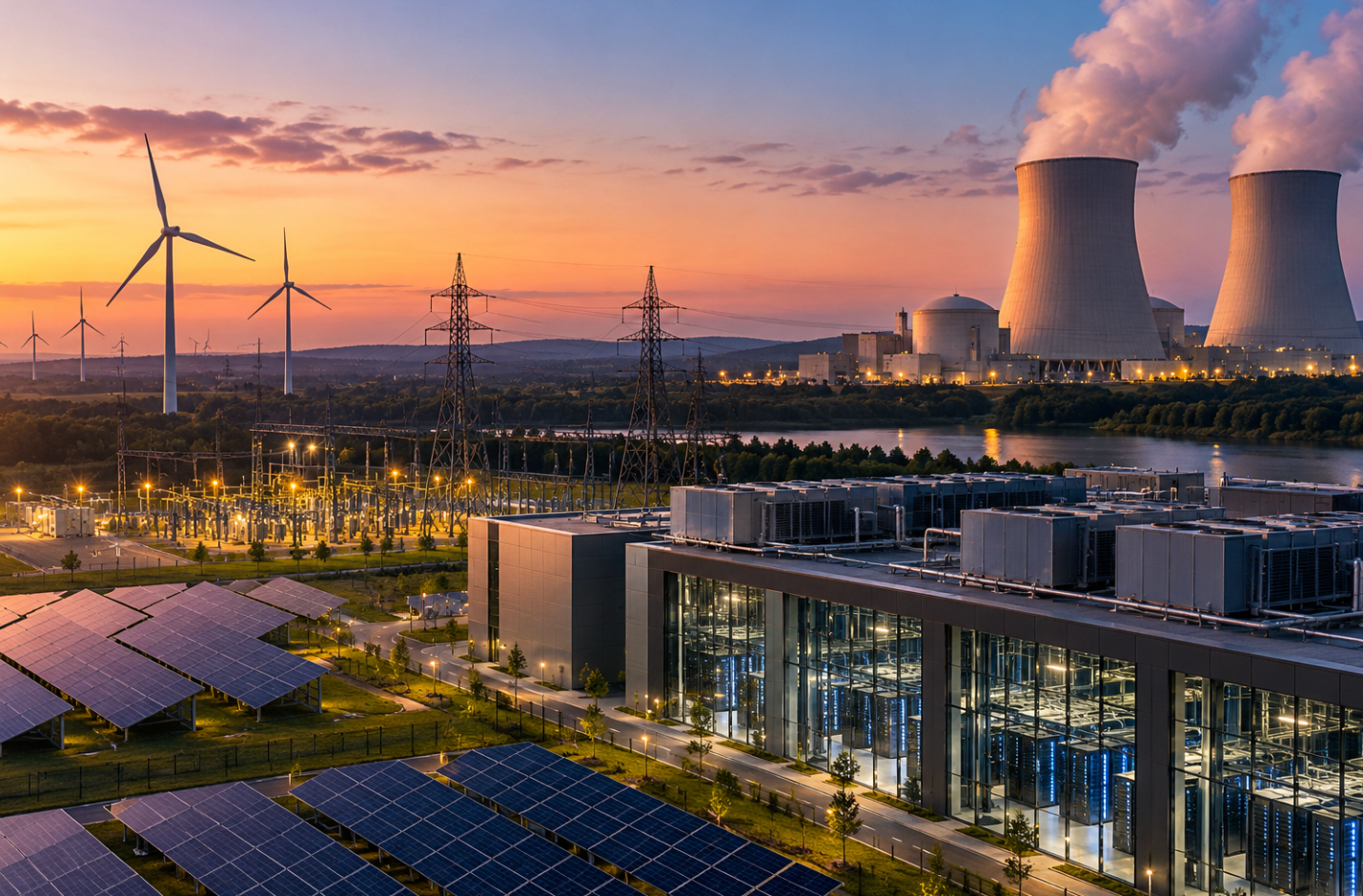
Unlike solar and wind, nuclear plants can provide large quantities of low-carbon electricity continuously. This makes nuclear particularly attractive for data centres requiring reliable, around-the-clock power.
The IEA expects nuclear generation to play an increasingly important role in meeting data-centre electricity demand toward the end of this decade and beyond, alongside renewables and natural gas. Its modelling also anticipates the first contributions from small modular reactors (SMRs) around 2030.
Globally, the broader power system is also moving toward more low-emissions generation. The IEA forecasts that renewables and nuclear together could provide around 50% of global electricity generation by 2030, up from about 42% in 2025.
For technology companies, energy strategy is therefore becoming inseparable from AI strategy.
Not all of the electricity entering an AI data centre powers processors.
High-performance servers generate enormous quantities of heat, which must be removed continuously. As rack densities rise, conventional air cooling becomes increasingly difficult, encouraging adoption of liquid cooling and other advanced thermal-management technologies.
Infrastructure such as cooling, power conversion and supporting systems contributes materially to overall data-centre electricity growth. The IEA previously estimated that cooling and other infrastructure could account for about 20% of the net increase in data-centre electricity consumption through 2030.
This means the AI infrastructure race extends beyond processors into cooling equipment, pumps, heat exchangers, electrical systems and water-management technologies.
The United States provides perhaps the clearest example.
According to the U.S. Department of Energy, data centres consumed approximately 176 TWh of electricity in 2023, equivalent to around 4.4% of U.S. electricity consumption. By 2028, they could consume between 325 and 580 TWh, representing approximately 6.7% to 12% of U.S. electricity demand.
The IEA expects data centres to account for almost half of U.S. electricity-demand growth through 2030.
Those numbers explain why utilities, grid operators, technology companies and governments are increasingly treating AI data centres as major industrial electricity consumers rather than ordinary commercial buildings.
The semiconductor industry remains critical to AI, and shortages of advanced chips and memory can still restrict deployment. But the industry is discovering that computing capacity cannot expand independently of physical infrastructure.
Every new AI cluster ultimately requires generation, transmission, substations, transformers, cooling and storage.
That transforms the AI supply chain. Companies producing GPUs remain important, but so do utilities, renewable-energy developers, nuclear operators, electrical-equipment manufacturers, battery companies, cooling specialists and grid developers.
The AI revolution is therefore becoming intertwined with one of the largest electricity infrastructure expansions in decades.
By 2030, nearly 950 TWh of global data-centre electricity consumption could make energy availability a decisive factor in where AI infrastructure is built and how quickly it can scale.
The defining constraint on the next generation of artificial intelligence may not simply be how many chips companies can manufacture.
It may be how quickly the world can build the electricity system needed to turn those chips on.
For questions or comments write to contactus@bostonbrandmedia.com



-v3.jpg)


-v3-02.jpg)