Stay informed with our newsletter.
.webp)


EN





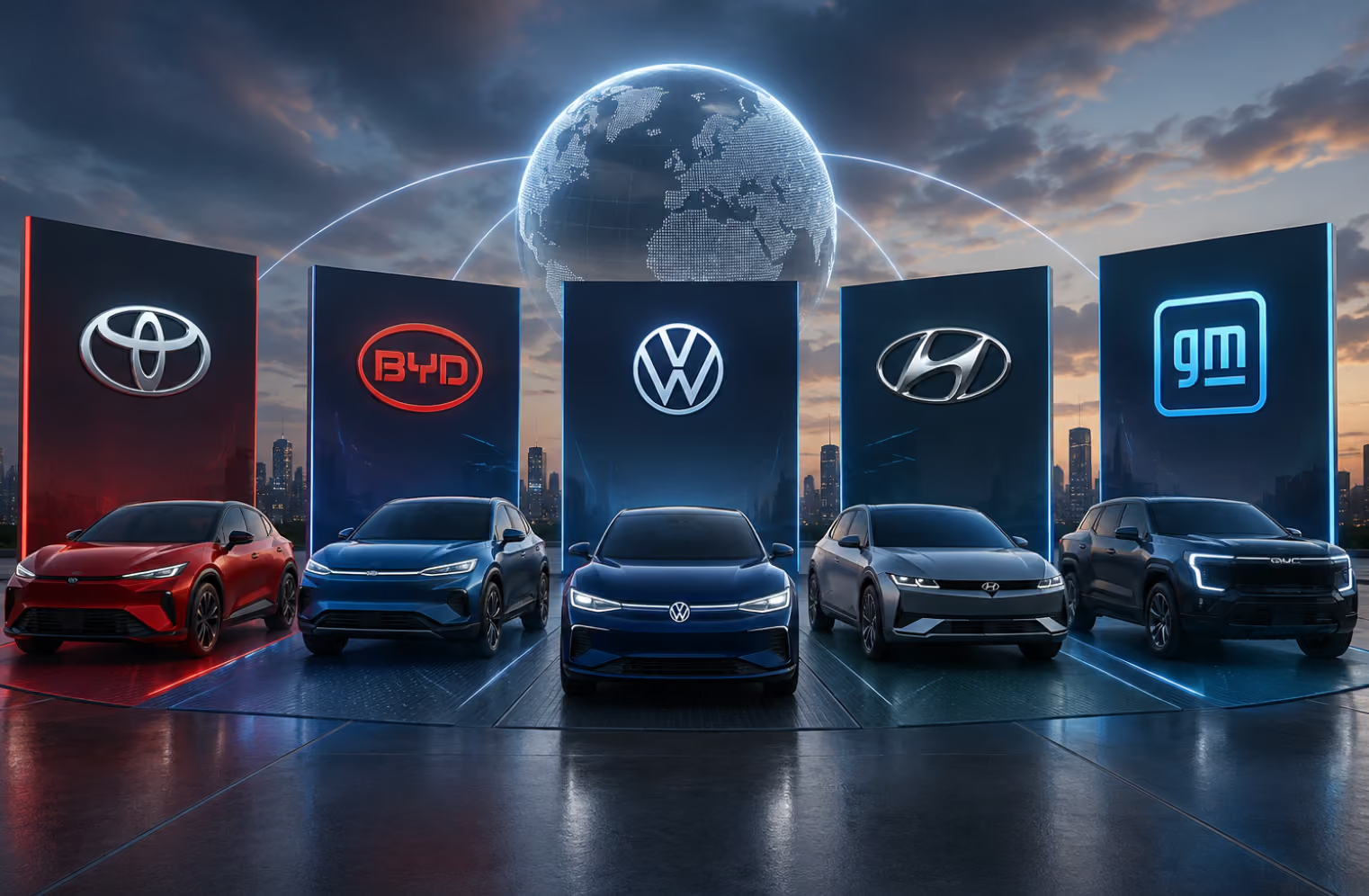
Five global automobile leaders, Toyota, BYD, Volkswagen, Hyundai and General Motors are shaping the automotive industry in 2026 through electrification, hybrid technology, software-defined vehicles, AI and global expansion. Toyota continues to lead in hybrids, BYD accelerates international EV growth, Volkswagen pushes affordable electric mobility, Hyundai advances connected intelligent vehicles, and GM balances strong truck and SUV demand with EV development. Together, they reflect the diverse strategies defining the industry's fast-changing future across major markets around the world.
The global automobile industry is undergoing one of its most consequential transformations in decades. Electrification, hybrid technology, artificial intelligence, software-defined vehicles, changing consumer preferences and the rapid international expansion of Chinese automakers are reshaping competition. At the same time, traditional manufacturers are discovering that the transition is not simply a race toward fully electric vehicles; consumers are increasingly demanding a combination of affordability, fuel efficiency, technology, range and convenience.
Global electric-vehicle sales reached approximately 1.85 million units in July 2026, up 9% year-on-year, while EV sales for the first seven months of the year reached about 11.5 million vehicles. Europe has become an important source of growth, while conditions in China and North America have been more challenging.
Against this changing backdrop, Toyota, BYD, Volkswagen Group, Hyundai Motor and General Motors stand out in 2026, not necessarily because they are the five largest companies under every individual ranking, but because their strategies illustrate five of the most important forces shaping the future of mobility.
For years, Toyota Motor Corporation has followed a diversified electrification strategy encompassing hybrids, plug-in hybrids, battery-electric vehicles and hydrogen technologies rather than concentrating exclusively on pure EVs. In 2026, strong consumer demand for hybrids is giving that strategy renewed significance.
During the first half of 2026, Toyota and Lexus continued to operate at extraordinary global scale, selling more than five million vehicles worldwide. In June alone, Toyota's global sales edged 0.1% higher to 868,454 vehicles, while global production increased 2.9% to 879,321 vehicles.
The United States has been another demonstration of Toyota's strength. Second-quarter U.S. sales increased 1.1% to 673,971 vehicles, supported partly by demand for hybrid and affordable models.
Toyota is also strengthening its manufacturing footprint. In South Africa, the company has begun pilot production of its next-generation Hilux after completing more than 77% of a R10.4 billion investment programme, with eventual production targeted at approximately 140,000 units annually for domestic and export markets.
Toyota's 2026 story therefore demonstrates an important industry reality: the transition toward lower-emission transportation may involve multiple technologies rather than one universal solution.
Few companies illustrate the transformation of the automotive competitive landscape better than BYD.
The Chinese new-energy vehicle manufacturer is rapidly evolving from a predominantly domestic success story into a global automobile manufacturer with international production, distribution and technology ambitions.
BYD's global sales reached 419,211 vehicles in July 2026, representing growth of 21.8% year-on-year, with overseas demand becoming increasingly important as competition intensified in its Chinese home market.
Brazil has become a particularly important part of this international expansion. BYD recorded 23,465 vehicle sales in Brazil during July, capturing approximately 9.1% of the market and becoming the country's fourth-largest automaker for the month. Its Dolphin GS alone recorded 5,861 retail sales.
More significantly, BYD is increasingly manufacturing vehicles specifically for overseas markets rather than simply exporting cars from China.
Its Brazilian-made Song Pro Super-Híbrido Flex Fuel combines plug-in hybrid technology with the ability to use electricity, gasoline or ethanol. The technology was developed jointly by Brazilian and Chinese teams and reflects how global automakers are increasingly adapting electrification to local energy infrastructure and consumer needs.
BYD is investing another R$5.5 billion in its Camaçari manufacturing operation, which is expected to produce around 180,000 vehicles in 2026.
This combination of competitive pricing, battery expertise, international manufacturing and localization makes BYD one of the automobile industry's most consequential companies to watch.
Europe's largest automotive groups are under growing pressure to make electric vehicles more affordable, and Volkswagen Group is positioning lower-cost EVs as an important part of its response.
The Group delivered approximately 4.13 million vehicles worldwide during the first half of 2026. Although overall deliveries declined amid challenging conditions, particularly in China, European demand for its upcoming electric models tells a different story.
Volkswagen reported that its European battery-electric vehicle order book had increased by more than 50%, while BEVs represented more than 30% of its overall order backlog.
Its new Electric Urban Car Family, including models such as the Volkswagen ID. Polo, Škoda Epiq and CUPRA Raval, had accumulated more than 54,000 orders by the Group's July delivery update.
The achievement is significant because one of the biggest barriers to mass EV adoption remains affordability. Volkswagen's strategy increasingly centres on taking electric mobility beyond premium buyers and making smaller electric vehicles accessible to mainstream European consumers.
Hyundai Motor Company represents another emerging philosophy: the automobile of the future will be defined not only by what powers it, but increasingly by its software, connectivity and intelligent digital services.
Hyundai's global hybrid sales increased 25% during the first half of 2026 to 353,668 vehicles. Together, electric vehicles, hybrids and plug-in hybrids represented more than one-quarter of Hyundai's worldwide sales.
This balanced approach is proving particularly valuable as hybrid demand strengthens in major markets. In the United States, consumers facing higher fuel prices have increasingly turned toward hybrids, benefiting Asian manufacturers including Hyundai and Toyota.
Beyond powertrains, Hyundai is pushing toward software-defined vehicles, where digital platforms, connected features and AI increasingly shape the ownership experience.
The significance of this strategy extends well beyond infotainment. Software-defined architecture could eventually allow vehicles to receive new capabilities through updates, personalize services and create long-term digital relationships between manufacturers and drivers.
Hyundai's competitive advantage may therefore come from combining electrification with intelligent vehicle technology, rather than treating them as separate transformations.
While several manufacturers are concentrating heavily on EV expansion, General Motors demonstrates why automotive transformation must remain grounded in consumer demand and profitability.
GM sold 714,896 vehicles in the United States during the second quarter of 2026, making it America's leading automaker by sales during the period. The company remained the country's No. 2 EV seller, while continuing to benefit from strong demand for full-size pickups and large SUVs.
Its financial performance has also been notable. GM's second-quarter adjusted EBIT rose to $3.9 billion, compared with roughly $3 billion a year earlier, prompting the manufacturer to increase its 2026 adjusted profit outlook to $14 billion–$16 billion.
GM is simultaneously expanding technologies such as Super Cruise, with the company reporting its best-ever quarter and first half for sales of new vehicles equipped with the hands-free driving system.
Its 2026 performance highlights a central dilemma facing established automakers: companies must invest in EVs, autonomous-driving technologies and software while continuing to generate profits from the vehicles customers are buying today.
The biggest lesson from these five companies is that there is no single winning automotive strategy in 2026.
Toyota demonstrates the continuing strength of hybrids. BYD represents the international rise of Chinese new-energy vehicle manufacturers. Volkswagen is pursuing more accessible electric mobility. Hyundai is combining electrification with software and AI-driven vehicles, while General Motors is balancing profitable traditional segments with advanced technology and future mobility investments.
The next phase of automotive competition will therefore be about much more than selling cars. Manufacturers will increasingly compete through battery technology, hybrid efficiency, software, artificial intelligence, localized manufacturing, charging ecosystems, autonomous-driving capabilities and affordability.
The companies that succeed will be those capable of giving consumers the right technology at the right price and at the right time.
In 2026, that race is accelerating and Toyota, BYD, Volkswagen, Hyundai and General Motors provide five very different visions of what the automobile industry's future could become.
For questions or comments write to contactus@bostonbrandmedia.com



-v3.jpg)


-v3-02.jpg)