Stay informed with our newsletter.
.webp)


EN





Climate disasters are no longer isolated environmental events; they are becoming serious business risks that affect infrastructure, insurance, supply chains, tourism, public health, and economic stability. Floods, wildfires, and heatwaves are disrupting operations, increasing costs, and exposing companies to new financial pressures. As extreme weather becomes more frequent and intense, businesses must rethink resilience, risk planning, and sustainability strategies to protect people, assets, and long-term growth in a rapidly changing climate worldwide.
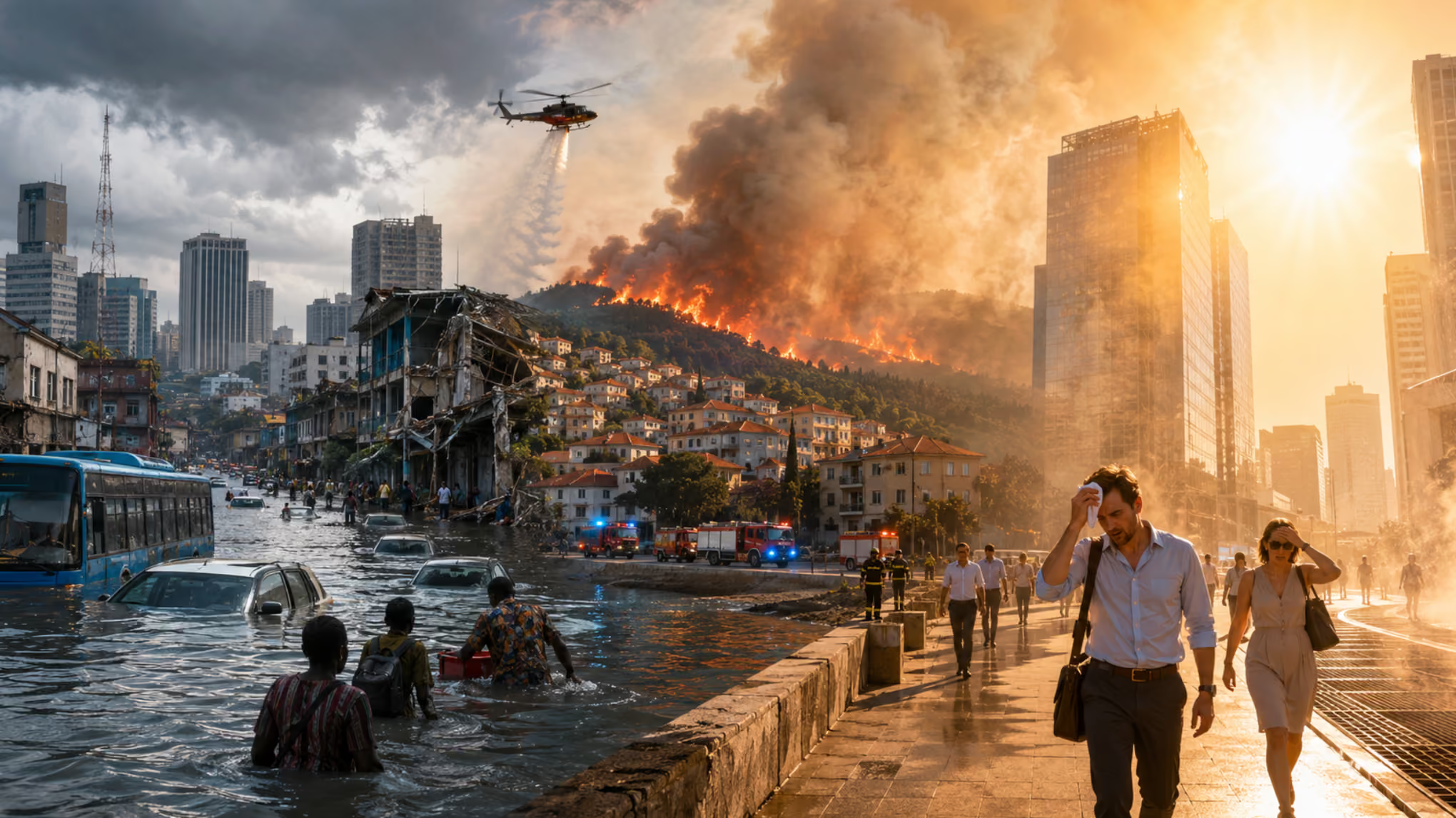
Climate disasters are no longer only environmental stories. They are now business risks, insurance risks, infrastructure risks, public health risks, and economic stability risks. From recent floods in Ghana to wildfires in Greece and record-breaking heatwaves across Europe, extreme weather is disrupting how cities function, how companies operate, how insurers price risk, and how governments plan for the future.
The latest events show a clear pattern: climate extremes are moving from the background of corporate planning to the center of business strategy.
In Ghana, sustained heavy rainfall since June 27, 2026, caused widespread flooding across Accra, Tema, and surrounding areas, affecting homes, businesses, and public infrastructure while disrupting social and economic activity. Ghana’s government said the floods hit especially hard in low-lying areas, once again exposing the vulnerability of urban centers where drainage systems, roads, housing, and commercial districts are under pressure.
The impact was not minor. Ghana’s Interior Minister disclosed that more than 7,700 households were displaced and seven people remained missing after devastating floods, while June 2026 recorded 593.2 millimetres of rainfall, the highest monthly rainfall total since records began in 1995. A single day of rain produced 169.2 millimetres, making it the fourth-highest daily rainfall ever recorded in the country. The Accra flood death toll also rose to nine, according to local reports, as rescue operations continued.
For businesses, the message is urgent. Flooded roads delay employees, stop deliveries, damage inventory, close shops, affect banks and telecom networks, and slow down the informal economy. When floodwaters enter markets, warehouses, offices, and transport corridors, the cost is not limited to physical damage. It also includes lost working hours, supply-chain delays, customer disruption, and higher recovery costs.
Ghana’s flooding problem also highlights a wider challenge facing fast-growing cities: urban expansion without climate-ready infrastructure. The National Development Planning Commission has warned that Accra’s economic dominance is connected to flood risk, as development pressure, poor land-use planning, and infrastructure gaps increase exposure. Floodwaters in Accra have repeatedly submerged homes, disrupted transportation, damaged businesses, and displaced residents.
In Greece, the threat looks different but carries the same economic warning. Wildfires near Thessaloniki killed a father and his 12-year-old son, while the mother was hospitalized with burn injuries. In central Greece’s Fthiotida region, authorities ordered evacuations in two villages as more than 135 firefighters and 25 aircraft battled a fire spreading through forests and farmland.
Wildfires are particularly dangerous for economies that depend on tourism, agriculture, transport, and real estate. Greece is one of Europe’s most important tourism destinations, and repeated fire seasons can affect hotel bookings, travel insurance, airline schedules, local businesses, and investor confidence in high-risk areas. Even when fires do not reach major tourist zones, smoke, road closures, evacuation alerts, and negative global headlines can influence traveler behavior.
The European Union has already treated wildfire risk as a continental emergency. For summer 2026, the EU announced its largest-ever wildfire response, with 777 firefighters from 14 European countries pre-positioned in high-risk areas including Greece, Cyprus, Italy, France, Spain, and Portugal. The EU also prepared 22 firefighting airplanes and five helicopters to support countries under pressure. This level of preparation shows that wildfire risk is no longer seasonal inconvenience; it is now a major public-safety and economic-resilience issue.
Europe’s heatwave crisis adds another layer to the problem. The World Meteorological Organization said an extraordinary heatwave across Europe shattered temperature records and caused major impacts on human health, ecosystems, agriculture, infrastructure, and labour productivity. The heatwave was also accompanied by local violent storms, worsening drought in some areas, and increased wildfire risk.
Reuters reported that Western Europe’s heatwave claimed lives, disrupted power supplies, shut schools and cultural landmarks, and pushed Britain to its highest June temperature, reaching 36.1°C in southern England. In Spain, official data attributed 1,029 excess deaths to extreme heat during June 2026, as the country experienced its second-hottest June on record.
For companies, extreme heat is a productivity shock. Construction workers, delivery drivers, factory staff, farmers, port workers, and tourism employees are among the most exposed. When temperatures become unsafe, businesses may need to shorten shifts, increase breaks, provide cooling stations, delay outdoor work, or absorb higher health and safety costs. In sectors such as agriculture and construction, heat can directly reduce output.
Extreme heat also stresses energy infrastructure. Air-conditioning demand rises sharply, electricity grids face pressure, and businesses become vulnerable to power cuts. Refrigerated logistics, food storage, healthcare facilities, data centers, and manufacturing plants all depend on stable energy systems. When grids struggle, climate risk quickly becomes operational risk.
The insurance industry is already sounding the alarm. Swiss Re reported that natural catastrophes caused USD 107 billion in insured losses across 190 events in 2025, with wildfires, storms, and floods contributing to a record 92% of global insured losses. Munich Re said natural disasters caused USD 224 billion in total losses in 2025, with insurers covering around USD 108 billion, and weather disasters accounting for 92% of all losses and 97% of insured losses.
This matters because higher losses usually lead to higher premiums, stricter underwriting, lower coverage availability, and wider protection gaps. Swiss Re estimated the global natural catastrophe protection gap at USD 424 billion in 2025, up from USD 395 billion a year earlier. For businesses in vulnerable regions, this can mean that climate-related damage becomes harder and more expensive to insure.
Tourism is another industry being reshaped by climate extremes. The OECD warned that heatwaves, wildfires, floods, and storms are disrupting tourism activity, damaging natural and built assets, and changing travel patterns across regions and seasons. This is especially important for countries where travel and hospitality support thousands of small businesses.
The lesson from Ghana, Greece, and Europe is clear: climate disasters are becoming balance-sheet events. They affect property values, operating costs, workforce safety, insurance pricing, supply chains, public spending, and investor decisions.
Businesses can no longer treat climate risk as a distant ESG issue. They need flood-resilient facilities, heat-response plans, supply-chain diversification, insurance reviews, employee safety protocols, and scenario planning. Governments also need to invest in drainage, cooling infrastructure, early-warning systems, emergency response, resilient power grids, and smarter urban planning.
Climate extremes are not waiting for long-term forecasts. They are already disrupting cities, industries, and economies. The companies and governments that adapt early will be better positioned to survive the next shock. Those that delay may find that the cost of inaction is no longer environmental, it is financial, operational, and deeply human.
For questions or comments write to contactus@bostonbrandmedia.com



-v3.jpg)


-v3-02.jpg)