Stay informed with our newsletter.
.webp)


EN





China has emerged as the dominant force in industrial automation, accounting for 59% of the world’s industrial robot deployments. The figure reflects the country’s rapid investment in smart factories, advanced manufacturing, and productivity-enhancing technologies. As Chinese manufacturers accelerate automation across sectors such as automotive, electronics, and machinery, the shift is strengthening production capacity, reshaping global supply chains, and increasing competitive pressure on economies seeking to expand their own robotics and manufacturing capabilities in coming years.
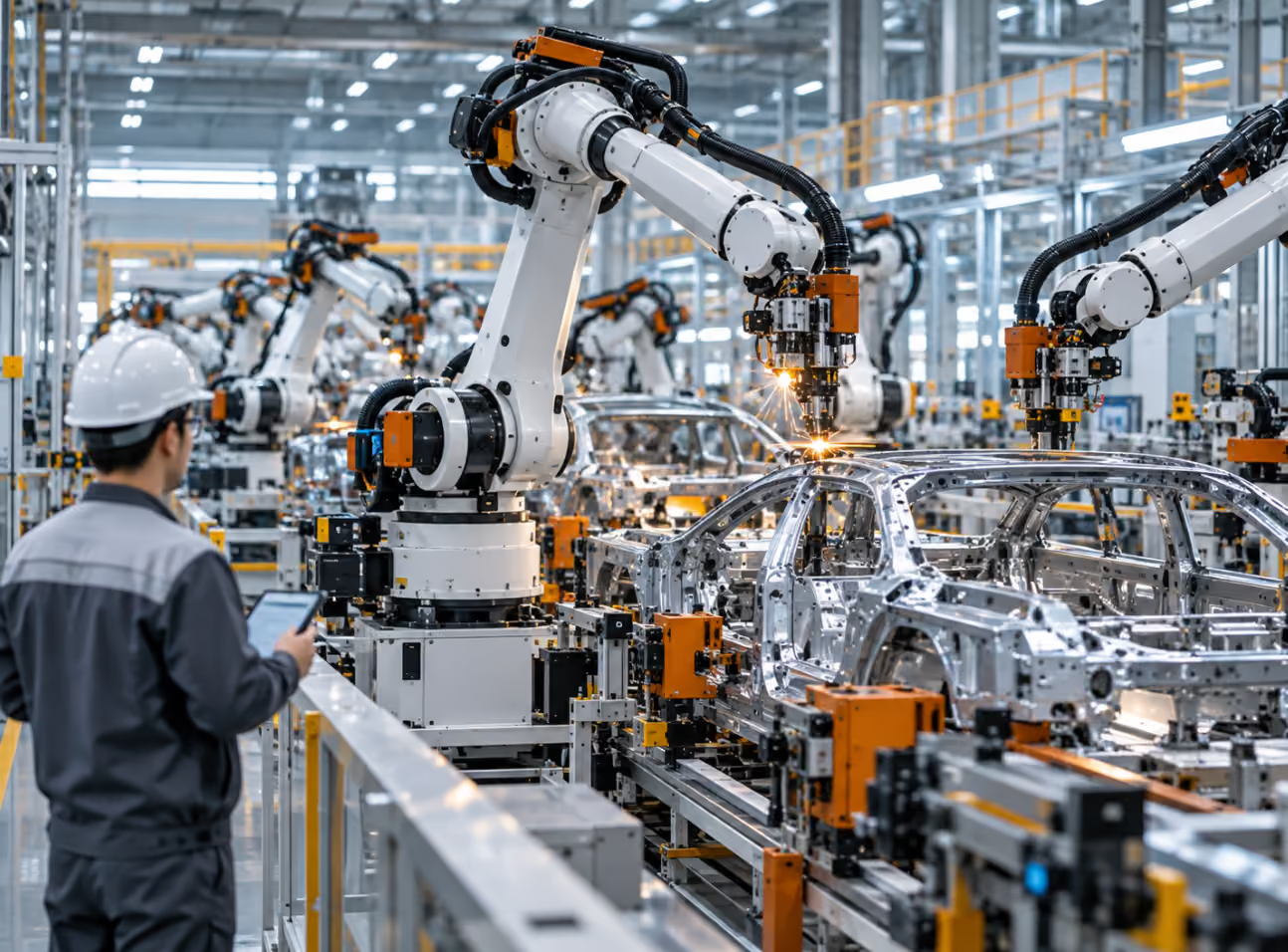
The global manufacturing sector reached a major automation milestone in 2025, with factories around the world adding a record 603,000 industrial robots. Yet one country stood far above the rest. China alone installed around 354,000 robots, reinforcing its position as the world’s largest market for industrial automation and demonstrating how aggressively the country is reshaping its manufacturing economy around robotics.
The figures come from the International Federation of Robotics’ World Robotics 2026 report, which provides an annual snapshot of global automation trends. According to the report, China not only led new installations but also expanded an already enormous base of operating machines. The country now has more than two million industrial robots working across its factories, the largest operational stock anywhere in the world.
China’s rise did not happen suddenly. Instead, the country has steadily increased its share of global robot installations over the past decade. In 2016, China represented about 32% of worldwide industrial robot deployments. By 2022, that proportion had climbed beyond half of all global installations. In 2025, China’s share reached an extraordinary 59%, meaning nearly six out of every ten newly installed industrial robots worldwide were deployed inside Chinese factories.
That scale leaves other major manufacturing economies far behind in absolute numbers. Countries such as the United States and Japan remain important robotics markets and technology producers, but neither comes close to matching China’s current pace of deployment. The gap highlights how central automation has become to China’s long-term industrial strategy, particularly as manufacturers seek greater productivity, higher precision and reduced dependence on labor-intensive production.
The country’s robotics expansion is closely connected to government policy. Jane Heffner, President of the International Federation of Robotics, has pointed to China’s decade-long national robotics strategy as a major factor behind the transformation of its industrial system. Rather than treating robots as isolated pieces of manufacturing equipment, China has increasingly positioned automation as part of a broader economic and technological modernization program.
That strategy is now entering another phase. Under China’s 15th Five-Year Plan for 2026–2030, policymakers are placing greater attention on the physical applications of artificial intelligence. The goal is to move AI beyond software, digital assistants and data analysis and into machines capable of operating in the physical world.
Industrial robots are expected to play a central role in that transition. By combining artificial intelligence, machine vision, advanced sensors, automation systems and increasingly sophisticated robotics, factories could become more adaptable and autonomous. Machines may gradually move beyond performing repetitive tasks toward responding to changing production conditions, identifying defects, optimizing processes and working more closely alongside human employees.
China’s dominance in total installations, however, tells only one side of the global robotics story. When automation is measured relative to the size of a country’s manufacturing workforce, the picture becomes very different.
The International Federation of Robotics uses a measure known as robot density, which calculates how many industrial robots are deployed for every 10,000 manufacturing workers. By this measure, China remains well behind several highly automated economies.
In 2024, China recorded approximately 166 industrial robots for every 10,000 manufacturing employees, placing it only around 22nd globally in robot density. That ranking may appear surprising given the enormous number of robots operating in Chinese factories, but the explanation lies in the extraordinary scale of the country’s manufacturing workforce.
China has more than 120 million manufacturing workers, giving it a labor base unlike that of almost any other industrial economy. Even millions of robots are spread across an enormous number of factories, sectors and employees. As a result, China can dominate the world in total robot installations while still having considerable room to increase the level of automation experienced by the average manufacturing worker.
Smaller industrial economies often show much higher robot-density figures because their manufacturing workforces are considerably more compact. Countries with strong automotive, electronics and advanced engineering industries are particularly likely to rely heavily on robotics.
South Korea stands at the top of the global ranking, with approximately 1,220 industrial robots for every 10,000 manufacturing employees. That level of automation is far above China’s current figure and reflects South Korea’s highly automated automotive and electronics industries.
Germany and Japan also maintain substantially higher levels of robot density, supported by decades of investment in precision engineering, vehicle manufacturing, electronics and advanced industrial production.
The contrast reveals an important point about China’s robotics revolution. China may already be the world’s largest robot market, but its automation journey is far from complete. With robot density still relatively modest compared with leading automated economies, the country has substantial capacity for further expansion.
If China continues closing that gap while maintaining its enormous manufacturing base, the next stage of its automation push could be even more significant. The country is therefore not simply buying more robots than anyone else; it is gradually building an industrial system in which robotics, artificial intelligence and smart manufacturing could become fundamental drivers of productivity, competitiveness and future economic growth.
For questions or comments write to contactus@bostonbrandmedia.com
Source: Statista



-v3.jpg)


-v3-02.jpg)