Stay informed with our newsletter.
.webp)


EN





Electric vehicles are no longer just replacing petrol engines with batteries; they are reshaping the entire automotive business model. As cars become connected, software-defined and increasingly intelligent, batteries, AI, autonomous driving, subscription services and vehicle-to-grid technology are turning vehicles into mobile energy and computing platforms. This shift is blurring the boundaries between automakers, technology companies, utilities and software providers, redefining what a car is and how it creates value throughout its lifetime for consumers worldwide.
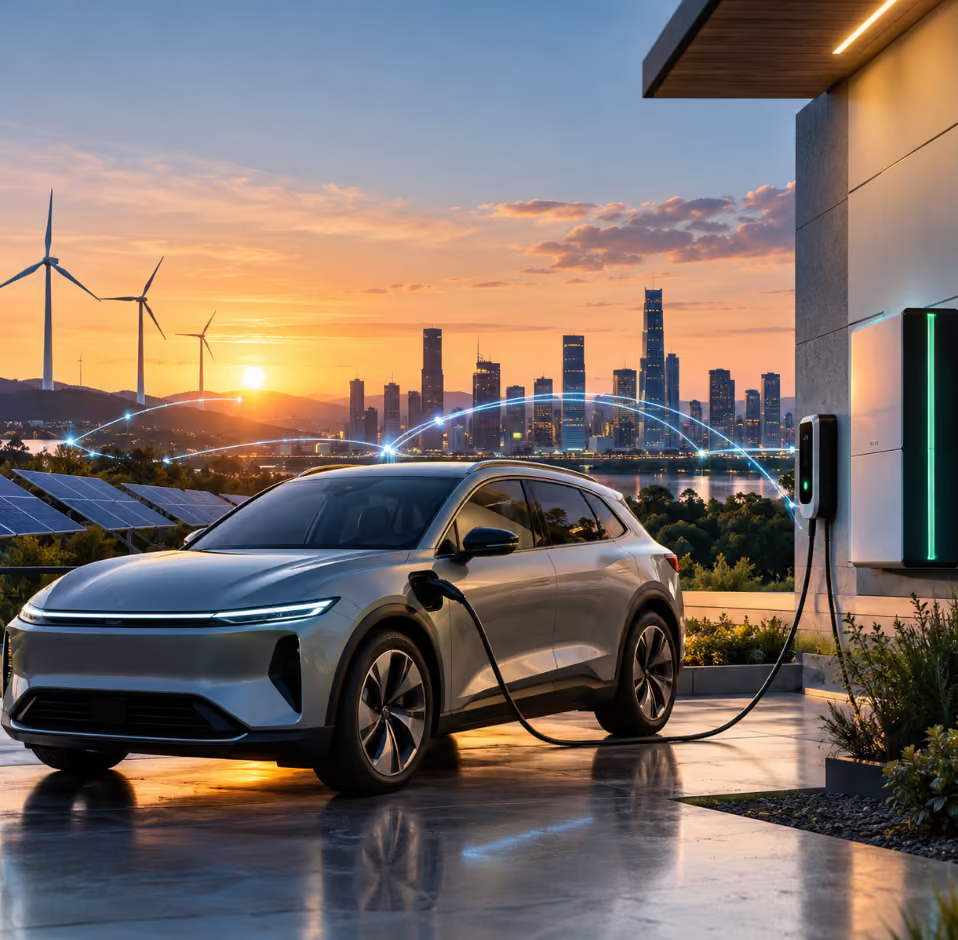
For more than a century, the automobile industry was built around one dominant idea: manufacture a machine, sell it, fuel it, service it and eventually replace it. The electric-vehicle revolution is beginning to dismantle that model.
The biggest transformation underway in mobility is not simply the replacement of petrol tanks with batteries. Cars are increasingly becoming energy-storage devices, connected computers, artificial-intelligence platforms and continuously upgradeable software products. The companies competing for the future of mobility may therefore find themselves operating simultaneously in the automotive, energy, semiconductor, cloud-computing and software industries.
And the scale needed to make that transformation possible has already arrived. Global electric-car sales exceeded 20 million in 2025, rising around 20% year on year and accounting for approximately one in every four new cars sold worldwide, according to the International Energy Agency. China alone saw EVs account for nearly 55% of new-car sales, while approximately 5% of the entire global passenger-car fleet is now electric. Those vehicles displaced an estimated 1.2 million barrels of oil consumption per day in 2025.
In a traditional car, the engine is overwhelmingly dedicated to one purpose: moving the vehicle. An EV battery is different. It can power propulsion, feed computers and sensors, store renewable electricity, provide emergency backup power and potentially sell electricity back into the grid.
That changes the strategic importance of the battery dramatically.
Global EV battery deployment reached approximately 1.2 terawatt-hours in 2025, almost 30% higher than in 2024 and more than seven times the level recorded in 2020. Electric vehicles accounted for more than 70% of total battery deployment worldwide, making the automotive sector one of the central forces shaping the global battery industry.
Battery chemistry is also evolving rapidly. Lithium iron phosphate, or LFP, accounted for more than 55% of EV batteries deployed globally in 2025, helped by its relatively low cost, durability and growing adoption beyond China. Meanwhile, the long-term collapse in lithium-ion costs has been extraordinary: the IEA estimates average lithium-ion cell prices were 97% lower in 2025 than in 2000.
The consequence is profound. Automakers are no longer merely sourcing a component called a battery. They are increasingly managing an energy platform that influences vehicle price, range, charging speed, performance, resale value and even the owner's electricity bill.
Perhaps the clearest sign that cars are merging with the energy industry is vehicle-to-grid technology, or V2G.
Most EVs today simply take electricity from the grid. Bidirectional charging reverses that relationship. An EV can charge when electricity is abundant or inexpensive and potentially discharge electricity into a house, building or electrical grid when demand rises.
Suddenly, millions of parked cars become a distributed network of batteries.
The IEA notes that the first commercial V2G offers for private EV owners appeared in 2025, while markets including France, the Netherlands and the United Kingdom have developed many of the technical and regulatory conditions required for deployment.
The implications could be enormous because cars spend much of their lives stationary. Instead of sitting unused in garages and parking lots, batteries could help absorb excess solar power in the afternoon and return electricity during evening peaks.
One modelling study cited by the IEA found that V2G could potentially avoid around three-quarters of transformer overloads by 2050 in the San Francisco distribution network compared with uncontrolled EV charging.
In other words, tomorrow's car may earn money while parked.
Another transformation is happening behind the dashboard.
Cars traditionally left the factory with most of their capabilities fixed for life. Software-defined vehicles challenge that idea. Increasingly, functions can be updated, repaired, improved or unlocked remotely through over-the-air software updates.
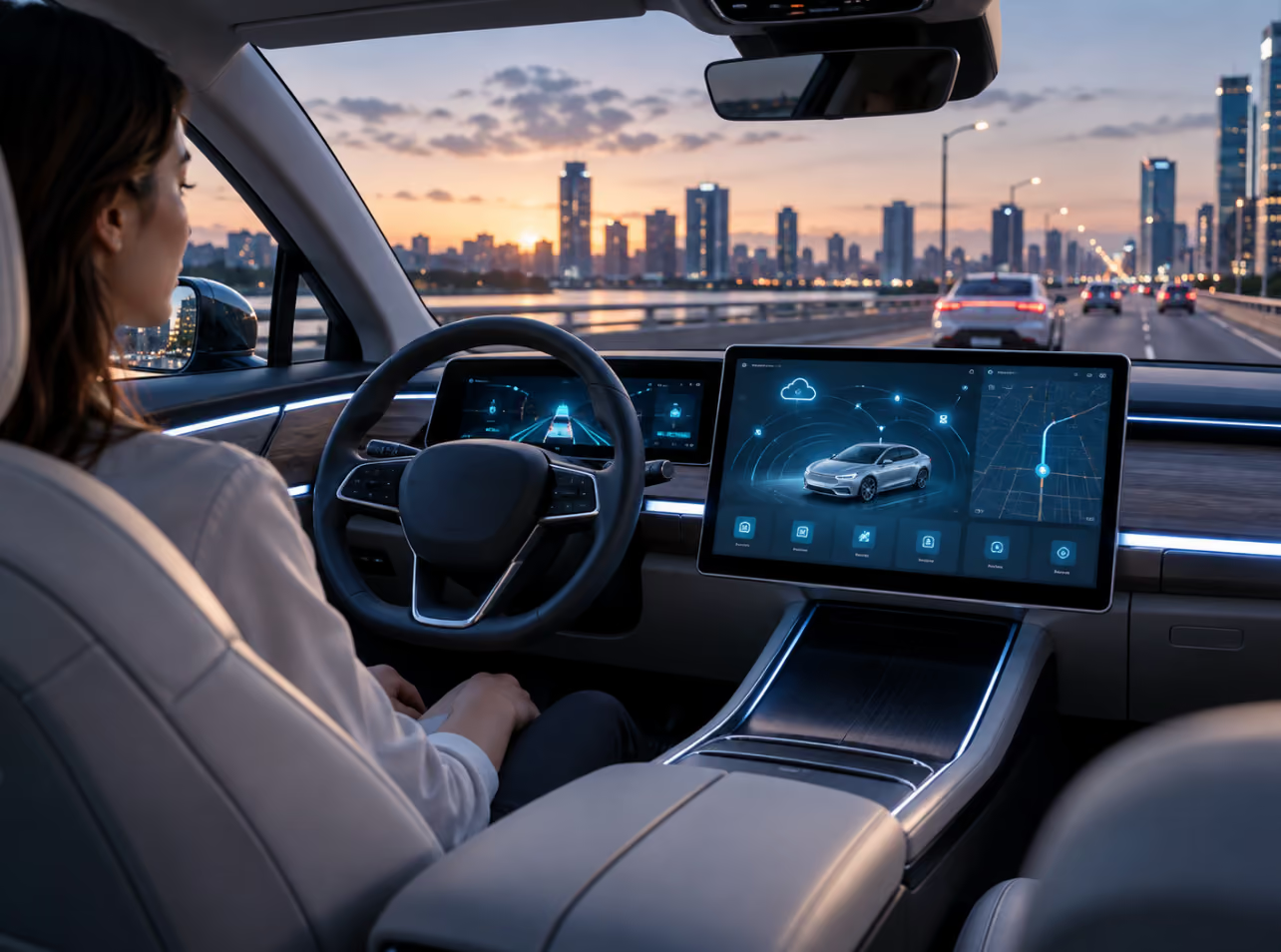
Rather than dozens of isolated electronic control units independently managing braking, lighting, entertainment and climate systems, next-generation vehicles are moving toward centralised or zonal computing architectures controlled by powerful onboard computers.
The IEA describes this as a fundamental shift toward the software-defined vehicle, with EV manufacturers helping pioneer architectures in which software determines an increasing proportion of vehicle functionality.
That means buying a car could increasingly resemble buying a smartphone.
The hardware might remain largely unchanged, while the digital experience evolves throughout ownership. Driving modes, entertainment services, connectivity, battery optimisation, navigation functions and advanced driver-assistance capabilities could potentially be added or upgraded years after the car leaves the factory.
This also creates something automakers have historically struggled to achieve: recurring revenue after the original vehicle sale.
Instead of earning primarily when a customer buys another car, manufacturers can potentially sell connectivity packages, autonomous-driving capabilities and other premium digital services through subscriptions or one-time software upgrades.
The commercial challenge will be convincing drivers that these features provide enough value to justify recurring payments.
Artificial intelligence makes this software transformation even more powerful.
AI can already help vehicles interpret camera, radar and other sensor data, optimise battery performance, calculate routes and support increasingly sophisticated driver-assistance systems. Behind the scenes, AI is also accelerating vehicle engineering, simulation, battery development, manufacturing and software testing.
Autonomous driving provides perhaps the most visible example.
In 2025, roughly half of new cars sold globally had Level 2 systems capable of controlling both steering and speed under certain conditions. A decade earlier, such technology appeared in less than 1% of new-car sales.
Fully autonomous Level 5 cars remain distant, but commercial Level 4 driverless taxi services are already operating in more than 20 cities worldwide, primarily in China and the United States. Significantly, the IEA reports that all commercially operating robotaxi services use electric vehicles.
That connection is not accidental. EV batteries provide the high-voltage electrical systems needed to support powerful chips, sensors and computers, while electric drivetrains allow highly precise digital control.
The EV and AI revolutions are increasingly reinforcing each other.
All of this changes how the industry may eventually define a "better car."
For decades, consumers compared horsepower, engine displacement, fuel economy and acceleration. Tomorrow's specifications could increasingly include computing capacity, charging architecture, battery chemistry, software support, autonomous-driving capability and energy-management intelligence.
The shift also introduces new vulnerabilities. Software-defined cars require more semiconductors and increasingly depend on complex digital supply chains. Connected vehicles introduce cybersecurity, privacy and data-governance risks that mechanical cars never faced at comparable scale.
Meanwhile, electrification itself will increasingly interact with the electricity system. Under existing policies, global EV electricity consumption could exceed 1,500 TWh by 2035 — roughly six times the 2025 level. Yet because global electricity consumption is also expanding, EVs would still represent only around 4% of total worldwide electricity demand in that year.
Managing when millions of vehicles charge could therefore become nearly as important as building the chargers themselves.
The first phase of the EV revolution was largely about proving that electric cars could compete with combustion vehicles. The next phase is considerably more disruptive.
A vehicle could soon be transportation while moving, an energy asset while parked, a software platform throughout its lifetime and an AI-powered computing system every second it operates.
That means the automotive industry's traditional boundaries are disappearing.
Automakers increasingly compete with technology companies for software engineers, with battery manufacturers for energy-storage expertise, with semiconductor companies for computing capacity and with utilities over how vehicles interact with electricity networks.
The remarkable statistic that more than 20 million electric cars were sold in a single year therefore tells only part of the story.
The bigger revolution is not simply that cars are becoming electric.
It is that the definition of a car itself is changing.
For questions or comments write to contactus@bostonbrandmedia.com



-v3.jpg)


-v3-02.jpg)