Stay informed with our newsletter.
.webp)


EN




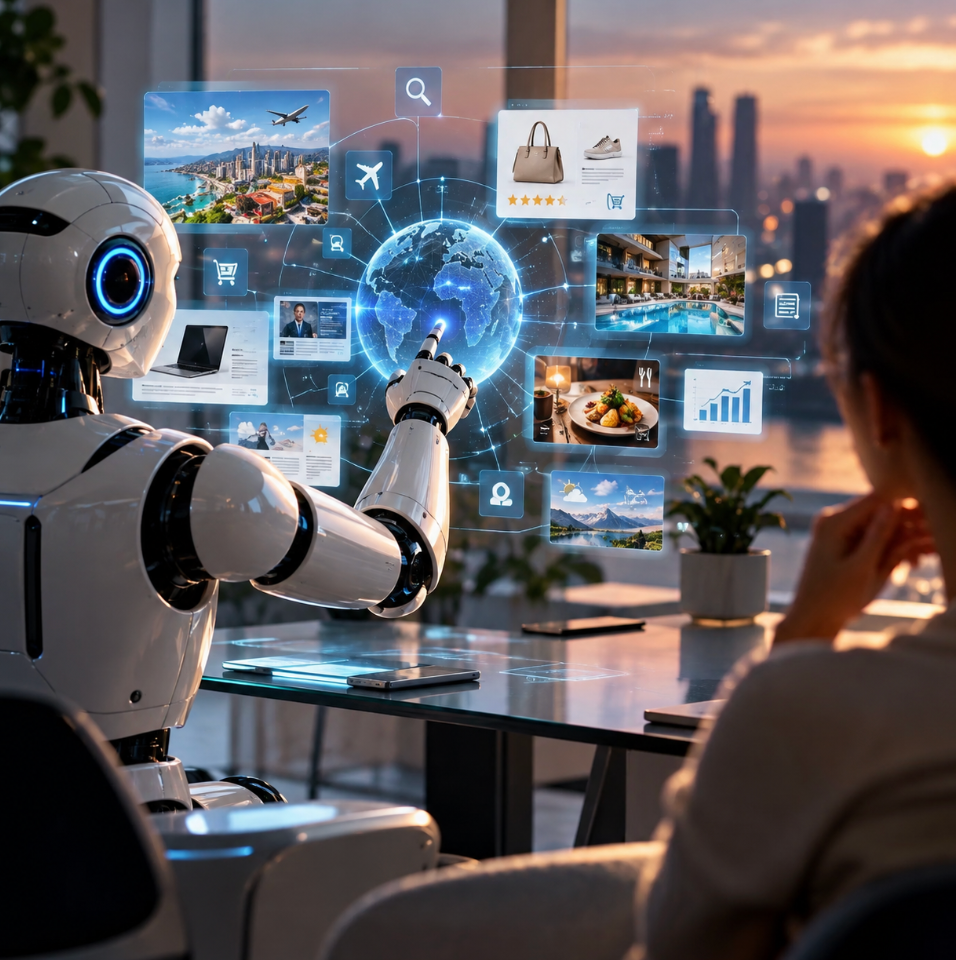
As AI agents become capable of searching, comparing, summarizing, shopping and transacting on behalf of users, the internet could shift from a human-browsed network to a machine-mediated ecosystem. This transformation may redefine Google Search, SEO, digital advertising, e-commerce, affiliate marketing, app stores and online publishing. Websites may increasingly serve as data sources for AI rather than destinations for people, forcing businesses to compete not only for human attention, but also for AI recommendations and decisions.
For three decades, the internet has been built around one basic assumption: humans visit websites. We search Google, open links, compare products, read reviews, scroll through articles, watch advertisements, download apps and eventually click “Buy.”
That assumption is beginning to break.
The next generation of the internet may still contain billions of websites, stores, apps and databases. But increasingly, humans may not be the ones visiting them. Instead, artificial-intelligence agents could search hundreds of sources, compare prices, summarize reviews, negotiate options, complete forms, make reservations and eventually conduct transactions on our behalf.
The internet would not disappear. What could disappear is the familiar ritual of browsing it ourselves.
And if that happens, some of the digital economy's most powerful institutions, Google Search, SEO, online advertising, e-commerce, affiliate marketing, app stores and digital publishing, may have to reinvent themselves.
The first stage of this transition is already happening.
Traditional search engines operated like enormous maps. You entered a query, Google showed you links, and you decided which roads to follow.
Generative AI changes that relationship. Instead of simply providing destinations, AI systems can read the destinations for you and construct an answer.
A 2025 Pew Research Center study tracking 68,879 Google searches found a striking behavioural difference. When users encountered an AI-generated summary, they clicked a traditional search result in just 8% of visits, compared with 15% when no AI summary appeared. Links directly cited inside the AI summary received clicks in only 1% of visits.
That is the beginning of what publishers sometimes call the zero-click internet: information is consumed without the user ever reaching its original website.
But AI is moving beyond answering questions.
Google said in May 2026 that its AI Mode had surpassed one billion monthly users, while introducing Search agents capable of continuously monitoring information across the web.
The progression is significant:
Search engine: “Here are ten websites.”
Answer engine: “Here is what those websites say.”
AI agent: “I researched the options, compared them and completed the task.”
The third stage could transform the internet far more profoundly than the first two.
Imagine planning a holiday in 2030.
Instead of opening 27 browser tabs, comparing airlines, checking hotel reviews, searching restaurant menus and opening weather websites, you might simply tell an agent:
“Plan a five-day trip to Tokyo under $3,000. Avoid overnight flights, find a highly rated hotel near a train station, book three restaurants and use my points wherever possible.”
Your AI could query airlines, hotels, maps, booking systems, loyalty programmes, restaurant platforms, travel publications and payment providers.
You receive the itinerary.
You may never see most of the websites involved.
This creates a strange possibility: the web becomes more important while websites become less visible.
Websites could increasingly function as machine-readable infrastructure — enormous repositories of prices, inventory, expertise, reviews, video, data and services that AI systems access on behalf of humans.
Cloudflare described this emerging environment in 2026 as an “Agentic Internet,” arguing that websites originally designed for human visitors are increasingly being accessed by machine agents instead.
Cloudflare Radar data covering much of 2026 illustrates how substantial automation already is. Approximately 58.7% of HTTP requests to HTML content worldwide were classified as bot traffic, compared with 41.3% human traffic in the measured period. That figure includes many types of legitimate and malicious bots, not simply AI agents, but it demonstrates how much of the modern web is already being accessed by machines.
For more than 20 years, companies have fought to appear on Google's first page.
Businesses hired SEO teams to optimise keywords, backlinks, page structures, loading speeds and content because ranking highly meant attracting human visitors.
But what happens when the visitor is an AI?
The objective may gradually change from ranking first for a human search to becoming a trusted source selected by an AI system.
SEO will not suddenly disappear. Google itself says established SEO principles remain relevant to AI Overviews and AI Mode. Its 2026 guidance emphasises original, useful, reliable and non-commodity content, along with structured information and strong technical foundations.
But another discipline is emerging beside SEO: sometimes called Generative Engine Optimisation, Answer Engine Optimisation or AI visibility optimisation.
The question becomes less “How do I make somebody click?” and increasingly “How do I become the source an AI trusts enough to cite, recommend or act upon?”
Authority, structured product data, original research, first-party information and verifiable expertise could become more valuable than simply producing enormous quantities of keyword-targeted articles.
The commercial web was largely built around attention.
A human visits a webpage. The page displays an advertisement. The publisher earns money. The advertiser gains exposure. Google and social platforms build enormous advertising businesses by connecting intent with attention.
But AI agents do not stare at banner ads.
If an agent scans 500 websites and returns one recommendation, 499 websites might contribute information without receiving a human impression.
That threatens one of the internet's foundational economic exchanges: content in return for traffic.
Cloudflare demonstrated the imbalance dramatically in 2025. It estimated that OpenAI's crawler made roughly 1,700 page requests for every referral it sent to websites, while Anthropic's ratio was around 73,000 to one, though Cloudflare noted that referral measurements may undercount traffic from native AI applications.
That economics cannot simply be mapped onto traditional display advertising.
Future advertising may therefore look less like banners competing for human eyeballs and more like brands competing to become eligible recommendations inside AI decision systems.
The most valuable advertising placement might eventually be the answer to: “Which one should I buy?”
Shopping is one of the clearest places where the transformation is already visible.
Adobe reported that traffic from generative-AI sources to U.S. retail websites grew 4,700% year over year in July 2025. Among surveyed consumers who had used AI for shopping, 73% described it as their primary source of product research.
By the 2025 holiday season, Adobe found AI-driven retail traffic rising 693% year over year, while visitors referred by AI converted 31% more frequently than other traffic sources during the period it measured.
Technology companies are already building infrastructure for the next step: allowing the agent to purchase.
In 2026 Google introduced Universal Cart, connecting shopping across Search and Gemini and building on the Universal Commerce Protocol for agent-assisted checkout. Google said its Shopping Graph contained more than 60 billion product listings.
Instead of visiting five retailers, humans could eventually tell an agent:
“Buy the best 55-inch television under $900 with strong reviews, free delivery and a warranty of at least three years.”
The AI becomes the shopper.
Retailers then compete not only for human loyalty but for machine recommendation.
Affiliate marketing depends heavily on a sequence of clicks: a publisher recommends something, a reader follows a link, a tracking system records the referral and commission is paid.
Agents complicate every step.
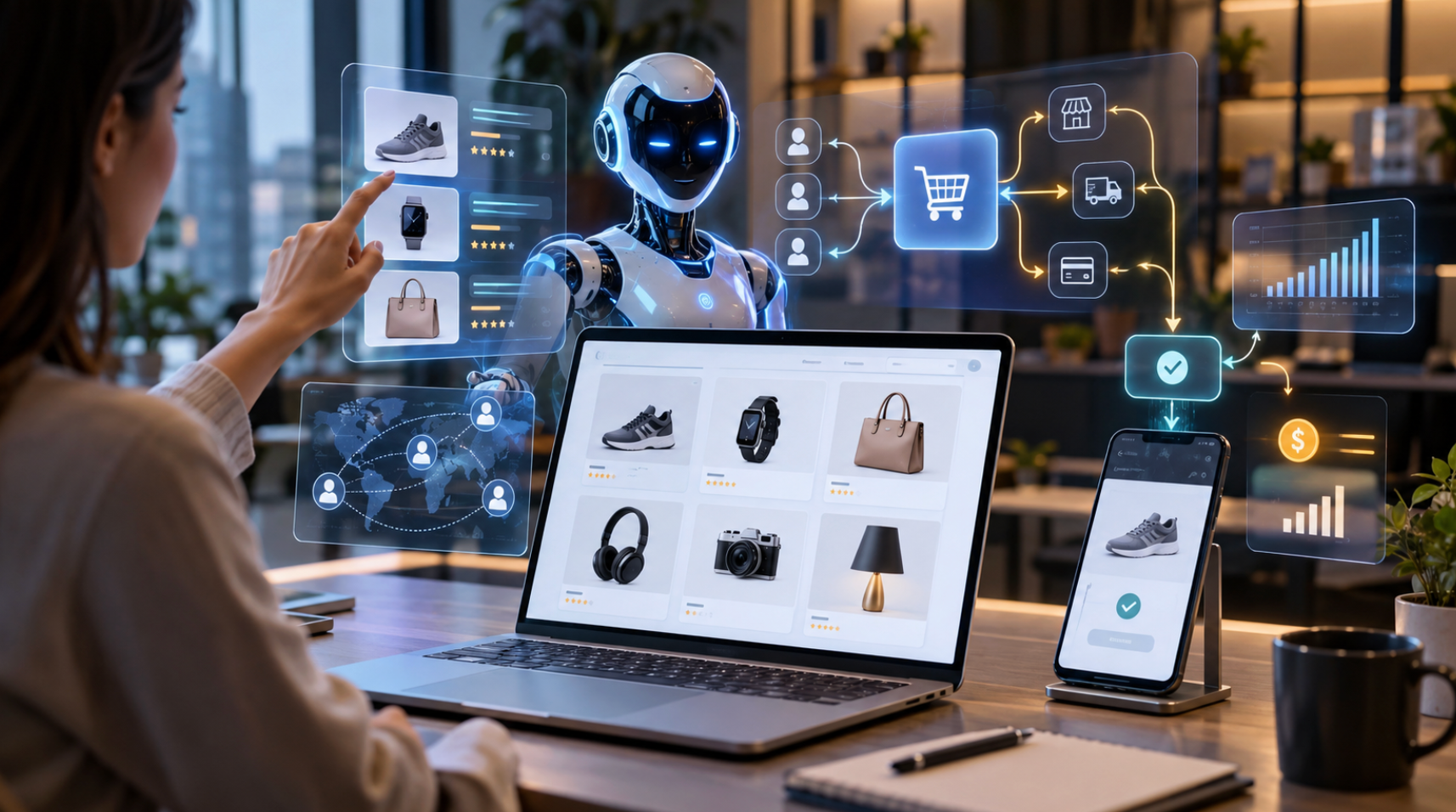
If an AI reads ten reviews, combines their conclusions and completes the transaction directly, who deserves the referral fee?
The publication that performed the original testing? The shopping platform? The AI provider? The merchant? All of them?
Entire attribution systems may need redesigning.
Instead of affiliate links designed for humans, the future may involve machine-readable commercial relationships, where agents automatically identify commissions, licensing terms and transaction fees.
The AI itself could become the world's largest affiliate intermediary.
The same principle extends beyond websites.
Today users open separate applications for banking, travel, food delivery, calendars, productivity, shopping and communication.
An AI agent could eventually interact with these services through APIs without requiring the user to open their interfaces at all.
Gartner estimates that as much as $234 billion in enterprise application software spending could be exposed to “agentic arbitrage” by 2030, as agents complete tasks across multiple systems and reduce the need for humans to interact directly with traditional software interfaces.
Apps may still exist underneath the experience.
Humans simply may not see them.
Perhaps no industry faces a more complicated transition than online publishing.
AI systems need high-quality human-created information to answer questions well. Yet if those answers eliminate the need to visit the original source, publishers lose traffic, subscriptions and advertising revenue.
That creates a paradox.
AI needs the web. But the economic model of the web depends on humans visiting it.
New models are already being explored: AI licensing agreements, paid crawler access, subscriptions, micropayments, machine-readable licensing rules and direct relationships between AI companies and publishers.
The future may reward information that cannot easily be commoditised: exclusive investigations, proprietary datasets, original interviews, specialist expertise, trusted communities and distinctive analysis.
Generic information becomes easy for machines to summarise.
Original information becomes valuable because machines cannot produce it without somebody discovering it first.
None of this means humans will stop browsing completely.
People still want entertainment, curiosity, community, design, personality and serendipity. We visit fashion sites not simply to obtain facts but to experience aesthetics. We read magazines because we enjoy voices and perspectives. We browse social platforms because we want to encounter other people.
The internet therefore may divide into two layers.
One will remain human-facing, immersive, social, emotional and creative.
The other will become increasingly machine-facing, structured, searchable, transactional and optimised for agents.
The biggest companies of the next internet may succeed at both.
The internet's first great revolution connected computers.
The second connected people.
The third connected businesses, creators and consumers through platforms.
The emerging fourth phase may connect AI agents to everything.
That would fundamentally change what it means to “go online.”
Instead of humans searching the internet, our agents may search it for us. Instead of comparing products, they may evaluate them. Instead of opening applications, they may operate them. Instead of navigating checkout pages, they may transact.
The browser will not necessarily disappear. Websites will not suddenly vanish. Search will not become irrelevant.
But the internet may gradually move backstage.
And when that happens, the most important question for every publisher, retailer, advertiser and technology company will no longer be:
“How do we attract people to our website?”
It may become:
“How do we make sure the machines acting for those people choose us?”
For questions or comments write to contactus@bostonbrandmedia.com



-v3.jpg)


-v3-02.jpg)