Stay informed with our newsletter.
.webp)


EN





Explore the fascinating world of weird and offbeat research, from ancient DNA solving a 12,000-year-old bone disorder mystery to new discoveries showing how exercise helps protect the brain from Alzheimer’s. Scientists are also questioning the fate of the cosmos, with studies suggesting the universe’s expansion might one day reverse. These surprising breakthroughs highlight how modern science continues to challenge assumptions and uncover astonishing truths about our past, our health, and the universe.
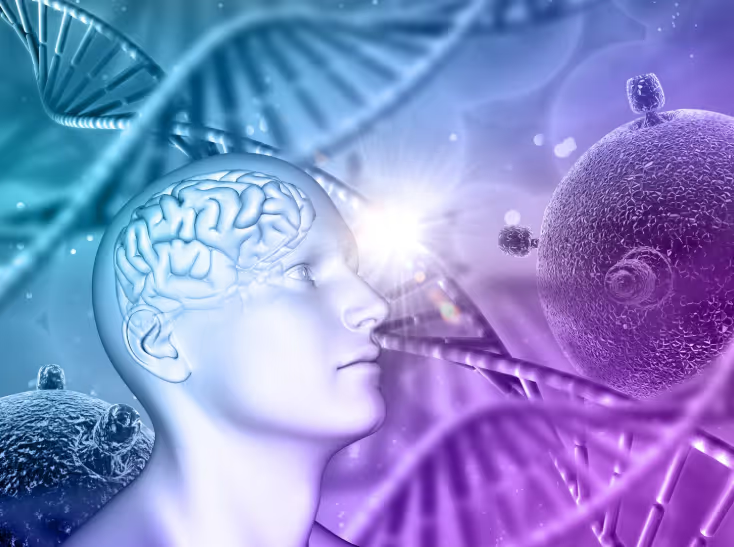
Science is often associated with serious laboratories, complex equations, and groundbreaking medical breakthroughs. But sometimes, the most fascinating discoveries are the ones that sound almost unbelievable. From solving a 12,000-year-old skeletal mystery to uncovering how exercise shields the brain from Alzheimer’s and even questioning whether the universe could one day reverse its expansion, researchers are venturing into truly weird and offbeat territory.
Here’s a closer look at some astonishing findings that are reshaping how we understand our past, our brains, and the cosmos itself.
For decades, archaeologists were puzzled by skeletal remains dating back roughly 12,000 years that showed unusual bone growths. These abnormal formations, discovered in prehistoric human remains, sparked intense debate. Were they signs of trauma? A rare disease? A genetic mutation? Or something entirely unknown?
Thanks to advances in ancient DNA analysis, scientists have now cracked the case.
By extracting and sequencing DNA from the remains, researchers identified genetic markers linked to a rare hereditary bone growth condition. The disorder, known today as multiple hereditary exostoses (MHE), causes benign bone tumors to develop along long bones during childhood and adolescence.
What makes this discovery extraordinary is not just the diagnosis, it’s the timeline. The presence of this condition in humans living 12,000 years ago proves that certain genetic disorders have been part of our species’ biological story far longer than previously documented.
Ancient DNA technology has revolutionized archaeology in recent years. Instead of relying solely on bone structure or burial context, scientists can now peer directly into the genetic blueprint of our ancestors. This breakthrough doesn’t just solve a historical puzzle, it humanizes the past. It reminds us that prehistoric individuals lived with health challenges, genetic variations, and physical conditions much like people do today.
In a way, this research collapses time. A diagnosis made possible by modern genomics has reached back millennia to tell the story of someone who lived in a world of stone tools and shifting climates.
If ancient DNA connects us to our past, neuroscience is helping protect our future, especially when it comes to cognitive health.
New research continues to reveal how physical exercise acts as a protective force against Alzheimer’s disease. Scientists have long observed that people who stay physically active tend to maintain better cognitive function as they age. But now, researchers are beginning to understand why.
Studies suggest that exercise stimulates the release of proteins and growth factors that strengthen neural connections. One key player is brain-derived neurotrophic factor (BDNF), often described as “fertilizer” for brain cells. BDNF supports the survival of existing neurons and encourages the growth of new ones particularly in the hippocampus, a region critical for memory and learning.
Regular physical activity also reduces inflammation and improves blood flow to the brain, delivering oxygen and nutrients that support long-term function. Some research indicates that exercise may help clear harmful protein buildups such as beta-amyloid plaques that are strongly associated with Alzheimer’s.
What’s especially compelling is that the protective benefits appear across various types of exercise. Whether it’s brisk walking, cycling, swimming, or strength training, movement itself seems to be the key ingredient.
The implications are profound. While there is currently no cure for Alzheimer’s, lifestyle choices may significantly influence risk. Something as simple as a daily walk could become one of the most powerful tools in safeguarding cognitive health.
This line of research may not sound “weird,” but it challenges a long-held perception that brain decline is inevitable. Instead, science suggests our brains are dynamic, adaptable, and deeply responsive to how we treat our bodies.
If the idea of ancient genetic disorders or brain-protecting workouts feels surprising, consider this: some studies now suggest that the universe’s expansion might not continue forever.
Since the late 1990s, astronomers have known that the universe is expanding and that this expansion is accelerating. The mysterious force driving this phenomenon is known as dark energy. For years, the dominant theory suggested the cosmos would continue expanding indefinitely, eventually leading to a cold, empty state sometimes referred to as the “Big Freeze.”
But new models and data analyses are raising alternative possibilities.
Some researchers propose that dark energy might not be constant. If its properties change over vast timescales, the expansion of the universe could slow down and potentially reverse. This hypothetical scenario is known as the “Big Crunch,” where cosmic expansion halts and gravity pulls everything back together.
While this idea remains speculative, it highlights how much we still don’t understand about the universe. The cosmos may not be on a one-way journey outward after all.
Even more intriguing is how scientific perspectives evolve. What was once considered nearly certain can shift with new observations and better instruments. Missions like the European Space Agency and the NASA continue gathering high-precision cosmological data that refine and sometimes challenge, our understanding of dark energy and cosmic fate.
The thought that the universe could one day contract instead of expand feels almost poetic. It suggests a cyclical rhythm to existence, expansion and collapse, birth and rebirth, echoing patterns seen in nature on much smaller scales.
What ties these discoveries together is not just their strangeness, but their reminder of science’s boundless curiosity.
Ancient DNA bridges thousands of years to solve medical mysteries. Neuroscience reveals how something as ordinary as exercise reshapes the brain’s resilience. Cosmology questions the ultimate destiny of everything we know.
Weird and offbeat research often begins at the edges of conventional thinking. It asks unusual questions. It challenges assumptions. And sometimes, it rewrites textbooks.
If there’s one consistent lesson from these astonishing findings, it’s this: the universe, from our bones to our brains to the cosmos itself, is far more dynamic, interconnected, and surprising than we imagine.
And science, relentlessly curious, continues to uncover its secrets.
For questions or comments write to contactus@bostonbrandmedia.com



-v3.jpg)


-v3-02.jpg)