Stay informed with our newsletter.
.webp)


EN





China’s Lunar New Year celebration turned futuristic when a humanoid robot dance performance captivated global audiences, generating an astonishing 23 billion views online. The viral showcase blended traditional festive elements with advanced robotics, highlighting rapid progress in artificial intelligence and motion technology. Broadcast during the iconic Spring Festival Gala, the performance sparked worldwide fascination, industry buzz, and conversations about the growing role of humanoid robots in entertainment and everyday life.
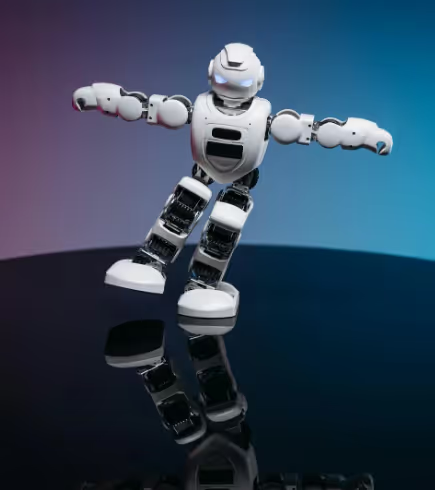
When audiences tuned in to China’s annual Spring Festival Gala this Lunar New Year, they expected dazzling lights, celebrity performances, and elaborate cultural showcases. What they did not expect was a group of humanoid robots stealing the spotlight and the internet. Within days, clips of the performance had amassed a staggering 23 billion views across Chinese and global social media platforms, transforming a festive stage act into a worldwide tech sensation.
The viral moment unfolded during the nationally broadcast Spring Festival Gala, hosted by China Central Television (CCTV). Known as the most-watched television program in the world, the gala is a staple of Lunar New Year celebrations, blending traditional music, comedy sketches, acrobatics, and dance. This year, however, technology took center stage in an unprecedented way.
The humanoid robots appeared dressed in festive attire, moving in near-perfect synchronization with professional human dancers. They executed complex choreography, spinning, stepping, bowing, and even performing martial-arts-inspired gestures, with remarkable balance and fluidity. For many viewers, it was difficult to believe they were watching machines.
The robots were developed by Unitree Robotics, a Hangzhou-based company known for pushing the boundaries of agile robotics. While the company had previously gained attention for its quadruped robot dogs and research prototypes, the Lunar New Year performance marked a turning point in public perception. These were not experimental lab machines; they were polished performers on a national stage.
Videos quickly flooded platforms like Douyin (China’s version of TikTok), Weibo, and international social networks. Hashtags related to the robot dance trended for days, and the view count, aggregated across replays, reposts, and livestream clips, surged past 23 billion. The spectacle sparked excitement, debate, and even a touch of unease about the accelerating pace of robotics.
Several factors contributed to the extraordinary virality of the performance.
First, timing. Lunar New Year is one of the most significant cultural events in China and across East Asia, symbolizing renewal, unity, and hope. Integrating advanced robotics into such a traditional celebration sent a powerful message: the future and the past can coexist. The imagery of cutting-edge humanoids dancing alongside human performers became a metaphor for technological harmony.
Second, accessibility. The dance was not framed as a technical demonstration but as entertainment. Viewers did not need engineering knowledge to appreciate it. The choreography was joyful and festive, making it widely shareable and instantly captivating.
Third, spectacle. Humanoid robots have long fascinated the public imagination, from science fiction films to research labs. Seeing them move with such precision in a live performance setting made abstract technological progress feel tangible. It was no longer about prototypes behind closed doors; it was about robots participating in cultural life.
Behind the seamless choreography lies a complex integration of artificial intelligence, motion control algorithms, high-precision actuators, and advanced sensors. Humanoid robots must constantly process real-time data to maintain balance and coordinate multi-joint movements. Even minor miscalculations can lead to instability.
Engineers reportedly spent months fine-tuning the robots’ gait and synchronization systems. Unlike industrial robots that operate in controlled factory settings, stage performers must adapt to lighting, sound vibrations, and spatial dynamics. The robots’ ability to move in harmony with music and human partners demonstrated significant advances in perception and control systems.
Experts note that such public showcases accelerate innovation cycles. When robotics companies move beyond research and into mass-viewed events, they attract investors, partnerships, and top engineering talent. Following the viral success, Unitree Robotics reportedly signaled plans to scale production, reflecting growing commercial interest in humanoid applications.
The reaction online ranged from enthusiastic admiration to philosophical reflection.
Many viewers expressed national pride, celebrating the performance as evidence of China’s technological leadership. Others were simply entertained, sharing clips with captions marveling at how “cute,” “cool,” or “unbelievable” the robots looked.
At the same time, some comments hinted at broader questions: What roles will humanoid robots play in society? Could they eventually work in service industries, eldercare, or hazardous environments? And how will humans adapt to increasingly lifelike machines?
Rather than fear, the dominant tone of the viral conversation was curiosity. The robots were presented not as replacements but as collaborators in celebration. That framing likely contributed to the overwhelmingly positive reception.
For decades, robotics demonstrations were primarily confined to trade expos, academic conferences, or industrial contexts. The Lunar New Year performance signaled a cultural shift. Robots are entering mainstream entertainment and doing so in a way that feels celebratory rather than clinical.
This evolution mirrors broader technological trends. Artificial intelligence tools are now embedded in smartphones, creative software, and everyday consumer products. Robotics, once seen as distant and industrial, is gradually becoming part of public life.
The gala performance served as a carefully choreographed introduction. Instead of showcasing robots assembling machinery or navigating obstacle courses, it showed them dancing, an inherently human art form tied to emotion and tradition.
The viral moment has implications beyond social media metrics. Humanoid robotics is a competitive and rapidly evolving sector, with companies worldwide racing to develop machines capable of operating in human-centric environments.
A high-profile demonstration at a global-scale event acts as a powerful marketing catalyst. It validates years of research and demonstrates reliability in front of millions of viewers. Investors often view such public successes as signals of maturity and readiness for commercialization.
Analysts suggest that viral exposure can accelerate adoption in sectors like hospitality, retail, and education, where interactive humanoids may soon assist customers or enhance learning experiences. While widespread deployment remains in early stages, public acceptance is a critical factor and the Lunar New Year performance appears to have boosted it significantly.
Beyond technology and economics, the imagery carried symbolic weight. Lunar New Year celebrates transformation and forward movement. Introducing humanoid robots into that narrative subtly reinforced themes of innovation and ambition.
The choreography itself blended traditional Chinese dance elements with futuristic aesthetics. The robots bowed respectfully, mirrored human gestures, and moved in geometric formations under vibrant red and gold stage lighting. The visual juxtaposition of silk costumes and metallic joints created a striking tableau.
For many viewers, the performance represented more than entertainment. It embodied a vision of the future, one where advanced machines enhance cultural expression rather than diminish it.
The 23 billion views are more than a viral statistic; they are a milestone in how society perceives humanoid robots. As robotics companies continue refining mobility, dexterity, and AI capabilities, public demonstrations will likely become more frequent and more sophisticated.
Future showcases may involve interactive performances, collaborative art, or even autonomous storytelling. The Lunar New Year dance could be remembered as the moment humanoid robots transitioned from laboratory curiosities to cultural participants.
While challenges remain, from technical limitations to ethical considerations, the overwhelming global response indicates that people are ready to engage with this new chapter of innovation.
In the end, the viral robot dance did something powerful. It turned cutting-edge engineering into shared joy. It invited billions of viewers to imagine a future where technology and tradition move together in rhythm, not in competition, but in harmony.
For questions or comments write to contactus@bostonbrandmedia.com



-v3.jpg)


-v3-02.jpg)