Stay informed with our newsletter.
.webp)


EN





Three major healthcare developments are reshaping medicine in 2026: a promising personalised mRNA cancer vaccine from Moderna and Merck, an escalating Ebola outbreak in the Democratic Republic of Congo, and the FDA’s approval of the first therapy for glycogen storage disease type Ia. Together, these stories highlight the rapid progress of medical innovation, the continuing threat of infectious diseases, and growing questions around treatment access, affordability, preparedness, and the future of global healthcare systems worldwide.
The global healthcare and pharmaceutical industry is witnessing a remarkable convergence of scientific breakthroughs, public-health emergencies and high-cost medical innovation. In August 2026 alone, three developments have captured international attention: Moderna and Merck’s personalised mRNA cancer vaccine achieved a major Phase 3 milestone, the Democratic Republic of Congo’s Ebola outbreak intensified into an unprecedented health emergency, and the U.S. Food and Drug Administration approved the first therapy for glycogen storage disease type Ia.
Together, these stories illustrate both sides of modern healthcare: extraordinary scientific progress and the persistent challenge of delivering effective treatment where it is needed most.
One of the biggest pharmaceutical breakthroughs of 2026 came from Moderna and Merck, whose personalised mRNA cancer vaccine, intismeran autogene, achieved positive results in a large late-stage study involving patients with high-risk melanoma.
The Phase 3 trial enrolled 1,137 patients with stage IIB to IV melanoma whose tumours had already been surgically removed. Patients received either Merck’s blockbuster immunotherapy Keytruda (pembrolizumab) alone or Keytruda combined with Moderna’s personalised mRNA vaccine. According to the companies, an interim analysis showed that the combination successfully met its primary goal of reducing cancer recurrence as well as a secondary goal of preventing the disease from spreading to other parts of the body.
The significance goes far beyond melanoma. It represents the first positive late-stage trial for an mRNA cancer vaccine, potentially validating an entirely new approach to treating cancer.
Unlike conventional vaccines designed to prevent infectious diseases, the Moderna-Merck therapy is created individually for each patient. Scientists analyse mutations found inside a patient’s tumour and develop a customised mRNA treatment that teaches the immune system to recognise those particular abnormalities.
In effect, the treatment attempts to turn the patient's own immune system into a precision cancer-fighting mechanism.
Earlier results had already generated optimism. Five-year follow-up from a mid-stage study showed the combination reduced the risk of recurrence or death by 49% compared with Keytruda alone. Importantly, the companies said the Phase 3 study has so far produced no new safety signals.
The potential commercial impact is also enormous. Analysts at Barclays have estimated the treatment could eventually generate approximately $3 billion annually from melanoma alone by 2035. Moderna and Merck are also studying personalised vaccines for lung, bladder, kidney, pancreatic and stomach cancers, while rivals such as BioNTech and Roche are developing competing cancer-vaccine technologies.
However, important questions remain. Complete Phase 3 data have not yet been published, and researchers still need to establish whether the treatment improves overall survival. Manufacturing individually tailored vaccines quickly and economically for potentially thousands of patients will also be a major challenge.
Nevertheless, the breakthrough raises an extraordinary possibility: the technologies originally propelled into mainstream medicine by COVID-19 vaccines may eventually help create personalised treatments for cancer.
While pharmaceutical innovation is creating new hope in cancer treatment, the Democratic Republic of Congo (DRC) is confronting an entirely different healthcare challenge.
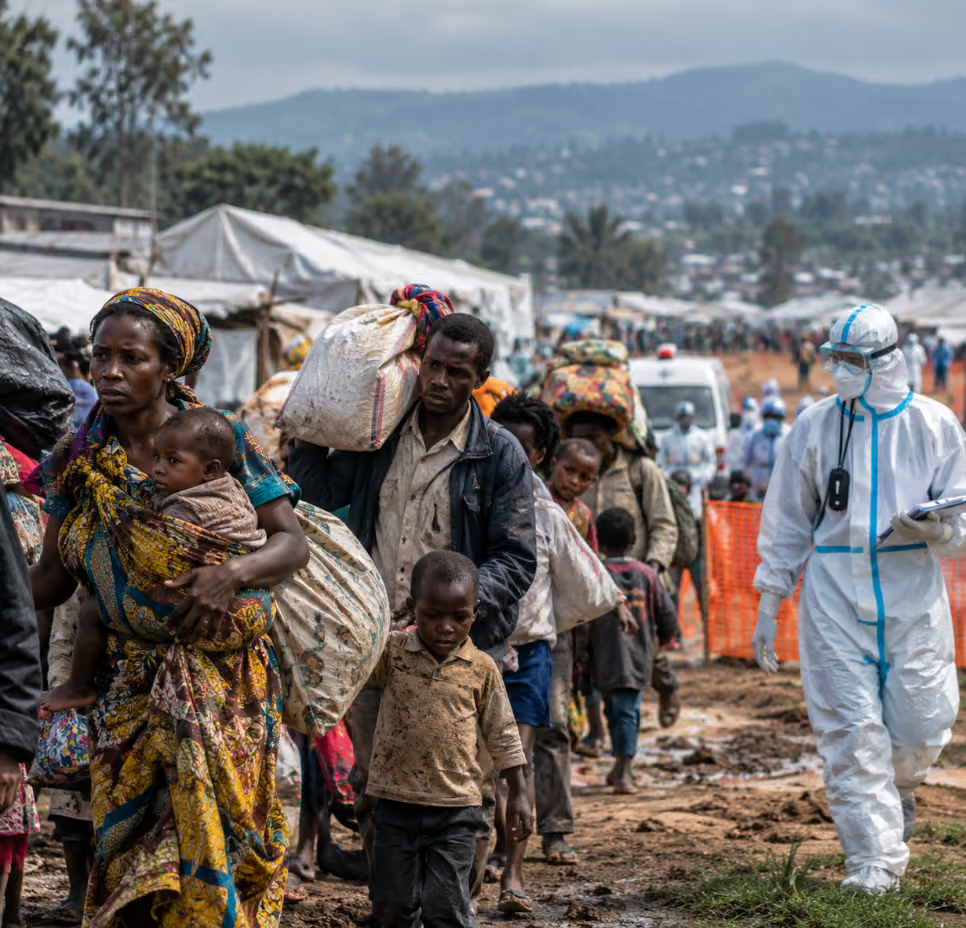
As of August 21, 2026, more than 2,500 people had died in Congo’s latest Ebola outbreak, according to a senior United Nations official. The epidemic has become the largest Ebola outbreak in the country's history by case numbers, overtaking Congo's devastating 2018–2020 outbreak.
The current epidemic is especially challenging because it is caused by the Bundibugyo species of Ebola virus. Unlike outbreaks caused by the more common Zaire Ebola virus, there is currently no vaccine or treatment specifically approved for Bundibugyo virus disease.
The outbreak has spread through an area reported to be larger than France, while decades of armed conflict, fragile healthcare infrastructure, community mistrust and funding shortages are complicating containment efforts. Around 160 healthcare workers had contracted Ebola and 43 had died, according to the UN coordinator cited by Reuters. More than 260 attacks on health workers had also been reported during the previous six months.
Amid the escalating crisis, international health authorities have approved the release of 70,000 doses of Merck’s Ervebo vaccine from the global Ebola vaccine stockpile.
The allocation is unusual and scientifically significant. Ervebo is licensed against Ebola virus disease caused by the Zaire species, not Bundibugyo. WHO and Africa CDC therefore announced that 20,000 doses will be used in a Phase 3 clinical trial to evaluate its impact against Bundibugyo virus, while 50,000 doses will be made available to frontline and healthcare workers under current expert recommendations.
The situation highlights a crucial lesson for global health: vaccines and treatments are only part of epidemic control. Surveillance, public trust, healthcare infrastructure, trained personnel, financing and rapid diagnosis can be equally decisive.
Congo's crisis is therefore not merely a national emergency. It is another test of the world's ability to respond quickly to dangerous infectious diseases before outbreaks become even harder to contain.
Another landmark development occurred on August 19, 2026, when the U.S. FDA granted accelerated approval to Genglycos (pariglasgene brecaparvovec-opnr) from Ultragenyx Pharmaceutical.
It became the first FDA-approved treatment for glycogen storage disease type Ia (GSDIa), also known as Von Gierke disease, for patients aged eight years and older.
GSDIa is an ultra-rare inherited disorder caused by deficiency of an enzyme called glucose-6-phosphatase (G6PC). Without the enzyme, the liver and kidneys cannot properly release stored glucose into the bloodstream. Patients can therefore experience dangerously low blood sugar if they go too long without eating.
Historically, managing the disease has required an extraordinary dietary routine involving frequent meals and regular consumption of uncooked or specially formulated cornstarch, including overnight, to maintain stable glucose levels.
Genglycos changes that approach by targeting the biological cause of the condition. The one-time AAV8-based gene therapy delivers a functional copy of the G6PC gene to liver cells, with the goal of enabling the body to better release stored glucose.
In a 48-week randomized, placebo-controlled trial, patients receiving Genglycos achieved an average 31% reduction in daily cornstarch intake, the study's primary endpoint. Because reduced cornstarch consumption is a surrogate marker rather than direct proof of long-term clinical benefit, Ultragenyx must continue collecting confirmatory safety and efficacy data.
The therapy also highlights another major issue facing modern medicine: affordability. Ultragenyx has set the U.S. list price at approximately $2.7 million per patient, placing Genglycos among the world's most expensive therapies.
These three developments capture the extraordinary transformation underway across healthcare. Personalised mRNA vaccines could redefine cancer treatment, gene therapy is beginning to address diseases that previously had no approved medicines, while the Ebola emergency demonstrates how quickly infectious disease can overwhelm communities where healthcare systems are fragile.
The defining healthcare challenge of the coming decade may therefore be more than discovering new treatments. It will be ensuring that scientific innovation, affordability, epidemic preparedness and equitable access advance together.
Medicine is becoming more precise, personalised and technologically sophisticated than ever before. But its greatest success will ultimately be measured not simply by what science can invent, but by how many lives those innovations can realistically reach and improve.
For questions or comments write to contactus@bostonbrandmedia.com



-v3.jpg)


-v3-02.jpg)