Stay informed with our newsletter.
.webp)


EN





Thousands of displaced people have fled an Ebola-affected camp in eastern Congo, intensifying concerns over disease containment and cross-border spread. The sudden movement has disrupted contact tracing, leaving hundreds of potentially exposed individuals unaccounted for. With the outbreak already affecting multiple provinces and thousands of people, health authorities face growing challenges from conflict, displacement, limited medical infrastructure and population movement, making rapid surveillance, testing and isolation increasingly critical to controlling further transmission.
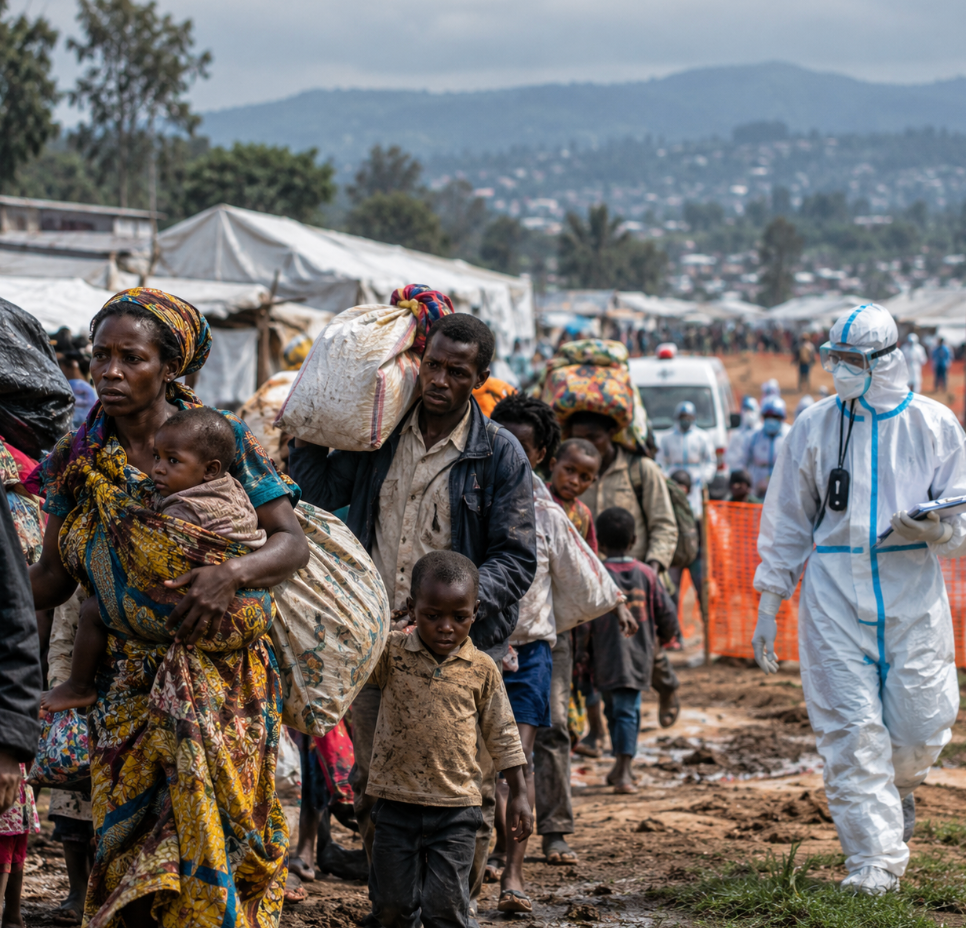
A dangerous new phase has emerged in the Democratic Republic of Congo’s escalating Ebola crisis. Thousands of people displaced by conflict have fled an Ebola-affected camp in eastern Congo, disrupting contact tracing and raising fears that infected or exposed individuals could carry the virus into surrounding communities.
The sudden exodus occurred at Kigonze camp in Ituri province, where roughly 19,000 displaced people had been living. Congolese and United Nations officials said security forces entered the camp searching for weapons, clashes followed, and residents fled during the final week of September. By October 1, the camp was reported to be essentially abandoned.
The development is particularly serious because health officials believe roughly 1,000 people considered Ebola contacts had been living in Kigonze. According to officials cited by Reuters, only about one-fifth of those individuals had subsequently been traced. The disappearance of hundreds of people who may have been exposed to the virus represents exactly the type of population movement that epidemiologists struggle to manage during an Ebola outbreak.
The flight from Kigonze comes during what has become the largest and deadliest Ebola outbreak in Congo’s history.
Government figures reported in late September showed that confirmed infections had exceeded 8,000 cases, with thousands of deaths. By October 1, Congolese government data cited in international reporting put the toll at approximately 8,224 confirmed cases and 3,982 deaths. The outbreak has overtaken Congo’s major 2018–2020 Ebola epidemic and is now second in overall scale only to the devastating 2014–2016 West African outbreak, which infected more than 28,000 people.
The current outbreak involves Bundibugyo virus, one of the viruses capable of causing Ebola disease. Unlike outbreaks involving the Zaire Ebola virus, for which licensed vaccines are available, the World Health Organization says there is currently no licensed vaccine or specific approved treatment for the Bundibugyo virus disease involved in this outbreak, although experimental candidates are being studied.
That difference makes traditional outbreak-control measures—including rapid diagnosis, isolation, contact tracing, infection prevention, safe burials and community cooperation—even more important.
Kigonze was already considered a highly vulnerable location.
Reuters reported in June that more than 30 people had died there in just over a month, with Ebola accounting for many of those deaths. Across Congolese displacement sites, the UN refugee agency has recorded at least 88 confirmed Ebola cases and 56 deaths, while warning that the real numbers are probably higher.
Displacement camps present exceptionally difficult conditions for controlling infectious disease. Large numbers of people may live close together with limited sanitation, scarce clean water and overstretched healthcare facilities. Residents may also move frequently between camps, markets, villages and relatives' homes.
The International Organization for Migration told Reuters that, although it did not have specific fatality statistics for Kigonze, Ebola cases in other displacement camps were experiencing a fatality rate of more than 80%, far above the roughly 50% average fatality level associated with the broader outbreak.
The crisis became still more complicated when an Ebola transit centre at Kigonze was burned down. Such centres are designed to isolate people suspected of infection, conduct testing and transfer confirmed patients for specialized treatment. Losing that infrastructure while thousands of residents simultaneously scatter across the region creates a major surveillance challenge.
The events at Kigonze expose a wider weakness in Congo’s outbreak response: authorities are struggling to keep track of people who have been exposed to confirmed Ebola patients.
In late September, Africa Centres for Disease Control and Prevention Director-General Jean Kaseya said roughly 30,000 potential contacts had been identified, when epidemiological expectations based on approximately 7,000 cases suggested that as many as 420,000 contacts might need to be followed.
Even more concerning, Africa CDC said more than 80% of newly detected Ebola cases were appearing among people who were not already registered as known contacts. That suggests substantial transmission is occurring outside established surveillance networks.
Effective contact tracing is one of the foundations of Ebola containment. When someone develops Ebola, health teams try to identify everyone who may have had close contact with that person, monitor them during the virus's incubation period and rapidly isolate anyone who develops symptoms.
When hundreds or thousands of people suddenly move without being registered, that chain can break.
The epidemic cannot be separated from eastern Congo’s wider humanitarian crisis.
Ituri, North Kivu and South Kivu are home to more than five million displaced people, many uprooted by years of armed conflict and insecurity. Ituri has become the province most severely affected by the current Ebola outbreak.
WHO reported on September 25 that Ebola had reached 63 health zones across seven of Congo’s 26 provinces, including Ituri, North Kivu, South Kivu, Bas-Uélé, Haut-Uélé, Tshopo and Sud Ubangi. The arrival of cases in Dungu health zone in Haut-Uélé, close to the South Sudan border, has increased concerns about possible cross-border transmission.
The relationship between insecurity and epidemics can become self-reinforcing. Violence forces communities to move. Population movement complicates disease surveillance. Fear and misinformation can reduce cooperation with medical teams. Meanwhile, health workers may find themselves unable to safely reach affected communities.
Those pressures are now converging at Kigonze.
Ebola does not spread as easily as airborne respiratory viruses. Transmission generally requires direct contact with the blood or other bodily fluids of an infected person, contaminated materials, or the body of someone who has died from Ebola. That means population movement alone does not automatically create new infections.
However, movement becomes dangerous when exposed people leave surveillance systems, develop symptoms elsewhere and have close contact with family members or caregivers before being diagnosed.
WHO had already warned that the outbreak was continuing to expand geographically, with its September assessment describing high levels of daily transmission and persistent difficulties in early case detection and access to care.
The Kigonze evacuation therefore represents more than the abandonment of a single camp. It illustrates how public health, displacement, security and regional mobility are becoming inseparable elements of Congo's Ebola emergency.
For health authorities, the immediate priority is now finding the missing contacts, restoring isolation and testing capacity, identifying where displaced residents have travelled and strengthening surveillance in surrounding communities.
With more than 8,000 infections, nearly 4,000 deaths and transmission spread across dozens of health zones, Congo’s Ebola emergency has already reached historic proportions. The dispersal of thousands of people from Kigonze shows why controlling the epidemic will depend not simply on medicine, but on whether public-health systems can continue functioning amid one of the world's most difficult humanitarian environments.
For questions or comments write to contactus@bostonbrandmedia.com



-v3.jpg)


-v3-02.jpg)