Stay informed with our newsletter.
.webp)


EN





Overnight trains offer a uniquely romantic way to travel, carrying passengers across borders, landscapes, and time zones while they sleep. Instead of losing hours in airports or on highways, travelers board in one city, settle into a cabin, and wake to a completely different destination. From Europe’s revived sleeper routes to legendary long-distance rail journeys, these trains combine transportation, comfort, nostalgia, and adventure, turning the simple act of getting somewhere into part of the experience.
This week’s travel stories move across very different worlds, from unusual rail journeys and bold desert design to sacred architecture and astronomy. Along the way, there are stories of innovation, adventure, cultural heritage, and destinations that continue to surprise even seasoned travelers.
Few ways of traveling feel as atmospheric as a sleeper train. There is something almost cinematic about boarding in one city, watching the landscape disappear outside the window, falling asleep to the rhythm of the tracks, and waking the next morning somewhere completely different.
For railway enthusiasts, overnight journeys can be found across six of the world’s seven continents, offering an extraordinary range of experiences. Some routes resemble luxury hotels on rails, carrying passengers toward globally famous landmarks such as Machu Picchu or the Taj Mahal, while others stretch across enormous countries and deliver scenery on a completely different scale.
In North America, long-distance trains crossing Canada and the United States are especially known for their dramatic viewing cars. Their expansive panoramic windows give travelers the chance to watch mountains, forests, plains, and distant horizons unfold from the comfort of the train.
The renewed interest in Anthony Bourdain has also brought attention back to one of his memorable rail journeys. During his travels through Russia in 2014, shortly before the Sochi Winter Olympics, Bourdain rode aboard the luxurious Grand Express between Moscow and St. Petersburg. The journey combined the romance of overnight rail travel with his distinctive curiosity about food, culture, and people.
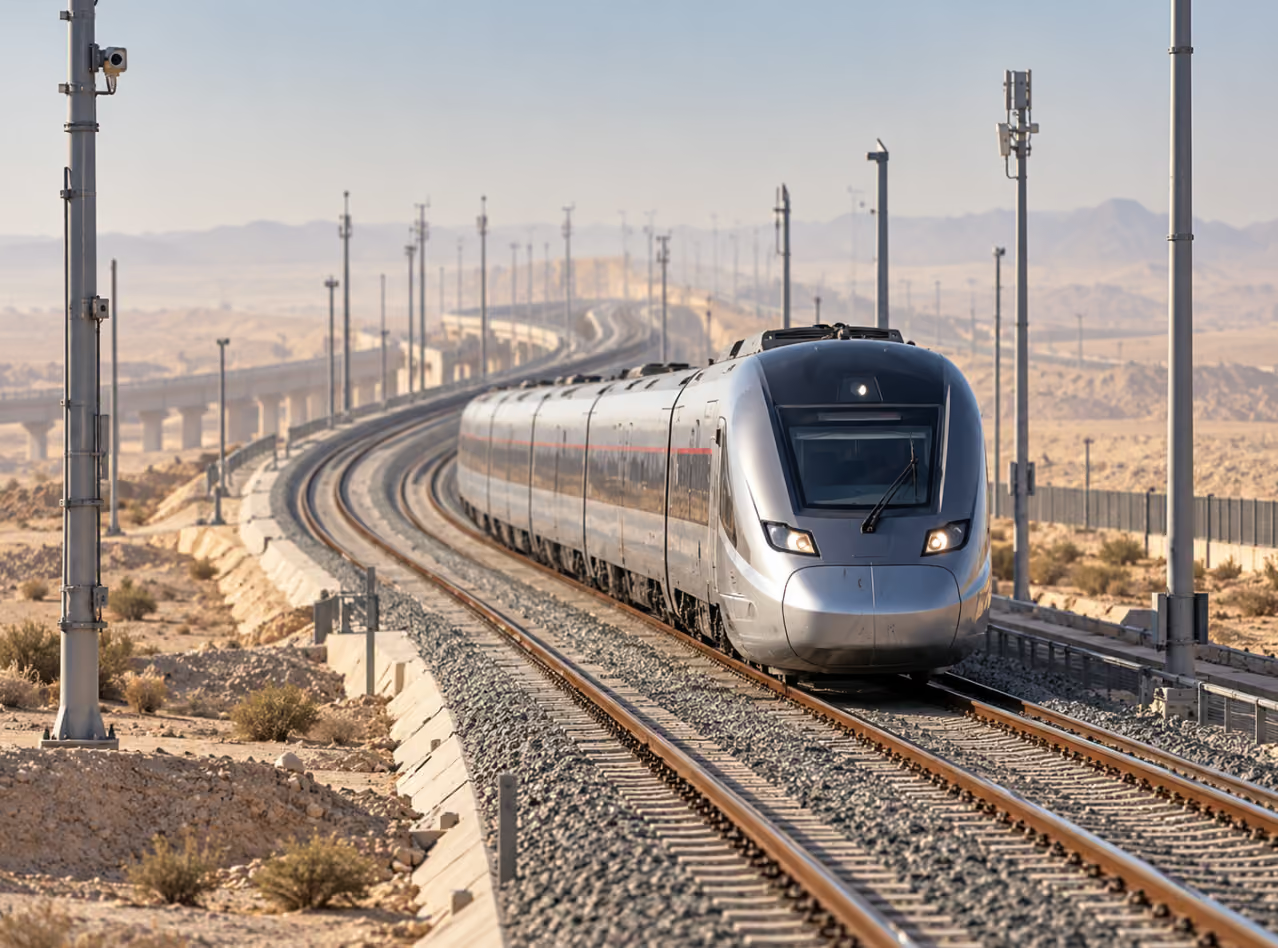
The United Arab Emirates has recently taken a major step in reshaping how people move around the country by launching its first national passenger rail network.
The new system represents an important milestone for a nation where private vehicles have traditionally dominated transportation. Once fully developed, the passenger network is expected to connect 11 cities, creating a faster and more integrated way to travel between major destinations.
Convincing residents to shift from cars to trains, however, requires more than building railway tracks. Planners must also solve the challenge of moving travelers efficiently between stations, homes, workplaces, hotels, and other destinations.
That challenge becomes especially important during the Gulf summer. Temperatures in the UAE can climb above 120°F, or around 49°C, making long outdoor walks between stations and final destinations impractical. Successful rail travel therefore depends heavily on convenient connections, reliable local transport, and climate-conscious infrastructure.
Farther south, the deserts of Namibia are inspiring a very different type of innovation.
A growing number of luxury properties are embracing what could be described as “invisible architecture.” Rather than dominating the landscape, these buildings are designed to visually disappear into their surroundings.
Earth-toned materials, low-profile structures, and carefully positioned rooms allow the properties to blend into Namibia’s vast desert environments. The result is a form of luxury based not on excess, but on privacy, isolation, and connection with nature.
In these remote settings, being difficult to locate has become part of the attraction. Exclusivity is no longer simply about expensive interiors or elaborate amenities; sometimes it means staying somewhere that feels almost completely removed from civilization.
At the Vatican Observatory, science and religion exist side by side in one of the world’s oldest astronomical research traditions.
The institution has been studying the universe for centuries and continues to contribute to modern scientific research. Among the subjects explored by its researchers are meteorites, planetary science, stars, and the possibility of extraterrestrial life.
Reverend Richard D’Souza and other scientists working with the observatory demonstrate how astronomical investigation can coexist with religious tradition. Their work represents a fascinating intersection between humanity’s spiritual questions and the scientific effort to understand the cosmos.
Another extraordinary religious landmark can be found in Istanbul, where the Sultan Ahmed Mosque, better known as the Blue Mosque, remains one of the city’s most recognizable architectural treasures.
Completed in the early 17th century, the mosque is celebrated for the more than 20,000 İznik tiles decorating its interior. Their distinctive blue tones create an atmosphere in which the ceiling and upper walls appear almost illuminated, giving visitors the impression of standing beneath an endlessly blue sky.
In the United States, Greenville, South Carolina, has emerged as one of the most compelling examples of urban reinvention.
At the heart of the city lies a dramatic waterfall that was hidden for nearly 40 years beneath a four-lane highway bridge. Removing that infrastructure required a bold vision of what downtown Greenville could become.
Today, the area has been transformed into an attractive public space supported by pedestrian routes, bicycle trails, restaurants, green areas, and cultural attractions.
Greenville’s revival is sometimes described as a “50-year overnight success story” because the city’s current popularity is the result of decades of planning, investment, and persistence.
Its transformation shows how cities can reclaim neglected natural features, redesign streets around people rather than traffic, and create public spaces capable of attracting residents, businesses, and visitors alike.
Across all these stories, one theme stands out: travel is increasingly about the experience between destinations, not simply arriving at them. Whether it is sleeping aboard a train, exploring disappearing desert architecture, studying the stars from the Vatican, or rediscovering a once-hidden waterfall, the world continues to offer unexpected ways of seeing familiar places differently.
For questions or comments write to contactus@bostonbrandmedia.com
Source: CNN



-v3.jpg)


-v3-02.jpg)