Stay informed with our newsletter.
.webp)


EN





AI agents are transforming marketing from reactive execution to intelligent orchestration. These systems analyze vast data, generate insights, automate decisions, and optimize customer journeys in real time. Instead of relying solely on dashboards and manual interpretation, organizations are deploying autonomous intelligence to drive personalization and performance. The shift marks a move from campaign-based thinking to system-level strategy, where AI agents continuously learn, adapt, and enhance customer engagement.

The marketing function is entering its most profound transformation in decades.
For years, artificial intelligence operated as an enhancement layer, generating content, analyzing campaign performance, optimizing media bids. It assisted human decision-making but rarely replaced it.
In 2026, that boundary is dissolving. AI is no longer merely producing outputs. It is beginning to make decisions.
Autonomous AI agents now monitor campaigns, reallocate budgets, adjust targeting parameters, personalize messaging, predict churn, and orchestrate customer journeys, often in real time, with minimal human intervention.
This shift marks the transition from AI as a tool to AI as an operational actor.
And it changes everything.
Automation follows rules.
Autonomous systems set and adapt rules.
Traditional marketing automation platforms required human configuration. AI agents, by contrast, ingest behavioral and contextual data, identify patterns dynamically, and modify decisions continuously.
The implications extend beyond efficiency.
When AI systems begin optimizing not just messaging but pricing, product bundling, and channel prioritization, marketing becomes an algorithmically adaptive ecosystem.
Brands are no longer managing campaigns.
They are managing decision systems.
This introduces a new competitive divide: organizations that architect AI-driven infrastructure versus those that layer AI onto legacy processes.
The shift is not limited to brands.
Consumers themselves are beginning to use AI agents for discovery and comparison. Digital assistants evaluate products based on structured data, reviews, delivery speed, sustainability indicators, and price fluctuations.
This raises a critical question:
Are brands optimizing for human buyers or algorithmic buyers?
When AI agents act on behalf of customers, persuasion alone is insufficient. Discoverability, structured data integrity, and verified credibility become equally important.
If AI becomes the filter, brand visibility depends on trust signals, not just creative appeal.
The battlefield is shifting from attention to architecture.
Recent developments illustrate how quickly autonomy is advancing:
• Major studios have pushed back against generative systems like Seedance 2.0, signaling tension between human creativity and AI production.
• Anthropic has embedded AI more deeply into enterprise workflows with Claude Cowork for Windows.
• Google has enhanced reasoning capabilities within Gemini’s Deep Think architecture, moving closer to advanced decision support.
• Spotify engineering teams increasingly rely on AI coding systems, accelerating development cycles.
The pattern is clear: AI is moving closer to core operations.
Marketing will not remain peripheral to this shift.
The organizations gaining measurable advantage are redesigning marketing architecture around AI-native systems.
This involves three structural shifts:
Unified data infrastructure
Clear governance models
Human–machine role redesign
Marketers must transition from operators to strategic supervisors of intelligent systems.
The most effective leaders are not asking, “Which AI tool should we buy?”
They are asking, “How should decisions flow across our organization?”
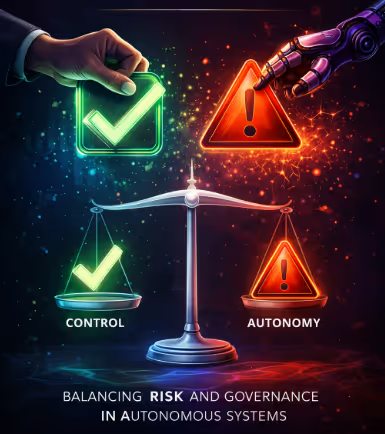
Autonomous systems introduce a paradox: greater efficiency often requires surrendering granular control.
For many organizations, this is uncomfortable.
Executives accustomed to manual oversight may resist delegating authority to probabilistic systems. Yet refusing this shift may create strategic lag.
The real risk is not automation. It is ungoverned automation.
Brands that deploy AI agents without ethical and structural guardrails face reputational and operational exposure.
In 2026, AI competence itself becomes part of brand credibility.
Earlier digital advantages were driven by scale, budget, and access. Today, those edges are flattening.
The differentiator is no longer tool access.
It is the ability to orchestrate them intelligently.
Brands that embed AI agents across acquisition, retention, pricing, and experience design will compound gains across the customer lifecycle.
Those that restrict AI to isolated experiments will see improvement but not transformation.
Instead of asking,
“How can AI improve our campaigns?”
Leaders must ask,
“How should our organization function in an AI-mediated marketplace?”
That includes confronting structural questions:
• Who owns the customer intelligence layer?
• How do we audit algorithmic decisions?
• Are we optimizing for short-term conversion or long-term brand equity?
These are not technical questions. They are governance decisions.
AI agents do not eliminate the human role. They elevate it.
Machines excel at optimization and scale. Humans remain essential for context, ethics, creativity, and judgment.
The most effective ecosystems combine:
AI-driven precision
Human strategic direction
Ethical oversight
Autonomy without values creates volatility.
Autonomy guided by principles creates advantage.
The rise of AI agents signals a restructuring of marketing itself.
Campaign cycles compress. Feedback loops accelerate. Expectations rise.
The brands that thrive will not experiment occasionally with AI.
They will redesign around it, deliberately.
Because in a marketplace where automation is accelerating and human expectations are rising, the ultimate advantage belongs to organizations that integrate intelligence systemically, while remaining deeply human in intent.
For questions or comments write to contactus@bostonbrandmedia.com



-v3.jpg)


-v3-02.jpg)