Stay informed with our newsletter.
.webp)


EN





Jamie Dimon, the CEO of JPMorgan Chase, has cautioned that the rapid rise of artificial intelligence could significantly disrupt the global workforce. He urged employees, businesses, and policymakers to prepare for major shifts in job roles as AI continues to transform industries. While the technology offers productivity gains and innovation, Dimon emphasized the need for workers to adapt, learn new skills, and stay ready for a future where automation and AI reshape many traditional jobs.
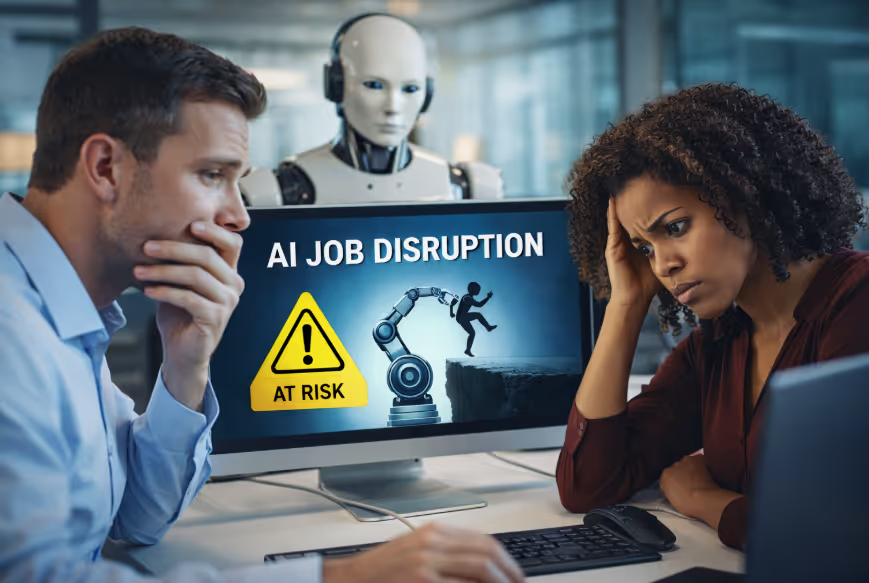
Jamie Dimon believes artificial intelligence is not a sudden revolution but a technology that steadily weaves itself into daily work and business operations. The chief executive of JPMorgan Chase has urged individuals and institutions to begin preparing immediately for the possibility that AI could reshape employment. Waiting until layoffs begin, he suggested, would be a mistake.
During an investor gathering, Dimon explained that planning for the impact of AI should start long before disruption becomes visible. He emphasized that he was not forecasting inevitable job losses. Still, he warned that if large-scale displacement does occur, the consequences could be significant. According to him, both governments and businesses must think ahead and design strategies to manage the potential societal impact of advanced technologies. Preparing early, he noted, would allow institutions to respond thoughtfully rather than react in crisis.
Within his own bank, AI is already transforming the way work is carried out. Dimon revealed that the company has developed its own large language model, now used by roughly 150,000 employees across the organization. Employees report that the tool is dramatically improving productivity, with many estimating that it saves them about four hours of work each day. Yet the bank does not treat those hours simply as a calculation for profit or cost reduction.
Instead of translating the time savings into financial metrics like net present value or immediately linking them to workforce cuts, the company views AI as an evolving productivity engine that improves how people work. Dimon explained that the benefits of technology are often difficult to quantify precisely. Like many digital innovations, AI becomes deeply embedded in operations, gradually reshaping efficiency, decision-making, and workflow.
He pointed out that measuring the real value of technology projects has always been challenging. From earlier eras of computing to modern digital infrastructure, breakthroughs tend to transform systems in ways that traditional accounting cannot easily capture. Reflecting on decades in finance, Dimon said technological change has repeatedly redefined entire industries. The shift from mainframe computers to servers and the dramatic increase in processing speed are examples of how innovation continuously rewrites the rules of business.
To illustrate the potential societal impact of AI, he highlighted the example of truck drivers in the United States. There are roughly two million people employed in that profession, making it one of the country’s largest occupational groups. If automation and advanced technologies were suddenly capable of replacing those drivers, the economic advantages could be significant. Transportation costs might fall, road safety could improve, and traffic congestion might ease.
However, the technological benefits would also raise a difficult social question: what happens to the millions of people whose livelihoods depend on those jobs? Dimon noted that many truck drivers earn around $120,000 annually. If those workers were displaced and forced into much lower-paying roles, perhaps earning only $25,000 a year, the financial shock could be devastating for families and communities.
Such a shift, he argued, would raise serious questions about fairness, stability, and how societies manage the transition during technological revolutions. Rather than halting innovation, Dimon believes the better solution is to introduce technological changes gradually. A slower, more deliberate rollout would give workers, governments, and companies time to adapt and build new opportunities.
This warning is not new from the veteran banker. Speaking earlier at the World Economic Forum Annual Meeting in Davos, Dimon cautioned that the pace of AI advancement could outstrip society’s ability to adjust if careful planning is not in place.
For questions or comments write to contactus@bostonbrandmedia.com
Source: NDTV



-v3.jpg)


-v3-02.jpg)