Stay informed with our newsletter.
.webp)


EN





The United Nations’ World Meteorological Organization warns there is now a 70% chance that global warming will temporarily breach the critical 1.5°C threshold before 2030. Driven by record greenhouse gas emissions and cyclical weather patterns, this acceleration places intense pressure on global leaders. To prevent this near-term spike from becoming permanent, humanity must aggressively slash emissions, overhaul energy grids, and invest heavily in climate adaptation during this decisive decade.
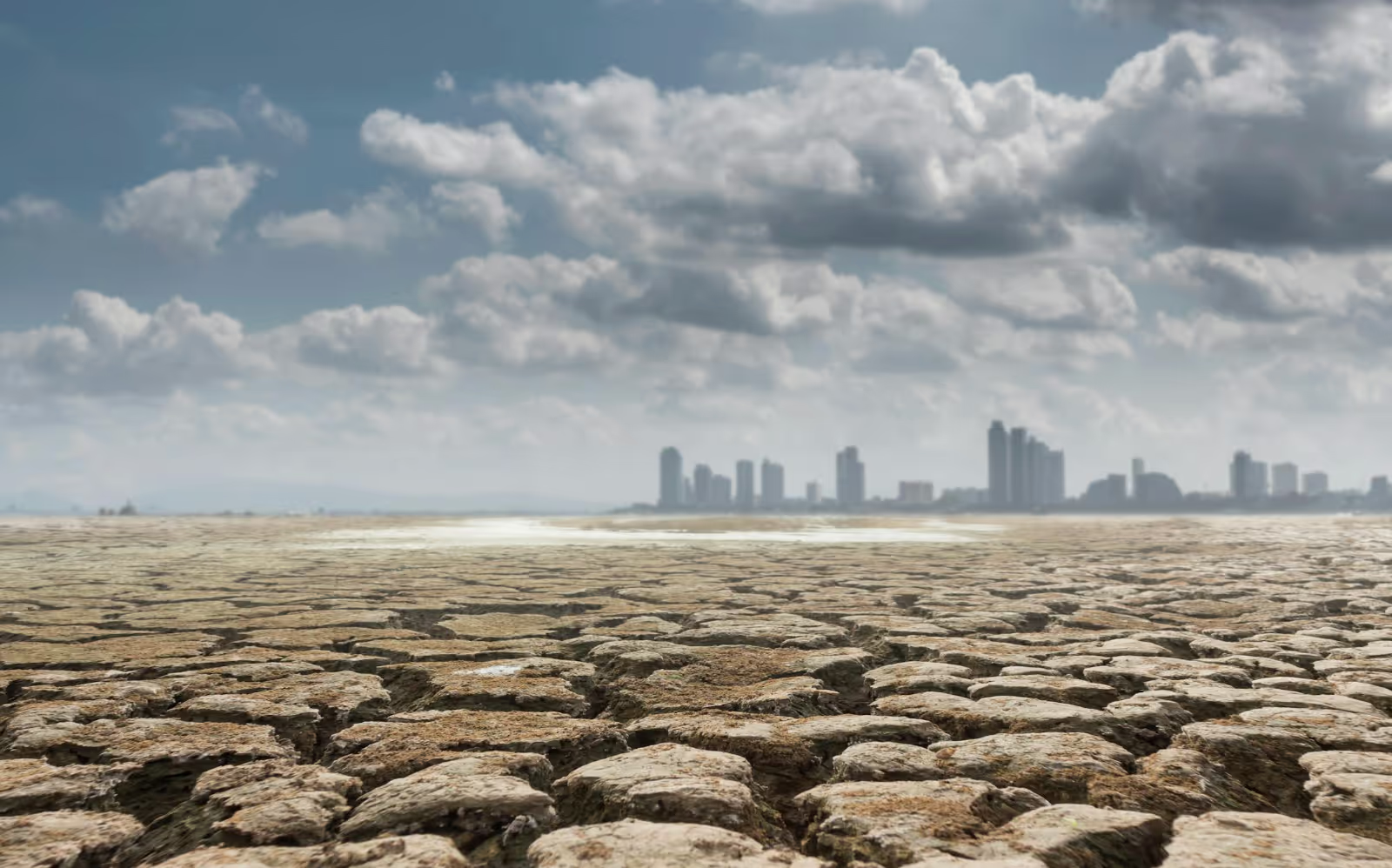
The 2015 Paris Agreement was hailed as a historic triumph of global diplomacy, anchoring humanity to a vital target: limit global warming to well below 2°C, and ideally, pursue efforts to cap the temperature rise at 1.5°C above pre-industrial levels. For years, this 1.5°C threshold was treated as a distant early warning marker for the mid-to-late 21st century.
However, a stark update from the United Nations’ World Meteorological Organization (WMO) has fundamentally altered that timeline. According to the WMO’s latest climate projections, there is now a staggering 70% to 75% chance that the five-year global average temperature will breach the 1.5°C international threshold before the end of the 2020s.
This revelation signals that we are no longer merely approaching the climate danger zone, we have crossed into it.
To fully comprehend the WMO’s warning, it is critical to separate short-term atmospheric volatility from long-term climatic shifts.
The WMO, alongside data compiled by the UK Meteorological Office, highlights two alarming near-term probabilities for the remaining years of this decade:
Important Distinction: Climatologists emphasize that a temporary breach over a single year or a five-year block does not mean the Paris Agreement has failed permanently. The international treaty defines a breach as a sustained, long-term temperature rise averaged over 20 to 30 years.
Nevertheless, transitioning from a "near-zero" chance of hitting this limit back in 2015 to a dominant probability today proves that global warming is accelerating at a terrifying velocity.
The rapid escalation of global temperatures throughout the mid-2020s is driven by a potent mix of anthropogenic emissions and cyclical natural phenomena.
The fundamental driver remains unchanged: human reliance on fossil fuels. Carbon dioxide ($CO_2$), methane ($CH_4$), and nitrous oxide ($N_2O$) concentrations in the atmosphere continue to break records annually. The Earth is trapping surplus energy at an unprecedented rate, with over 90% of that excess heat absorbed by our oceans, driving marine heatwaves and destabilizing global weather systems.
The natural warming phase of the tropical Pacific Ocean, known as El Niño, has acted as a turbocharger on top of human-caused warming. The strong El Niño cycle that peaked mid-decade triggered a multi-year streak of record-breaking months. Even as the planet transitions between El Niño and its cooling counterpart, La Niña, the baseline atmospheric temperature remains so elevated that natural cooling cycles can no longer reset the thermometer.
Many scientists are now actively researching whether global warming is entering an accelerated phase. Historically, global temperatures rose by roughly 0.2°C per decade. If current five-year projections hold true, the planet will have warmed by a quarter of a degree Celsius (0.25°C) in just ten years, lending significant weight to fears that climate feedback loops are speeding up the crisis.
Climate change is not a linear problem, nor is 1.5°C a "cliff edge" where everything suddenly breaks. Instead, every fraction of a degree introduces exponentially worse outcomes.
[+0.1°C Temperature Rise]
├──► Hyper-Intensified Heatwaves & Droughts
├──► Disrupted Agricultural & Food Price Shocks
└──► Exponential Acceleration of Polar Ice Melt
As climate scientist Friederike Otto from the Imperial College of London points out, sustained temperatures above 1.5°C will subject global populations to extreme weather events so severe that modern urban infrastructure, agricultural models, and civil planning are utterly unprepared to withstand them.
A warmer atmosphere holds more moisture, leading to a volatile cycle of prolonged, severe droughts followed by catastrophic, erratic rainfall. Major agricultural hubs across Europe, Asia, and North America are already witnessing diminished crop yields, triggering sudden food price shocks that disproportionately impact vulnerable nations.
The late 2020s have already given the world a preview of what a 1.5°C world looks like: uncontrollable wildfires consuming millions of hectares across hemispheres, severe droughts restricting shipping lanes in vital waterways, and lethal urban heatwaves crippling power grids.
The Arctic is warming more than three times faster than the global average. This rapid melting of glaciers and land-based ice sheets has caused global sea-level rise to nearly double, jumping from 2.1 mm per year in the late 1990s to an alarming 4.1 mm per year today.
The WMO’s data places immense pressure on world leaders, policymakers, and corporate entities. The 2020s were always designated as the decisive decade for climate action, but the window of opportunity is narrowing faster than anticipated.
To prevent a temporary breach from solidifying into a permanent climate catastrophe, global greenhouse gas emissions must be slashed by roughly 45% by 2030 compared to 2010 levels, with the ultimate goal of reaching net-zero carbon emissions by 2050. Currently, the Nationally Determined Contributions (NDCs) promised by governments fall drastically short of these targets.
Because a temporary overshoot of the 1.5°C threshold is now highly likely, global strategy must expand. Mitigation (reducing emissions) must be aggressively coupled with adaptation. This means reinventing building codes, engineering resilient power grids, investing in drought-resistant agriculture, and fortifying coastal defenses against an encroaching ocean.
The World Meteorological Organization’s warning that there is a 70% to 75% chance of breaching the 1.5°C threshold in the near term is a sobering reality check. It dismantles any lingering illusions that climate change is a problem for future generations.
The threshold is no longer a theoretical line in the sand, it is our current address. While a temporary overshoot may be inevitable, every tenth of a degree we can shave off through aggressive, immediate decarbonization will save lives, preserve biodiversity, and determine the stability of human civilization on this planet. The steering wheel is still in our hands, but we are running out of road.
For questions or comments write to contactus@bostonbrandmedia.com



-v3.jpg)


-v3-02.jpg)