Stay informed with our newsletter.
.webp)


EN





Despite escalating tensions and the reported closure of the Strait of Hormuz, Indian ships continue to navigate the crucial trade route without major disruption. The Indian government has reportedly activated a discreet contingency strategy involving naval coordination, alternative shipping protocols, and real-time monitoring to safeguard energy supplies and commercial cargo. Officials say the plan was prepared in advance to minimize risks to Indian vessels and ensure uninterrupted trade flows through one of the world’s most strategically sensitive maritime corridors.
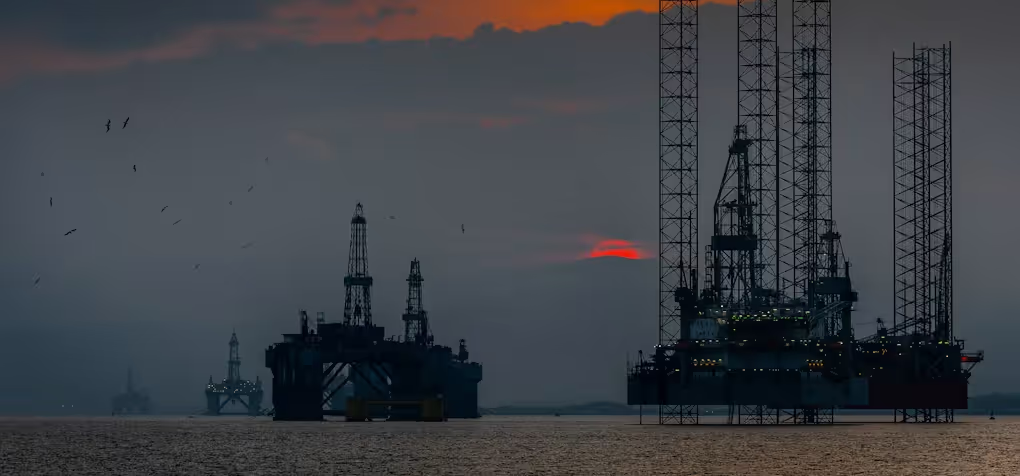
Even as tensions continue to disrupt maritime traffic in the Strait of Hormuz, several Indian-linked vessels have continued to move through the strategically vital waterway, helping India sustain energy supplies amid one of the region’s most volatile security crises in years.
The development is significant because Iran maintains a commanding geographic position over the narrow passage and has repeatedly targeted commercial shipping in retaliation for the U.S.-Israeli strikes on February 28 that sparked the conflict.
Since Iran formally entered the war, the Strait of Hormuz a narrow corridor between Iran and Oman that carries nearly 20% of the world’s oil and natural gas supplies has faced severe disruption. The instability has rattled global energy markets, driven up fuel prices and heightened concerns over broader economic fallout across Asia and other energy-dependent regions.
Although an April 9 ceasefire brought active fighting to a halt, maritime traffic through the Strait has remained heavily constrained, with many global shipping operators reducing or suspending transit through the area due to ongoing security risks.
Still, Indian vessels have continued navigating the route.
At an inter-ministerial briefing on Friday, Indian shipping officials offered a rare glimpse into how New Delhi has managed vessel movement through the conflict zone, though they declined to disclose operational specifics.
“In terms of how we coordinate with India, Iran, and how we decide the priority, I would not like to tell you for obvious reasons,” said Opesh Kumar Sharma, director of shipping at India’s Ministry of Ports. “We coordinate through the Ministry of External Affairs, and that is where we are.”
Sharma said ship movement priorities are determined in coordination with multiple ministries responsible for energy security and essential imports.
“The priorities are decided in coordination with the Ministry of Petroleum and Natural Gas, the Ministry of Fertilisers, and other agencies,” he said. “Based on those coordinated priorities, we try to move the ships accordingly.”
According to Indian officials, approximately 13 Indian-flagged vessels are currently operating in the Strait of Hormuz region. The fleet includes one LPG tanker, five crude oil tankers, one chemical or product tanker, three container ships, two bulk carriers and one dredger.
Among the Indian-linked vessels that have transited the Strait since February 28 are Shivalik, Nanda Devi, Jag Laadki, Pine Gas, Jag Vasant, BW Tyr, BW Elm and Green Sanvi.
Despite escalating risks, India remains among the countries maintaining relatively active shipping movement through the corridor.
Officials were also questioned about whether publicly accessible ship-tracking platforms could pose security risks during the ongoing crisis.
“These are commercial applications,” Sharma said. “People can subscribe to them, and the information is publicly available.”
Asked whether such data could be exploited, he acknowledged the challenge.
“Any public-domain data can potentially be used either way,” Sharma said. “It depends on the intention of the user. But at present, the data is helping us and the public track vessel movement.”
Ship traffic through Hormuz has slowed sharply since Iran’s retaliatory actions following the February 28 strikes, with several major international shipping firms avoiding the route altogether amid fears the conflict could reignite.
For questions or comments write to contactus@bostonbrandmedia.com
Source: NDTV



-v3.jpg)


-v3-02.jpg)