Stay informed with our newsletter.
.webp)


EN





JetZero’s blended-wing aircraft represent a major shift in aviation design, moving beyond the traditional tube-and-wing model used for decades. By merging the wings and fuselage into one aerodynamic structure, the aircraft could reduce fuel consumption, lower emissions, and improve operating efficiency. Backed by airline and military interest, the design signals how next-generation aircraft may help the aviation industry meet sustainability goals while reshaping passenger travel and future fleet planning.
The global aviation industry may be approaching one of its most significant design shifts in decades. For more than half a century, commercial aircraft have largely followed the same familiar formula: a cylindrical fuselage, two wings, underwing engines, and a tail. This “tube-and-wing” structure has powered modern air travel, from short domestic hops to long-haul international routes. But as airlines face rising fuel costs, tougher climate expectations, aircraft delivery delays, and pressure to modernize fleets, a new generation of aircraft designs is gaining momentum.
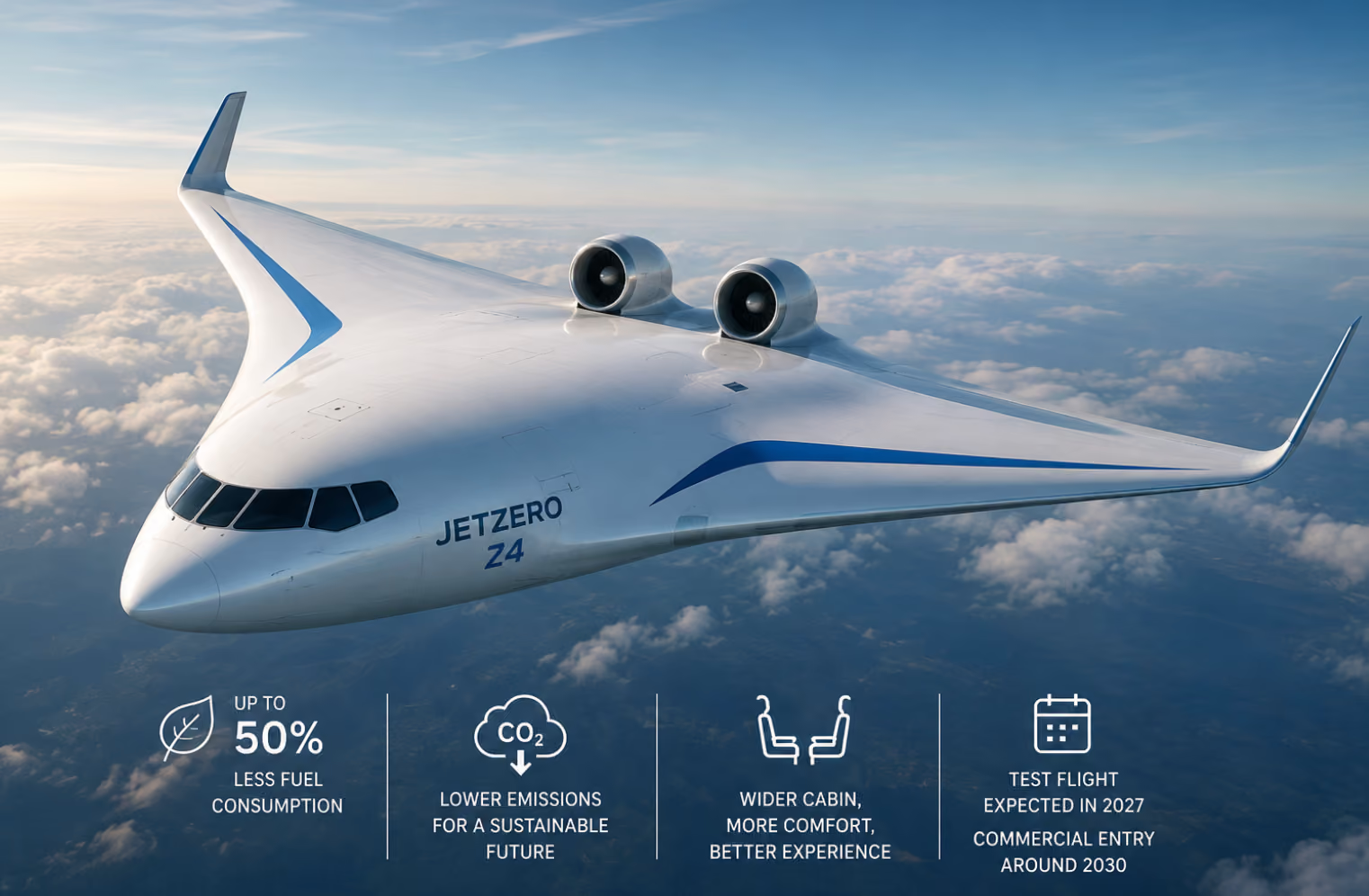
At the center of this shift is JetZero, a U.S.-based aerospace startup developing a full-size blended-wing body aircraft that could cut fuel consumption by up to 50%. Reuters reported that JetZero is building a full-size demonstrator in the Mojave Desert, with the aircraft targeting the 200–270 seat market, a segment historically served by aircraft such as the Boeing 757 and 767. The company’s Z4 aircraft has drawn support from United Airlines, Alaska Airlines, and the U.S. Air Force, placing it among the most closely watched clean-sheet aircraft concepts in commercial aviation today.
Unlike traditional aircraft, a blended-wing body merges the wings and fuselage into one continuous lifting surface. Instead of relying mainly on the wings to produce lift while the fuselage creates drag, the entire aircraft body contributes to lift. This gives the aircraft a wide, manta ray-like shape, improving aerodynamic efficiency and potentially reducing both fuel burn and emissions. JetZero says its low-drag, lightweight Z4 design could use up to 50% less fuel than today’s commercial jets.
The timing is critical. Airlines worldwide are under pressure to reduce operating costs while meeting long-term sustainability goals. IATA member airlines have committed to achieving net-zero carbon emissions by 2050, making fuel-efficient aircraft technology a major part of aviation’s future strategy. While sustainable aviation fuel, carbon offsets, and operational improvements are all part of the industry’s decarbonization roadmap, aircraft design itself remains one of the most powerful tools for reducing emissions at source.
JetZero’s progress is attracting attention because it offers a different path. Rather than depending entirely on future fuels or electric propulsion, the company is betting on aerodynamic efficiency. If an aircraft can carry the same number of passengers while burning far less fuel, the economics could be highly attractive for airlines. Lower fuel burn means lower emissions, lower operating costs, and greater resilience during periods of jet fuel price volatility.
The U.S. Air Force has played a major role in accelerating the project. In 2023, the Department of the Air Force selected JetZero to develop a blended-wing body aircraft prototype, with initial flight testing expected as early as 2027. The Air Force’s interest is not only commercial; the same design principles could support future military tankers, cargo aircraft, and long-range mobility platforms by improving range and fuel efficiency.
Airline backing has further strengthened JetZero’s credibility. United Airlines announced an investment in JetZero in 2025, with a path to purchase up to 200 aircraft, including an initial option for 100 aircraft and the possibility of an additional 100, depending on development milestones. United said the Z4’s design could improve passenger experience while reducing fuel burn per passenger mile by as much as 50% compared with similarly sized aircraft. Reuters also reported that United’s investment is tied to the successful flight of JetZero’s full-scale demonstrator by 2027.
Alaska Airlines has also invested in JetZero, with its agreement including options for future aircraft orders. The carrier has described the design as part of its broader interest in fuel-efficient aircraft and lower-emission operations. For airlines, the commercial logic is clear: aircraft that burn dramatically less fuel could reshape route economics, especially on medium- and long-haul routes where fuel is one of the largest cost components.
The passenger experience could also change. A blended-wing body aircraft creates a much wider cabin than conventional narrowbody or mid-market aircraft. This could allow for multiple aisles, different seating zones, faster boarding, larger overhead storage, and potentially more flexible cabin layouts. Instead of a long tube, passengers may enter a broader interior space that feels closer to a lounge or widebody cabin. However, this also creates new design questions around windows, seating orientation, emergency evacuation, airport compatibility, and passenger comfort.
Reuters reported that JetZero’s demonstrator is being built by Scaled Composites and will use the same Pratt & Whitney engines as the Boeing 757. The demonstrator will not be identical to a final passenger aircraft; only the cockpit will be pressurized. Still, a successful test flight would be a major milestone in proving that blended-wing aircraft can move from computer models and wind-tunnel concepts into practical aviation hardware.
The road ahead remains challenging. Commercial aviation is one of the most heavily regulated industries in the world, and any new aircraft design must pass years of testing, certification, safety validation, manufacturing planning, airline evaluation, and passenger acceptance. A blended-wing body is not simply a new aircraft model; it is a new architecture. Regulators, airports, airlines, pilots, maintenance teams, and passengers will all need confidence in how it performs.
Certification could be especially complex because current standards are built around conventional aircraft layouts. Questions around emergency exits, evacuation times, cabin pressurization, structural design, airport gates, cargo handling, and pilot training will need detailed answers. Manufacturing scale is another hurdle. Airbus and Boeing have decades of production experience, global supplier networks, and deep relationships with airlines. JetZero will need major funding, industrial partners, and flawless execution to compete at scale.
Even so, the momentum behind JetZero reflects a larger truth: aviation cannot rely on yesterday’s aircraft designs to solve tomorrow’s challenges. The industry is already dealing with aircraft shortages, delayed deliveries, rising demand, volatile fuel costs, and pressure to decarbonize. A successful blended-wing aircraft could become one of the most important aviation breakthroughs since the jet age.
For now, JetZero is still a bold bet, not a guaranteed revolution. But the combination of U.S. Air Force funding, United Airlines’ investment, Alaska Airlines’ backing, and a targeted 2027 test flight gives the project real weight. If the Z4 can deliver even close to its promised efficiency gains, it could reshape airline fleet planning and challenge the dominance of traditional aircraft design.
The future of flight may not look like the aircraft passengers know today. It may be wider, smoother, quieter, and far more efficient. As next-generation aircraft designs gain momentum, JetZero’s blended-wing body concept is sending a clear message to the aviation world: the next big leap in air travel may come not from flying faster, but from flying smarter, cleaner, and more efficiently.
For questions or comments write to contactus@bostonbrandmedia.com



-v3.jpg)


-v3-02.jpg)