Stay informed with our newsletter.
.webp)


EN





International student mobility is entering a more regulated era as governments balance the economic value of global education with concerns over migration, housing, visa integrity and institutional capacity. Countries including Australia, Canada and the UK are tightening rules, while universities remain dependent on international enrolments and tuition revenue. The trend signals a shift from rapid expansion toward sustainable student recruitment, stronger oversight and policies focused on long-term value, welfare and national priorities for global education.
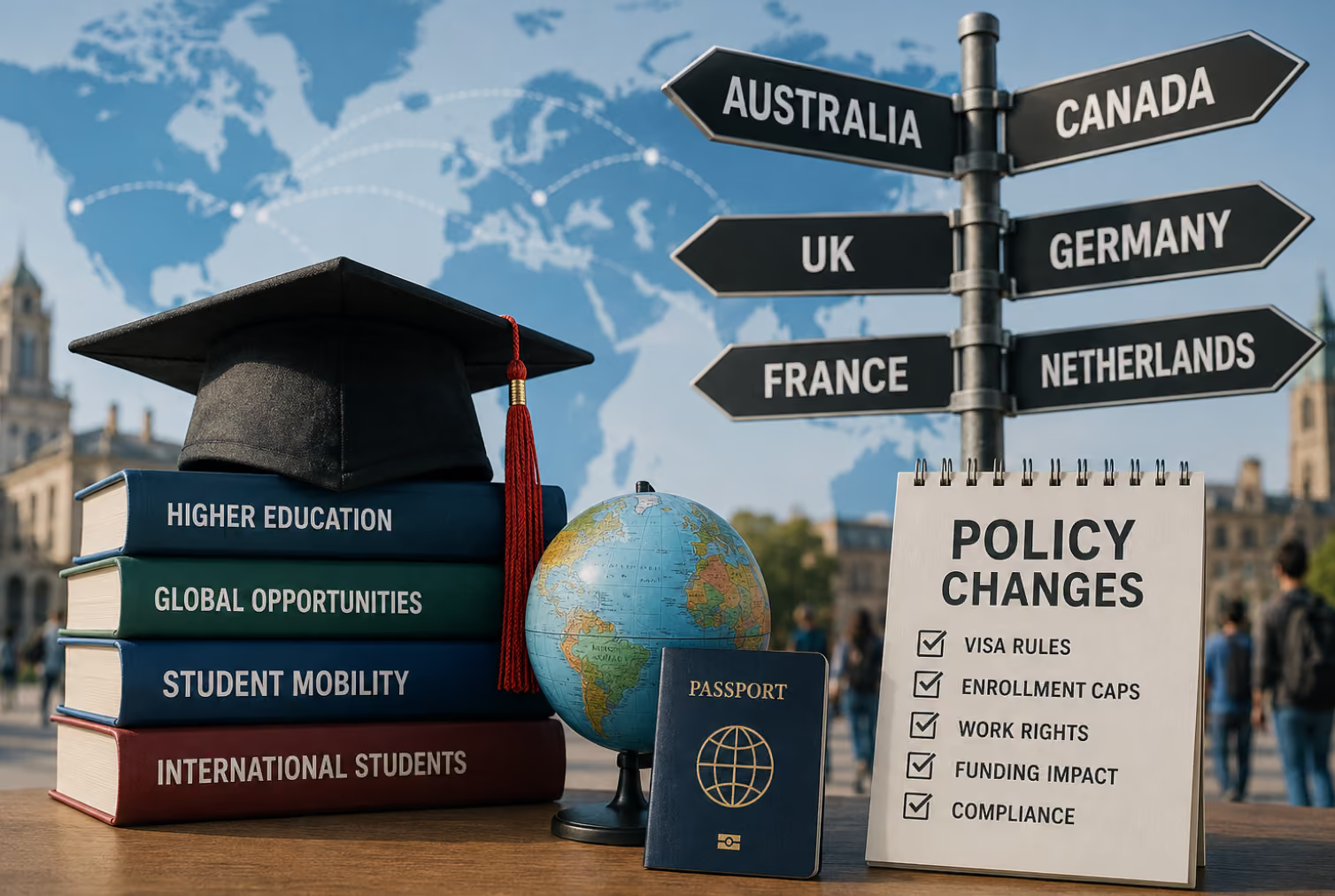
International student mobility, once seen as one of the most reliable engines of higher education growth, is entering a more complex and politically sensitive phase. Across major study destinations, governments are trying to balance the economic value of international students with rising domestic concerns over migration levels, housing pressure, visa integrity, institutional capacity, and the long-term sustainability of higher education funding.
The shift is particularly visible in Australia, where the government has maintained its 2027 international student National Planning Level at 295,000. The decision provides some certainty for universities and education providers, but it also confirms a broader message now shaping the global education industry: the era of unchecked international student growth is being replaced by a more managed, regulated, and politically scrutinized model. Australia’s 2027 planning level remains unchanged after the government said international student commencements were tracking below the limit, with no active provider set to receive a lower allocation in 2027 than in 2026.
For universities, this matters because international students are no longer just a cultural or academic asset; they are a major part of the financial structure of higher education. The OECD’s 2026 report on International Students in Higher Education notes that countries such as Australia, Canada, France, Germany, the Netherlands, and the United Kingdom recorded strong international enrolment growth over the past decade. These students contributed to enrolment expansion, shaped campus life, and, in some countries, became deeply linked to institutional finances.
Australia shows the scale of this dependence clearly. According to Australian government data, international education was worth A$53.6 billion to the Australian economy in the 2024–25 financial year, including A$29.9 billion in goods and services and A$23.5 billion in tuition fees. Higher education alone accounted for A$38.75 billion of education export income. This makes international education not only a university issue, but also a national economic priority linked to jobs, local businesses, research funding, tourism, accommodation, and global soft power.
Yet the same growth has created pressure points. In Australia, the government has said the 295,000 planning level is designed to deliver stability and certainty while keeping the sector sustainable. Government figures cited in recent reporting show international student commencements were 8% lower than the same period in 2025 and 13% below 2019 levels, while the planning level remains 8% below the immediate post-COVID peak. The message is clear: Australia still wants international students, but it wants growth to be aligned with national priorities, housing capacity, regional education goals, and institutional accountability.
The policy environment has also become more expensive for students. Australia recently increased student and temporary graduate visa fees by 25%, lifting the subclass 500 student visa fee to A$2,500. This adds another layer of pressure for prospective students who are already weighing tuition fees, living costs, accommodation shortages, exchange-rate volatility, and post-study work opportunities. In a highly competitive global market, even small changes in visa cost or processing certainty can influence whether students choose Australia, Canada, the UK, Germany, France, the Netherlands, or emerging education destinations in Asia and the Middle East.
Australia is not alone. Canada has also moved toward a more controlled system. For 2026, Immigration, Refugees and Citizenship Canada announced 309,670 study permit application spaces under the cap for students requiring provincial or territorial attestation letters. Within that framework, up to 180,000 study permits are expected to be issued to applicants in the PAL/TAL-required cohort. Canada’s policy shift reflects similar concerns: rapid enrolment growth, pressure on housing, student support quality, and the need to ensure that international education serves both students and national economic goals.
In the United Kingdom, policy pressure has taken a different form. The UK remains one of the world’s most international higher education markets, with Universities UK noting that 732,285 international students are studying in the country. However, the government has explored a levy on university income from international student tuition fees, with a White Paper technical annex using 6% as a model for assessing impact. Although the proposal is not yet finalized, it signals a wider political debate over how much universities should rely on international tuition revenue and how that income should be reinvested into the broader skills system.
Meanwhile, the Netherlands illustrates how quickly internationalization policy can shift with political change. After years of pressure to reduce English-taught programs and limit international enrolments, a new coalition government has reversed some proposed cuts and announced €1.5 billion in investment for education and science. This came after international enrolments at Dutch universities reportedly declined for three consecutive years, including a 5% fall in 2024–25. The Dutch case shows that policy pressure does not always move in one direction; governments may tighten, pause, reverse, or recalibrate depending on labour-market needs, public sentiment, and economic priorities.
The OECD frames this global moment as a transition from pure recruitment toward sustainability and balance. Its 2026 overview highlights that political and social pressures, including recruitment integrity, low stay rates, housing pressures, capacity constraints, and reliance on international tuition fees—have pushed countries such as Australia, Canada, the Netherlands, and the UK to tighten policy settings. At the same time, France and Germany continue to pursue strategies to attract and retain more international students.
For students, the consequences are practical and immediate. They face more documentation, higher costs, stricter visa scrutiny, and greater uncertainty around post-study work. For universities, the challenge is strategic. Institutions must diversify revenue, invest in student support, strengthen recruitment ethics, improve housing partnerships, and prove that international enrolment growth benefits both students and local communities.
The bigger story is not that international student mobility is declining. It is that mobility is becoming more selective, more regulated, and more closely tied to national interest. Students will continue to cross borders in search of better education, career pathways, and global exposure. But the destinations that succeed in this new era will be those that combine quality education, transparent visa systems, affordable living conditions, career pathways, and a credible promise of student welfare.
For the global education industry, 2026 marks a turning point. International student mobility remains one of the most powerful forces in higher education, but its future will be shaped less by volume alone and more by trust, capacity, policy stability, and long-term value creation.
For questions or comments write to contactus@bostonbrandmedia.com



-v3.jpg)


-v3-02.jpg)