Stay informed with our newsletter.
.webp)


EN





A network of nomadic tent camps is transforming access to the remote “Mountains of Heaven,” giving hikers a practical way to explore Kyrgyzstan’s dramatic high-altitude landscapes. By offering shelter, meals, local guidance, and cultural encounters along isolated routes, these camps connect adventure tourism with traditional nomadic life. The model is opening once-inaccessible valleys to international trekkers while creating income for rural communities and helping preserve the region’s distinctive heritage and hospitality for future generations too.
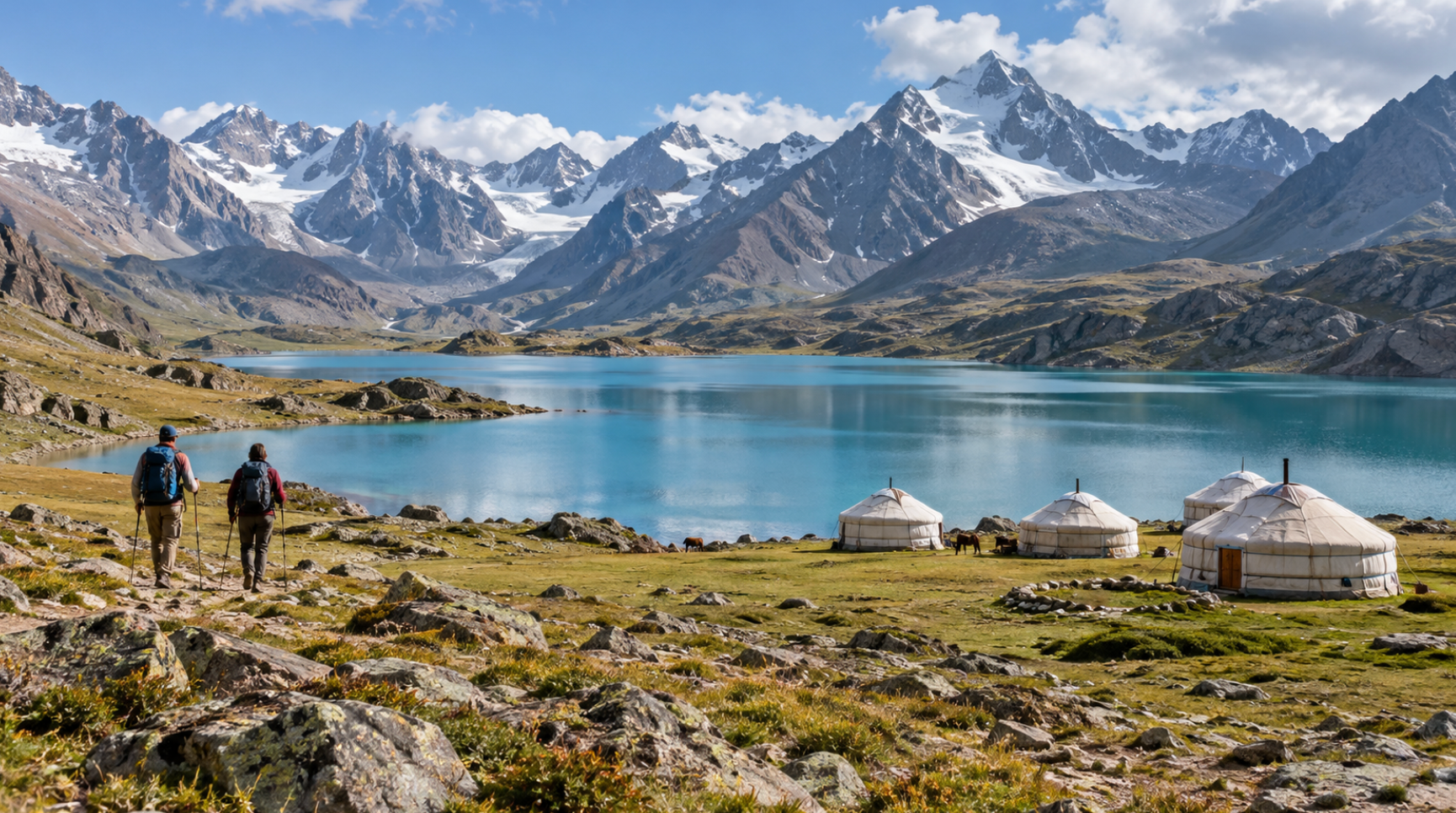
Only a short climb remains across the loose, snow-dusted rocks before the trail finally reaches the mountain pass. At the top, the effort is rewarded instantly: layer after layer of rugged peaks rise beyond a striking ribbon of blue glacial water.
These mountains are often called the “Mountains of Heaven,” a name derived from Tengir Too in Kyrgyz and Tien-Shan in Chinese. Standing high above the valleys with the landscape stretching seemingly without end, the description feels entirely appropriate. Below lies Ala-Kol Lake, one of the most dramatic sights on a roughly 110-kilometer, or 70-mile, journey across Kyrgyzstan’s high country.
The route is known as the Ak-Suu Transverse, or AST, and it cuts through some of the most spectacular sections of the Kyrgyz Tien-Shan. For years, completing it meant being prepared for a serious expedition, with hikers carrying tents, sleeping equipment, food, extra clothing and almost everything required to survive several days far from roads or settlements.
That has begun to change.
A growing collection of traditional boz-ui yurts, the round felt-covered dwellings long associated with Kyrgyz shepherds, has been adapted into a network of overnight camps. The result is transforming one of the country’s wildest trekking routes into an adventure that can increasingly be completed with little more than a daypack.
The beauty of the Tien-Shan can change quickly.
As the descent toward Ala-Kol begins, a storm suddenly moves in from the south. Light mist thickens rapidly until heavy rain covers the trail and surrounding mountains. Cold water works its way through layers of clothing while other trekkers disappear into the haze.
The lake sits several hundred meters below, but the worsening weather makes the descent feel far less straightforward. Questions begin to surface: will the camp still be visible through the rain? Will someone be there so early in the trekking season? And, as many exhausted hikers have probably wondered before, why voluntarily keep putting yourself through this?
Darkness gathers around the mountains as waves begin breaking against rocks beside the lake.
Then, through the storm, a voice carries across the slope.
Someone is shouting a name repeatedly from above.
A figure soon races down the mountainside, rounds the curve beside the lake and reveals himself to be the host of the nearby yurt camp.
Half an hour later, the contrast could hardly be greater. Outside, rain continues to batter the highlands. Inside the yurt, hot tea is waiting and plov, Central Asia’s comforting mixture of rice, meat and vegetables, is cooking over the stove.
After hours of cold rain and soaked clothing, the advantage of paying for a sheltered night in the mountains suddenly becomes very easy to understand.
The Ak-Suu Transverse begins near Jyrgalan, an emerging ecotourism destination in eastern Kyrgyzstan.
From there, the route crosses seven mountain passes while accumulating more than 21,600 feet of elevation gain and loss. Along the way, hikers move through high-altitude lakes, waterfalls, river valleys and summer grazing lands known locally as jailoo.
These elevated pastures remain an important part of rural life. During the warmer months, shepherds move livestock including sheep, horses, cattle and yaks into the mountains in search of fresh grazing ground.
Most trekkers complete the AST in approximately nine days.
The major difference today is that travelers no longer necessarily need to carry their accommodation on their backs. Yurt stays are now positioned across much of the route, providing places to eat, sleep and recover before tackling the next mountain pass.
Yurts are hardly a new arrival in Kyrgyzstan.
For centuries, the portable felt structures have been part of the country’s mountain landscape, offering shepherding families shelter while they follow livestock into remote summer pastures.
Modern Kyrgyz society is far less nomadic than it once was. Soviet-era collectivization fundamentally altered traditional patterns of seasonal migration, and relatively few families today live entirely nomadic lives.
Yet every spring, yurts continue to emerge from village storage and return to the highlands.
As snow retreats and grazing conditions improve, families transport the structures upward alongside livestock. Throughout the summer, camps shift according to pasture conditions, maintaining a cultural practice deeply tied to Kyrgyz identity.
In 2024, entrepreneur and former trekking guide Daniyar Alymbekov saw another possibility for this tradition.
His tourism company, Kyrgyz Life, had previously organized trekking expeditions using teams of guides, cooks and porters. Alymbekov began changing that model by developing a continuous chain of yurt camps along the Ak-Suu Transverse.
At first, the idea was much smaller.
Several camps were already operating successfully along sections of the trail, convincing him that travelers were willing to pay for accommodation in such remote places. His original intention was simply to add several more.
As demand increased, however, it became clear that hikers wanted something more ambitious: dependable lodging across the entire AST route.
The experiment expanded rapidly.
What began as isolated overnight stops has grown into clusters of yurts that can resemble miniature seasonal settlements.
Success has also created new difficulties.
Operating accommodation in isolated mountain terrain is very different from running a conventional hotel. Supplies have to be transported into locations without normal road access, weather can disrupt operations, and finding employees willing to spend an entire season in the backcountry is challenging.
According to Alymbekov, staffing has become one of the biggest obstacles, particularly because the work exists only during the relatively short trekking season.
Demand, meanwhile, keeps climbing.
Where the company once had the capacity to serve only a handful of larger trekking groups simultaneously, its expanded network can now accommodate the equivalent of 40 to 50 tours per day across the camps, while sometimes still having additional room available.
That growth illustrates how quickly the AST is moving from being a specialist expedition into a recognizable adventure-tourism product.
Perhaps the biggest attraction of the new system is remarkably simple: hikers can carry less.
Across much of Kyrgyzstan, multi-day trekking still requires visitors to be highly self-sufficient. A typical backpack might include a tent, sleeping bag, stove, cooking equipment, several days of food and emergency supplies.
On the Ak-Suu Transverse, yurt accommodation changes that calculation.
With camps providing shelter, meals and bedding, many travelers can complete the route carrying only clothing, basic personal equipment, water and a camera.
A small backpack and trekking poles can replace the enormous expedition packs that were once almost unavoidable.
Reducing that weight does more than make the trek physically easier.
It also creates greater freedom to explore.
Trekkers who still have energy after reaching camp can make additional excursions toward viewpoints overlooking the approximately 14,600-foot Tashtambek-Tor Bashi peak. Others can wander into the smaller valleys surrounding Boz Uchuk and Anyrtor, where secluded lakes sit among alpine slopes.
Without 15 or 20 kilograms of equipment strapped to their shoulders, hikers can spend more time experiencing the landscape rather than simply trying to reach the next overnight stop.
For Alymbekov, accessibility is one of the project’s most important achievements.
Previously, traveling deep into these mountains required considerable experience and physical preparation because trekkers had to transport almost everything they needed.
The yurt network lowers that barrier.
People who might never consider themselves serious mountaineers can now attempt sections of terrain that were once largely reserved for experienced backpackers.
That does not make the AST easy.
Crossing seven passes and roughly 100 kilometers of high-altitude wilderness remains a substantial physical challenge. Weather can change abruptly, river crossings can become difficult and there are long sections without roads or conventional infrastructure.
For some visitors, that challenge has become part of the attraction.
Alymbekov says many guests now approach the route almost like an endurance event, setting themselves the goal of completing every pass and reaching the end of the trail.
The company has even introduced “Ak-Suu Finisher” medals. Travelers collect stamps from individual yurt camps along the journey and can receive the medal after completing the route.
It adds a small element of ceremony to what is otherwise an intensely natural experience.
The impact of the new infrastructure is already visible on the trail.
Not long ago, trekkers might spend several days seeing almost nobody apart from local shepherds.
Today, groups regularly encounter one another while heading toward major landmarks such as Ala-Kol.
Yet the route has not suddenly become crowded with conventional tourism infrastructure.
There are no ski lifts, highways or large resorts across much of the backcountry. Mobile coverage can disappear, paths can be rough and mountain weather remains unpredictable.
That absence of development is one of the trail’s greatest attractions.
On the climb toward Anyrtor Pass, hikers move slowly upward across demanding terrain, sometimes discovering that what appeared to be the summit is merely a false saddle hundreds of feet below the true ridge.
The disappointment usually passes quickly.
Around them is a landscape increasingly difficult to find in heavily visited mountain regions: broad valleys without buildings, rivers without bridges, grazing horses without fences and mountain ridges without roads.
Eventually, the route reaches one of its defining moments.
The final climb toward Ala-Kol Pass is steep and exhausting, but reaching the top can make aching legs and blistered feet temporarily irrelevant.
Here, the Ak-Suu Transverse intersects with the better-known trekking circuit that connects the thermal springs of Altyn Arashan, Ala-Kol Lake and the Karakol Valley.
The encounter briefly breaks the feeling of isolation.
More hikers appear, trails become busier and the wilderness suddenly feels connected to a larger network of visitors.
The view, however, becomes even more dramatic.
Beyond the intense blue of Ala-Kol stretches the roughly mile-long Takyr-Tor Glacier, which feeds the lake. Behind it rise successive walls of mountains, with some summits climbing beyond 16,000 feet.
The entire horizon becomes a procession of ice, rock and shadow.
It is the sort of panorama that tends to outlast memories of wet socks, sore knees and difficult climbs.
And somewhere beyond the pass, there is usually another yurt with a hot pot of tea waiting.
Visitors who complete the AST often describe the combination of natural scenery and human encounters as one of its defining qualities.
American trekker Tara Fenwick-Smith, who has completed the route, has described it as a journey combining demanding mountain passes with green valleys, snow-covered peaks, powerful rivers and challenging crossings.
What stood out equally strongly was the human side of the experience.
In some parts of the backcountry, travelers may encounter more horses than people.
A shepherd who has seen few outsiders during the summer may invite passing hikers into a yurt for tea. These spontaneous interactions provide something that cannot easily be replicated by conventional tourism infrastructure: direct contact with a culture that still maintains a close relationship with the mountains.
For Fenwick-Smith, the experience offered both exceptional wilderness and a glimpse into the warmth of Kyrgyz hospitality.
Her most practical advice for anyone following her footsteps is considerably simpler: bring a raincoat.
For international travelers, reaching the region still requires some planning.
Karakol Airport (IKG) reopened in 2024 and has been designated for international operations, although current scheduled services primarily connect the region with domestic destinations such as Bishkek and Osh.
Another option is Issyk-Kul International Airport (IKU), which operates seasonal connections with destinations in countries including Kazakhstan, Uzbekistan and Russia.
For travelers arriving from farther away, Manas International Airport (BSZ) in Bishkek provides the broadest range of connections, linking Kyrgyzstan with major hubs across Europe, Asia and the Middle East.
From there, visitors continue overland toward Karakol and the eastern Tien-Shan.
The new accessibility does come with a price, but it remains relatively affordable compared with many guided high-altitude trekking destinations.
A self-guided package that includes yurt accommodation and three meals per day starts at approximately 5,600 Kyrgyz som, or around US$64 per person per day, when arranged directly through Kyrgyz Life.
Travelers wanting additional support can hire guides or horses at extra cost.
Budget-conscious groups can also look for fixed-date summer departures, which can reduce expenses by allowing travelers to share logistics.
Those hiking sections independently should also expect a small entrance charge of approximately 300 Kyrgyz som, around US$3.50, for Karakol National Park, along with transportation expenses to and from the trailheads.
The Ak-Suu Transverse remains demanding enough to feel like a genuine expedition.
Storms can arrive without warning. Trails disappear into rocky slopes. Rivers swell. Mountain passes test endurance, and much of the surrounding landscape still feels remarkably untouched.
What has changed is the amount of equipment required to experience it.
By transforming the traditional Kyrgyz yurt into a network of mountain lodges, local entrepreneurs have created an unusual middle ground between independent wilderness travel and supported trekking.
Visitors can travel lighter without completely separating themselves from the landscape.
They can sleep inside structures connected to centuries of pastoral tradition, eat local food and meet the people whose families have used these valleys for generations.
Most importantly, they can reach corners of the Tien-Shan that once demanded serious expedition logistics.
For hikers standing above Ala-Kol, surrounded by glaciers and peaks rising more than 16,000 feet into the sky, the nickname “Mountains of Heaven” suddenly feels less like tourism marketing and more like a remarkably accurate description.
And after another long day crossing Kyrgyzstan’s untamed high country, few luxuries feel greater than spotting a felt yurt in the distance and knowing that warm food, shelter and tea are waiting inside.
For questions or comments write to contactus@bostonbrandmedia.com
Source: CNN



-v3.jpg)


-v3-02.jpg)