Stay informed with our newsletter.


EN





Global property markets are undergoing a major transition, with high borrowing costs, changing workplace patterns and selective investment reshaping the sector. U.S. housing demand is struggling with affordability, while premium offices, logistics facilities and data centres are attracting stronger interest. Europe faces pressure from expensive financing and weaker transactions, even as prime assets remain desirable. The emerging landscape increasingly favours high-quality properties, strategic locations, sustainable financing and assets aligned with long-term economic growth trends.
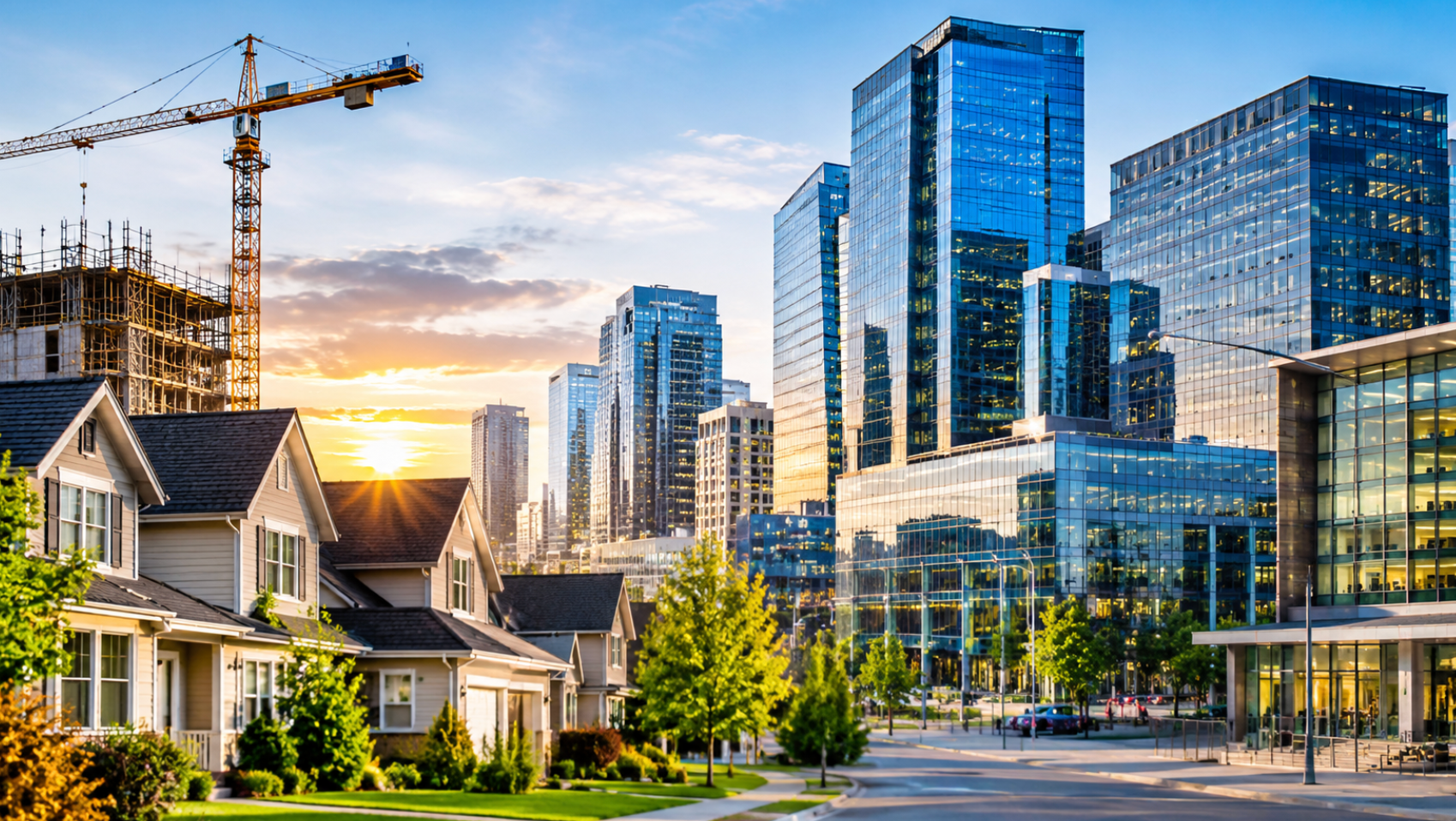
The global real estate market is entering one of its most unusual periods in years. U.S. homebuyers are retreating under the pressure of high mortgage rates, global office demand is recovering, and Europe's commercial property market is again struggling with expensive debt and falling transaction volumes.
Instead of a synchronized property recovery, the world is seeing an increasingly divided market.
Some of the strongest demand is flowing toward prime offices, logistics facilities and data centres, while interest-rate-sensitive residential markets and heavily financed commercial properties remain under pressure. The result is a global real estate landscape increasingly defined by location, asset quality, financing costs and changing patterns of work.
The American housing market provides one of the clearest examples of how dramatically borrowing costs can change property demand.
In October 2026, contracts to purchase previously owned U.S. homes fell 4.7% from the previous month, according to the National Association of Realtors. The Pending Home Sales Index dropped to 63.0 - its lowest level since the series began in 2001.
Pending transactions were also 16.7% lower than a year earlier, with declines recorded across all four major U.S. regions.
The principal problem is affordability.
The average U.S. 30-year fixed mortgage rate stood at 7.18% in mid-November after approaching 7.40% in October. At those levels, financing a home becomes significantly more expensive than it was during the era of exceptionally cheap mortgages.
The effects are spreading into home construction.
U.S. single-family housing starts increased 4% in October, but remained 3.2% below their level a year earlier. More concerning for future construction, single-family building permits fell 8.7% to an annual rate of 772,000 units, their lowest level since January 2023.
Builders are responding aggressively. In November, 46% of U.S. homebuilders reported cutting prices, while 68% were offering some form of sales incentive. Builder confidence fell to its lowest level since April 2012.
This creates an unusual housing environment: many households still want homes, but the monthly cost of financing them is preventing potential buyers from entering the market.
If residential housing illustrates the damage caused by high borrowing costs, offices are producing a very different story.
Only a few years ago, the future of the office was being questioned as remote and hybrid working transformed corporate behaviour. But by 2026, the sector was demonstrating signs of a meaningful recovery, particularly for high-quality properties.
According to JLL, global office leasing increased 5% year-on-year in the third quarter of 2026. Leasing volumes across the first nine months of the year reached a new post-pandemic peak.
The recovery is not occurring equally everywhere.
Asia Pacific has been a major driver, while the U.S. has also recorded continued expansion. Europe, meanwhile, has remained broadly stable in occupational demand even as investment transactions face pressure.
The U.S. office market has now recorded five consecutive quarters of positive net absorption, according to JLL, with approximately 21 million square feet of occupancy gains during the first nine months of 2026.
One important explanation is the "flight to quality."
Companies may require less space than they did before the pandemic, but many are increasingly willing to pay for better space, modern buildings, strong locations, improved amenities and workplaces capable of attracting employees back to the office.
That distinction is becoming crucial.
The future of commercial offices may not be about whether offices survive. Instead, it may be about which offices survive and prosper.
The office resurgence is particularly visible in India.
India's seven largest office markets recorded 61.06 million square feet of gross leasing during the first nine months of 2026, the strongest January-to-September performance on record, according to JLL.
The third quarter alone recorded 23.17 million square feet of leasing.
Bengaluru led Q3 activity with a 33.4% share, followed by Hyderabad at 19.6%, Delhi NCR at 18.1% and Mumbai at 12.4%.
A major driver has been the expansion of Global Capability Centres (GCCs). These operations leased approximately 26.2 million square feet during the first nine months of 2026, representing 42.9% of overall office demand and an increase of 30.6% year-on-year.
The figures demonstrate how global companies continue to invest heavily in locations offering skilled workforces and scalable operations.
The commercial real estate story is also extending well beyond traditional offices.
JLL reports that logistics take-up accelerated across all major regions, while demand for data centres remained at record levels during the third quarter. Prime retail locations also continued to attract leasing activity.
This reflects structural changes occurring across the global economy.
E-commerce, supply-chain diversification, cloud computing, digital services and rapidly expanding computing infrastructure are changing what constitutes strategically important real estate.
Warehouses, logistics hubs and data centres increasingly represent the physical infrastructure behind the digital economy.
Europe presents perhaps the clearest example of the contradiction running through global commercial property.
Companies may want high-quality space, but investors still have to finance the buildings.
European commercial real estate transaction volumes fell to approximately €43 billion during Q3 2026, according to MSCI data. That represented a 24% year-on-year decline.
Office transactions were particularly weak, falling 33% to €8.8 billion.
Higher government bond yields and borrowing costs have complicated refinancing and pushed buyers and sellers further apart on valuations.
Reuters reported that some European property investors were attempting to renegotiate transactions at discounts of 10% or more as financing conditions deteriorated.
Germany and France experienced particularly sharp declines in transaction activity. MSCI figures show Q3 commercial real estate volumes falling 47% year-on-year in Germany and 49% in France.
Yet Europe is not simply experiencing a collapse in demand.
Prime properties continue to attract substantial capital. Major trophy transactions in Paris and London demonstrate that investors are still willing to deploy hundreds of millions of euros when they believe an asset offers exceptional location, quality or long-term potential.
This is producing an increasingly two-speed property market.
Despite Europe's problems, global real estate investment has not collapsed.
JLL estimates that global direct real estate investment volumes increased 19% during the first nine months of 2026. Third-quarter investment reached approximately $235 billion, up 7% year-on-year, although growth slowed as higher bond yields forced investors to reassess valuations.
Asia Pacific recorded particularly strong momentum, with investment volumes rising 29% year-to-date, while the Americas increased 21%.
The contrast illustrates why describing the current environment simply as a global "property downturn" would be misleading.
Capital is still moving but investors are becoming much more selective about where it goes.
The defining trend of the current property cycle may ultimately be divergence.
The divide is becoming visible between:
Prime and secondary properties. Growing and stagnant cities. Cash-rich and highly leveraged investors. Modern and obsolete offices. Affordable and unaffordable housing markets.
For much of the previous property cycle, cheap money lifted valuations across a wide range of assets. Today's environment is different.
Investors must increasingly ask whether an individual property can generate sustainable demand and income rather than assuming lower interest rates will continually support valuations.
The direction of global real estate through 2027 will depend heavily on interest rates, inflation, economic growth and financing availability.
If borrowing costs decline materially, residential affordability could improve and commercial transactions could accelerate. But if rates remain elevated, heavily indebted property owners may face refinancing pressure while buyers continue demanding lower valuations.
At the same time, structural forces are creating powerful opportunities.
Data centres, logistics infrastructure, premium offices, flexible workspaces and properties serving expanding urban economies could continue attracting investment even if the wider market remains difficult.
The property market is therefore not disappearing or simply declining.
It is being repriced, reorganised and reinvented.
The winners of the next real estate cycle are unlikely to be determined solely by who owns the most property. They may instead be those who own the right properties, in the right locations, with sustainable financing and exposure to the economic forces shaping the next decade.
For questions or comments write to contactus@bostonbrandmedia.com