Stay informed with our newsletter.
.webp)


EN





Germany’s automotive sector is under growing pressure as Volkswagen cuts its profit outlook and moves ahead with major workforce reductions. The crisis reflects deeper challenges facing German manufacturers, including high production costs, weaker demand in China, rising competition from Asian automakers, and the costly transition to electric vehicles. Worker protests have intensified concerns over jobs, factory competitiveness, and Germany’s long-term position as a leading global automotive manufacturing hub in an increasingly competitive market worldwide today.
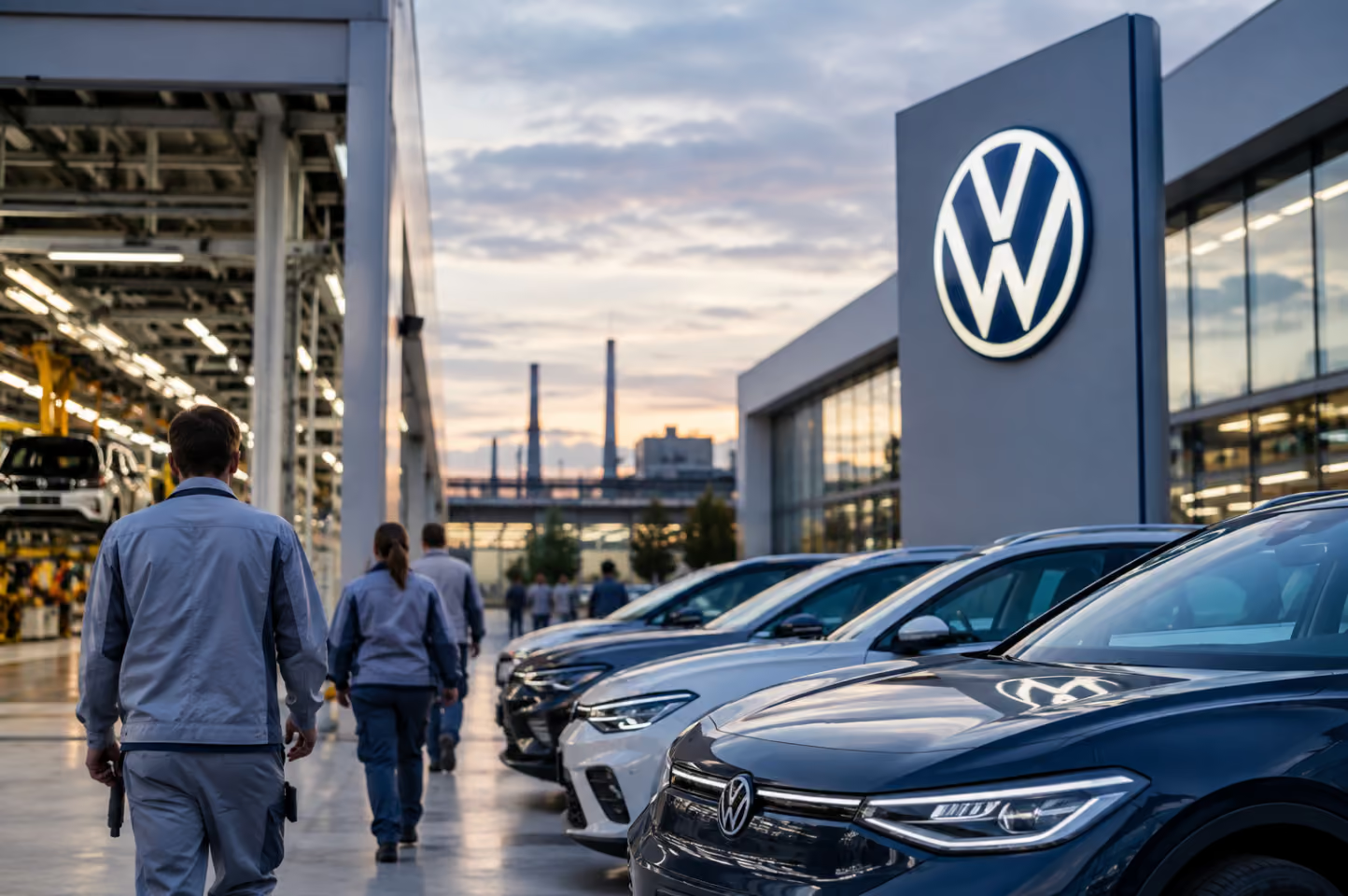
Germany’s automotive industry is confronting one of its most difficult periods in decades as Volkswagen slashes its profit outlook, manufacturers accelerate restructuring plans and workers take to the streets over fears of job losses and factory closures.
On September 21, 2026, automotive workers participated in protests across Germany as concerns intensified about the future of one of the country’s most strategically important industries. Employees linked to major companies including Volkswagen, BMW and automotive supplier Bosch joined demonstrations focused on employment security, industrial investment and the competitiveness of German manufacturing.
The demonstrations came just days after Volkswagen delivered another major warning about the scale of the pressures facing Europe’s largest automaker.
Volkswagen announced on September 18 that it now expects an operating return on sales of no more than 1% for 2026, dramatically lower than its previous forecast range of 4% to 5.5%.
The company expects approximately €315 billion in group revenue for the year, but around €10 billion in special effects are expected to weigh on operating profit. Without those special effects, Volkswagen said its operating return on sales would be around 4%.
A significant part of the financial hit is connected to problems at Porsche, whose performance has been affected by weaker demand, particularly in China, as well as restructuring costs and other market pressures. Reuters reported that around €6 billion of Volkswagen’s impairments were associated with revised expectations for Porsche.
The warning immediately rattled investors. Volkswagen shares dropped 5.6% following the announcement, while Porsche and Porsche SE also recorded declines.
For Volkswagen, however, falling profitability is only part of a much larger transformation.
Volkswagen’s supervisory board approved a major transformation plan in early September designed to make the group smaller, more efficient and better positioned to compete with increasingly aggressive international rivals.
Reuters reported that the programme envisages an additional 50,000 job reductions across the Volkswagen Group, alongside an already ongoing round of roughly 50,000 reductions. The plan also raises questions about the long-term future of German facilities including Emden, Zwickau, Neckarsulm and Hannover, which could lose vehicle programmes in the coming years.
Volkswagen has described the restructuring as necessary to secure the company’s future competitiveness.
Its broader strategy also includes simplifying a historically complicated corporate structure. Volkswagen said in July that it intended to reduce its model range by as much as 50% and cut offering complexity by up to 75%, as it attempts to lower costs and concentrate resources on the strongest market opportunities.
The scale of those changes helps explain why workforce anxiety is spreading well beyond Volkswagen.
Germany’s powerful IG Metall union has intensified pressure on both companies and policymakers as manufacturers consider job cuts, production transfers and plant restructuring.
Volkswagen’s works council and IG Metall are calling for measures including greater industrial investment, lower electricity costs, continued partial-retirement programmes and stronger protection against what they regard as unfair international competition.
The dispute is increasingly about more than individual jobs. It concerns whether Germany can remain one of the world’s leading automotive production centres as the industry rapidly transitions toward electric vehicles, software-defined cars and increasingly digital manufacturing.
For decades, Germany’s combination of engineering expertise, sophisticated suppliers and premium automotive brands helped make cars one of the foundations of its industrial economy.
That position is now being tested.
One of the most serious problems facing German automakers is their declining position in China, historically one of their most important and profitable markets.
During the second quarter of 2026, Volkswagen, Mercedes-Benz and BMW all suffered major sales declines in China. Volkswagen’s sales in the country reportedly fell 36.6% year-on-year, while the German manufacturers faced mounting competition from domestic companies such as BYD, Geely and other fast-growing Chinese EV makers.
Volkswagen had already reported earlier in 2026 that its Chinese market performance had fallen sharply. In its first-half results, the company said deliveries outside China had increased, but its Chinese market business had fallen by around 20%.
Chinese manufacturers are competing not only on price but increasingly on battery technology, software, connectivity, vehicle features and development speed.
The challenge is also moving closer to home.
Reuters analysis published in September estimated that Chinese brands captured around 9% of EU car sales during the first half of 2026, illustrating how competition that once primarily affected European companies in China is increasingly appearing inside Europe itself.
Despite the growing concerns, Germany remains one of the world’s largest automotive manufacturing centres.
German factories produced approximately 4.15 million passenger cars in 2025, an increase of 2% from the previous year and the highest total since 2019.
However, production remained more than 500,000 vehicles, or around 11%, below 2019 levels.
Germany has also made substantial progress in electrification. Electric vehicles represented around 40% of German passenger-car production in 2025, while domestic EV production increased 23% during the year.
Around 3.17 million passenger vehicles produced in Germany were exported in 2025, underlining just how dependent the industry remains on international demand.
For 2026, the German Association of the Automotive Industry expects domestic passenger-car production to decline slightly to around 4.11 million vehicles, while exports are forecast to fall approximately 1% to 3.14 million units.
Germany’s progress in EV manufacturing highlights one of the contradictions at the heart of the current crisis.
The transition to electric mobility creates enormous opportunities for manufacturers, battery suppliers, software developers and technology companies. But it also requires billions of euros of investment while companies are simultaneously trying to protect profitability.
Traditional automakers must finance new EV platforms, battery technologies, software systems and factories while continuing to support existing combustion-engine businesses.
Volkswagen is therefore attempting to accomplish several difficult goals simultaneously: reduce costs, improve profitability, strengthen its position in China, compete with lower-cost Asian manufacturers and accelerate its technological transformation.
The pressure is unlikely to disappear quickly.
Volkswagen’s latest profit warning is therefore more than another disappointing financial forecast.
It represents a broader warning for Germany’s automotive industrial model.
Volkswagen, BMW, Mercedes-Benz, Porsche, Bosch and thousands of suppliers form an ecosystem that supports manufacturing employment, exports, research and regional economies throughout Germany.
As workers protest and companies restructure, the central question is becoming increasingly urgent: Can Germany transform its automotive industry quickly enough to remain globally competitive without sacrificing the industrial scale and skilled employment that made it successful?
Germany still possesses formidable advantages, world-renowned brands, advanced engineering capabilities, major manufacturing infrastructure and rapidly growing EV production.
But the combination of weakening profitability, high operating costs, falling China sales, tens of thousands of potential job reductions and rising Asian competition shows how quickly the global automotive balance is changing.
For Volkswagen and Germany’s wider car industry, 2026 is increasingly looking like a defining year, one in which restructuring is no longer optional, but central to determining who remains competitive in the next era of global mobility.
For questions or comments write to contactus@bostonbrandmedia.com



-v3.jpg)


-v3-02.jpg)