Stay informed with our newsletter.
.webp)


EN





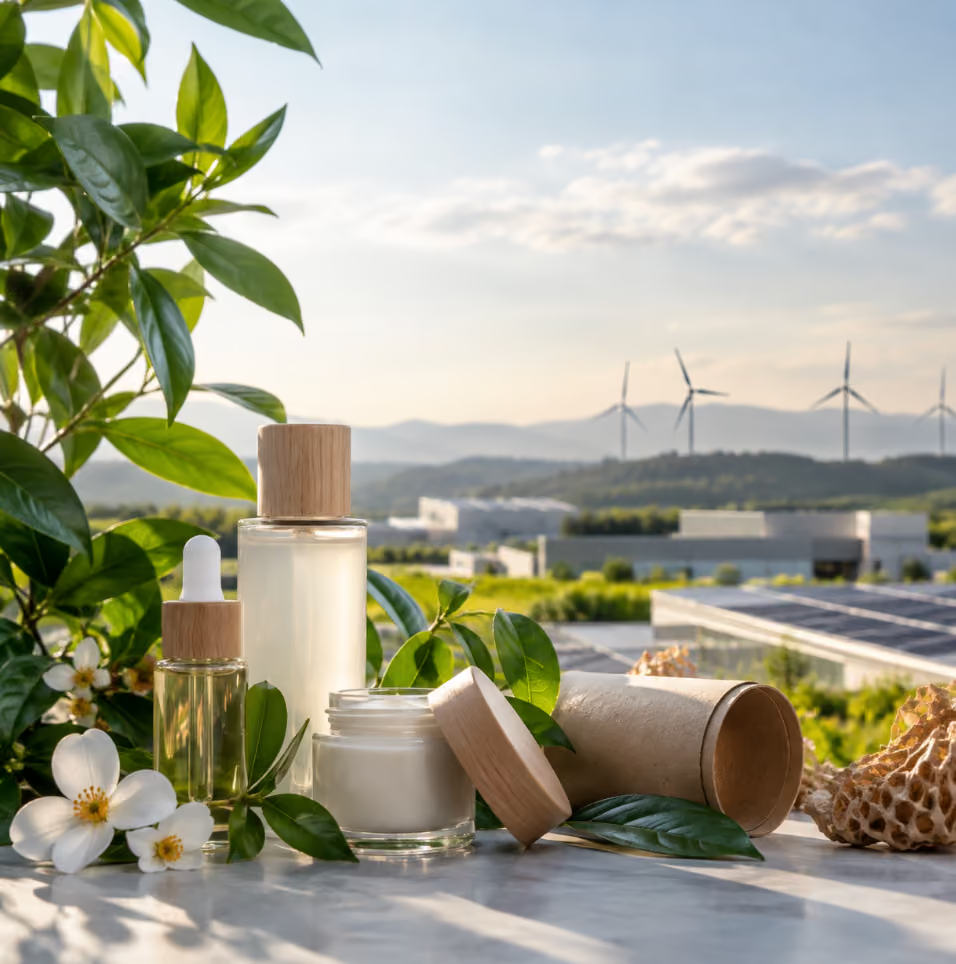
L’Oréal is strengthening sustainability across every stage of its value chain, from sourcing and product development to manufacturing, packaging, distribution, and consumer use. Under the leadership of Chief Corporate Responsibility Officer Ezgi Barcenas, the company is integrating environmental and social responsibility into core business decisions. Its approach focuses on reducing emissions, improving resource efficiency, supporting responsible sourcing, and encouraging continuous innovation, showing how sustainability can become a practical driver of long-term business transformation and resilience.
Growing up in Cyprus, Ezgi Barcenas experienced firsthand how limited natural resources can shape everyday life. Water scarcity, in particular, gave her an early appreciation of the pressures societies face when essential resources are stretched.
Her academic path took her to the United States, where she spent four years studying electrical and biomedical engineering. But rather than limiting her career to a traditional engineering track, she became increasingly interested in using that analytical foundation to create change on a much broader scale.
She later gained experience across the public sector and international development, before moving into business. After completing an MBA, she spent more than a decade working in the beverage industry, building experience across complex global operations.
That varied career has shaped the way Barcenas now approaches sustainability. She combines systems thinking, curiosity, collaboration, measurable impact and large-scale transformation when tackling environmental and social challenges.
Today, as Chief Corporate Responsibility Officer at L’Oréal, she oversees the company’s worldwide sustainability agenda alongside its philanthropic programmes.
L’Oréal has built much of its global reputation around scientific research and beauty innovation. Increasingly, however, sustainability has become just as important to how the company defines its future.
Barcenas brings an engineer’s perspective to the company’s work on climate action, biodiversity, circularity and social impact, particularly through the L’Oréal for the Future programme.
Her approach treats sustainability as a design challenge rather than an isolated environmental responsibility.
For Barcenas, sustainability provides a framework that can influence how products, operations and entire business systems are created.
That means reconsidering everything from raw-material sourcing and formulation to packaging, manufacturing and customer engagement.
Instead of adding sustainability at the end of the process, L’Oréal is increasingly attempting to build it into decisions from the beginning.
This mindset forms part of what the company describes as “dual excellence” - pursuing stronger business performance while simultaneously advancing environmental and social objectives.
L’Oréal does not view commercial success and environmental responsibility as competing ambitions.
Instead, its model seeks to make financial performance and sustainable progress reinforce one another.
Sustainability responsibilities are therefore not confined to one specialist department.
They are shared across senior leadership and multiple business functions, creating greater accountability throughout the organisation.
One of Barcenas’ important internal relationships is with Chief Financial Officer Christophe Babule, reflecting how closely sustainability decisions can intersect with investment, operations and long-term financial planning.
Barcenas believes companies can strengthen their relationships with consumers and communities when they see themselves as active contributors to social progress.
That thinking supports L’Oréal’s wider strategy of combining commercial excellence with positive societal impact.
It also explains why finance leaders play an important role in sustainability discussions, particularly when companies are evaluating investments, risks and new business models.
For L’Oréal, sustainability is increasingly treated as a source of business value and strategic opportunity, rather than simply an additional corporate obligation.
This philosophy influences decisions involving procurement, product development, manufacturing and commercial strategy.
The scale of the task is significant. L’Oréal works with approximately 35,000 suppliers worldwide, creating both enormous potential for influence and considerable operational complexity.
Turning sustainability commitments into meaningful results therefore requires changes in everyday business decisions rather than relying only on long-term targets.
It also demands close coordination between departments, markets, suppliers and leadership teams.
Barcenas' leadership style places particular emphasis on collaboration, openness and humility when solving complicated sustainability challenges.
Her concept of a “team of teams” encourages sustainability expertise to spread throughout the organisation instead of remaining concentrated in one department.
That philosophy fits naturally with L’Oréal’s history as a company driven by research and product development.
From Barcenas’ perspective, sustainability represents another major frontier for business innovation.
One of the clearest examples of this philosophy is the L’Oréal Sustainable Innovation Accelerator, known as L’Accelerator.
L’Oréal has committed €100 million through 2030 to help identify, test and scale solutions capable of addressing major sustainability challenges.
Priority areas include decarbonisation, circular packaging and next-generation ingredients.
Rather than pretending every solution already exists, the company has publicly identified dozens of areas where new ideas are still needed.
L’Oréal issued 70 specific challenges, effectively inviting entrepreneurs, researchers and startups to help solve problems the company believes require new approaches.
Opening those challenges to the wider innovation ecosystem allows L’Oréal to collaborate with specialists beyond its own organisation.
The programme generated significant international interest.
Its first call for solutions attracted nearly 1,000 applications from more than 100 countries, demonstrating how strongly sustainability entrepreneurs are looking for opportunities to work with global companies.
Successful applicants move into an acceleration stage where they gain access to L’Oréal expertise as well as outside partners.
Among those supporting the initiative is the University of Cambridge Institute for Sustainability Leadership.
The programme also attempts to address a common problem for startups: navigating the slow and complicated processes of large multinational organisations.
Young companies can often struggle to identify the right corporate decision-makers or secure opportunities to test their technologies at meaningful scale.
L’Oréal aims to reduce those obstacles by creating clearer access to relevant internal specialists.
Pilot projects generally run for six to 12 months, with performance measures agreed before implementation begins.
Establishing those metrics early allows both L’Oréal and participating startups to determine whether a solution can deliver measurable results and eventually scale.
Even when a pilot does not become a commercial deployment, the process can still generate useful knowledge.
For Barcenas, learning itself is an important outcome, helping both L’Oréal and participating founders understand what works, what does not and what needs to change.
Innovation programmes represent only one part of L’Oréal’s sustainability strategy.
The company is also using impact investment, debt financing and philanthropy to support environmental and social objectives.
Each financial mechanism is designed to address a different type of sustainability challenge.
The L’Oréal Fund for Nature Regeneration, for example, invests in projects intended to restore damaged ecosystems while also pursuing financial returns.
Managed by external specialists, the fund supports projects in regions including Latin America and Southeast Asia.
Its broader purpose is to demonstrate that protecting natural systems does not necessarily have to come at the expense of financial performance.
Some investments also take place beyond L’Oréal’s immediate supply network.
That allows the company to gather insights from wider environmental projects that could eventually inform its own operations.
The Circular Innovation Fund follows a similar philosophy by supporting technologies and businesses capable of accelerating the transition towards a circular economy.
Supply-chain decarbonisation is another major area of investment.
In 2024, L’Oréal launched a dedicated €50 million debt fund aimed at helping suppliers finance emissions-reduction projects.
This initiative is especially relevant to tackling Scope 3 emissions, which originate from activities across a company’s wider value chain.
Alongside investment programmes, L’Oréal also operates philanthropic initiatives addressing environmental and social vulnerability.
These include the Fund for Women and the Climate Emergency Fund, both of which support communities facing social inequality and growing climate-related risks.
Reducing greenhouse-gas emissions remains essential, but L’Oréal’s strategy also recognises another growing challenge: climate adaptation.
Communities around the world are already experiencing the consequences of rising temperatures and increasingly severe weather conditions.
Businesses are therefore beginning to consider not only how to reduce future emissions, but also how communities can become more resilient to impacts that are already occurring.
One example comes from India, where a project supports female urban workers through parametric insurance.
Unlike conventional insurance, parametric coverage provides payments when a predetermined event or threshold is triggered.
In this case, extreme heat levels can activate compensation for workers whose health or earnings are affected by dangerous temperatures.
The approach offers a faster mechanism for providing financial support during climate-related disruption.
Barcenas has indicated that the initiative has delivered encouraging results and could potentially be adapted for communities outside India.
Sustainability also has to make sense at the consumer level.
L’Oréal is therefore exploring ways to turn environmental commitments into practical product experiences that customers can easily adopt.
One major area is refillable packaging.
Instead of repeatedly buying the same full-sized container, consumers can retain a durable primary package and purchase lighter refill units.
This can help reduce the amount of packaging material required while potentially lowering costs for customers.
Creating successful refill systems, however, involves far more than simply redesigning a bottle.
Teams responsible for packaging, product formulations, manufacturing and commercial operations must coordinate closely to ensure that the new format remains convenient, attractive and technically effective.
L’Oréal refers to this type of approach as “multi-solving”, creating solutions capable of addressing several objectives simultaneously.
A refillable product cannot succeed only because it uses less material.
It must also remain desirable, functional, easy to use and competitively priced.
Consumer behaviour therefore plays an essential role.
Environmental benefits alone may not persuade people to change purchasing habits if the alternative is inconvenient or significantly more expensive.
L’Oréal is consequently investing in product design that aims to balance sustainability with aesthetics, performance and affordability.
Retail partners are another important part of the process.
Stores and ecommerce platforms influence how refillable products are presented, discovered and understood by consumers.
Working with retailers allows L’Oréal to experiment with different messaging, formats, merchandising approaches and price points.
The resulting data can help the company better understand what actually motivates consumers to embrace more circular purchasing models.
One characteristic consistently shaping Barcenas' leadership philosophy is curiosity.
Her engineering background encourages her to begin complex challenges by asking questions rather than assuming that existing systems are fixed.
That means bringing different experts into discussions, challenging established practices and openly examining the structural barriers that can slow progress.
For Barcenas, curiosity creates an environment where people can exchange ideas, challenge assumptions and develop solutions together.
It also encourages teams to learn from one another rather than approaching sustainability from isolated perspectives.
This philosophy is visible in initiatives such as L’Accelerator, where identifying unanswered questions is just as important as finding immediate solutions.
In complex sustainability challenges, asking better questions can sometimes be the first step towards producing better answers.
Barcenas ultimately views sustainability as a collective effort rather than the responsibility of a single executive, department or company.
The future she is working toward is one where the beauty industry becomes more sustainable, more inclusive and more transparent, while continuing to deliver products that consumers genuinely want.
For questions or comments write to contactus@bostonbrandmedia.com
Source: sustainabilitymag



-v3.jpg)


-v3-02.jpg)