Stay informed with our newsletter.
.webp)


EN





Berlin’s housing crisis is intensifying as rents rise sharply and housing supply struggles to keep pace with demand. The city estimates it needs around 211,000 additional homes by 2040, while asking rents remain far above levels seen a decade ago. Population growth, limited land, high construction costs and planning challenges are worsening affordability. Although building permits have improved, Berlin still faces a long-term test in creating enough accessible housing for residents.
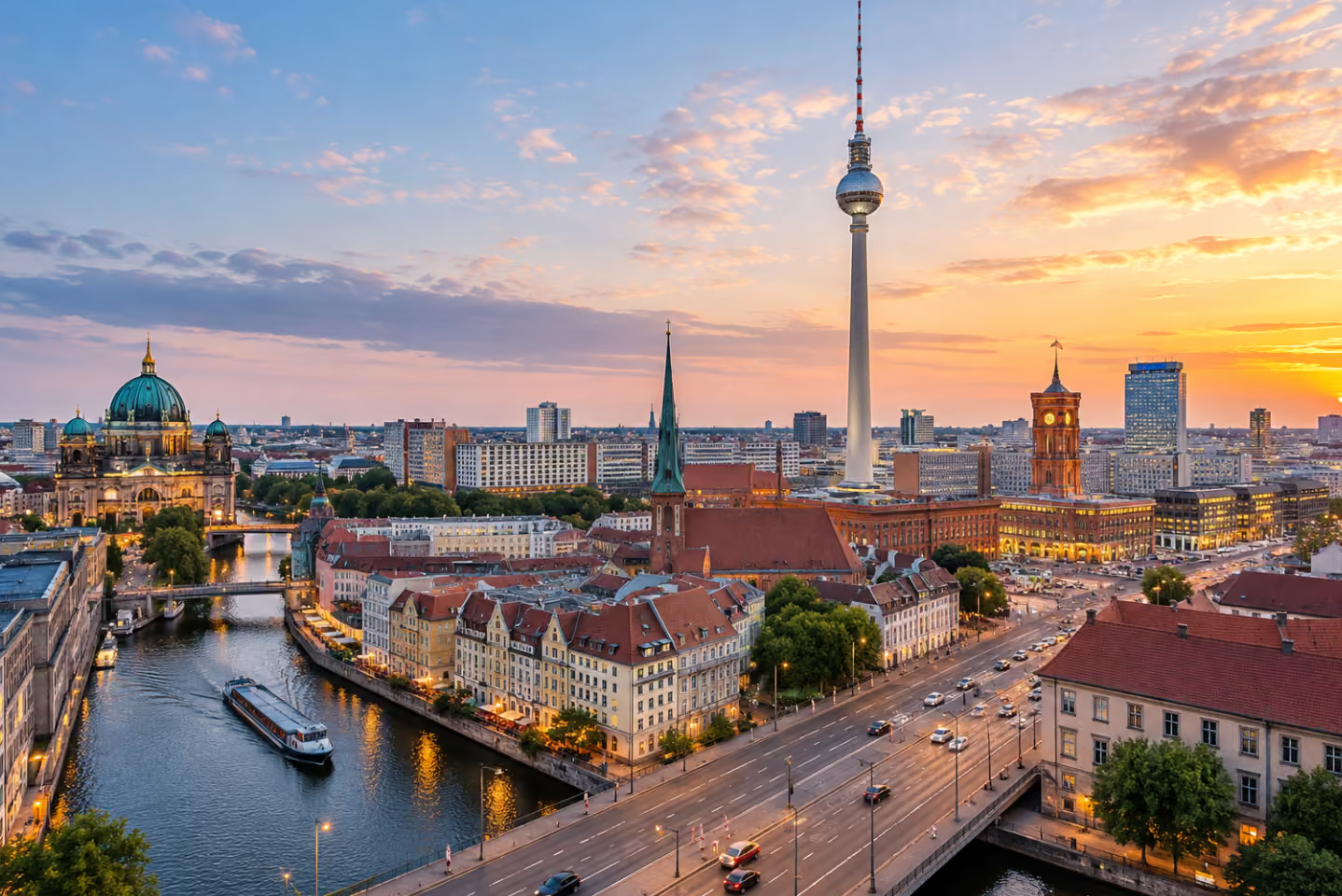
Berlin was once celebrated as one of Europe’s most affordable major capitals, attracting students, artists, technology workers and young professionals with relatively inexpensive housing. That image is becoming increasingly difficult to sustain. Rents have risen dramatically, housing construction has struggled to keep pace with demand, and the German capital now estimates it will need another 211,000 homes between 2026 and 2040.
The pressure has turned housing into one of Berlin’s most urgent economic and social challenges. Reuters reported in September 2026 that advertised rents have nearly doubled since 2014, reflecting a profound transformation in a city where renting remains the dominant form of housing.
Official housing-market figures provide a similar picture. Investitionsbank Berlin, or IBB, reported that the median asking rent reached €15.78 per square metre in 2025, compared with €9.00 per square metre in 2016, an increase of 75.3% in nine years. Looking from 2015 to 2024, median asking rents increased by an even steeper 85.2%, from €8.50 to €15.74 per square metre.
Berlin did receive a small measure of relief in 2025. After two years of sharp increases, the median asking rent rose just 0.3% from 2024, effectively stagnating at €15.78 per square metre.
But that stabilization came after years of substantial growth, meaning rents remain exceptionally high compared with the levels households faced a decade earlier.
The distinction between asking rents and existing rents is especially important. Asking rents represent prices advertised to people currently searching for accommodation, while existing tenants may still have considerably lower rents under older contracts.
IBB reported that Berlin’s average existing rent stood at approximately €7.10 per square metre in mid-2025, while the official local comparative rent was €7.21. The citywide median asking rent of €15.78 was therefore more than twice the local comparative rent.
This divide creates a particularly challenging situation for people trying to move to Berlin, young adults leaving their family homes and existing residents who need a larger apartment.
The pressure becomes more visible when individual districts are examined.
In Mitte, the median asking rent reached €20.00 per square metre in 2025. Friedrichshain-Kreuzberg followed at €19.40, while Charlottenburg-Wilmersdorf recorded €19.17.
Even areas traditionally regarded as more affordable have experienced significant price pressure. Spandau recorded a median asking rent of €12.50 per square metre, while Marzahn-Hellersdorf stood at €11.56.
Across Berlin’s inner-city areas, the median asking rent was approximately €19.22 per square metre in 2025.
For households entering the rental market, these figures can translate into a substantial monthly expense before utilities and other housing costs are added.
The underlying issue is not simply rising rents. Berlin does not have enough housing to comfortably meet current and future demand.
In June 2026, the Berlin Senate updated its long-term housing strategy and estimated that the city requires 211,000 additional housing units between 2026 and 2040.
Of those, approximately 138,000 homes are needed specifically to relieve pressure on the existing housing market, while another 73,000 homes are required to accommodate projected demographic growth.
Berlin has identified potential sites capable of delivering roughly 213,000 homes, only slightly above the estimated requirement. Authorities also want to identify enough additional land to provide a strategic reserve equivalent to another 50,000 housing units, allowing the city to respond to unexpected population increases or future crises.
That illustrates how narrow Berlin’s margin has become: almost every major identified development opportunity may matter if the city is to ease the housing shortage.
Berlin has continued building despite rising construction costs and financing pressures. According to the city government, approximately 60,000 homes were completed between 2022 and 2025.
IBB reported 15,362 housing completions in 2024, but building permits fell to just 9,772 units that year. There was a significant improvement in 2025, when permits increased 44.1% to 14,079 homes.
Yet even at around 14,000 to 15,000 homes per year, sustaining sufficient construction for more than a decade will be challenging, especially amid high building costs, complex planning processes, limited land and financing constraints.
The city’s planned 24 new urban quarters could play a major role. Together, they have potential capacity for approximately 61,000 homes, with an emphasis on housing intended to serve broader public needs.
Berlin’s attractiveness is part of its housing problem.
The city added 22,884 residents during 2024, bringing its population to approximately 3.69 million.
Growth in technology, services, culture, research and international business has made Berlin increasingly attractive to workers from Germany and abroad. But employment and population growth create additional housing demand when new construction cannot expand at the same speed.
This imbalance can affect more than renters. Employers may have greater difficulty attracting workers when employees cannot find affordable accommodation near their workplace.
Housing shortages can therefore become an economic competitiveness issue, not merely a residential one.
One of the most visible debates concerns Tempelhofer Feld, the vast former airport site that is now a major public park.
Some political parties support allowing limited residential development on parts of the site, arguing that Berlin needs additional land for housing. Others oppose construction and want the area preserved as open public space. The issue has become a prominent part of Berlin’s current housing debate.
The disagreement illustrates the broader challenge confronting rapidly growing cities: how to create significantly more housing while protecting green spaces, neighbourhood character and public amenities.
Berlin’s property market is not only challenging for renters.
After declines in 2023 and 2024, the median asking price for apartments increased again in 2025 to €5,807 per square metre, up 2.1% from the previous year.
Newly constructed apartments were considerably more expensive, reaching a median asking price of €7,995 per square metre, an increase of 3.8%.
Higher purchase prices combined with borrowing costs can also keep households in the rental sector for longer, potentially adding further demand to an already constrained rental market.
Berlin’s housing market is unlikely to be transformed by a single policy or construction project. The scale of the problem reflects more than a decade of rising demand, limited supply and rapidly increasing market rents.
There are some signs of improvement: asking rents stopped accelerating in 2025, building permits rebounded and the city has identified substantial development capacity.
But the structural numbers remain difficult to ignore.
Berlin needs 211,000 additional homes by 2040. Median asking rents are roughly 75% higher than in 2016, and people searching for homes face prices far above those paid by many long-established tenants.
The central question is therefore no longer whether Berlin has a housing shortage. It is whether the city can build quickly enough and affordably enough, to prevent one of Europe’s most dynamic capitals from becoming increasingly inaccessible to the people who want to live and work there.
For questions or comments write to contactus@bostonbrandmedia.com



-v3.jpg)


-v3-02.jpg)