Stay informed with our newsletter.
.webp)


EN





A biologist has been awarded the “Environment Nobel” for groundbreaking research on hidden fungal networks beneath the earth’s surface. These underground systems, often called the “wood wide web,” connect plants and trees, allowing them to exchange nutrients, water, and signals. The discovery has transformed scientific understanding of forest ecosystems, revealing how plants cooperate and communicate through fungi, and highlighting the critical role these networks play in maintaining biodiversity, ecosystem resilience, and overall environmental health.
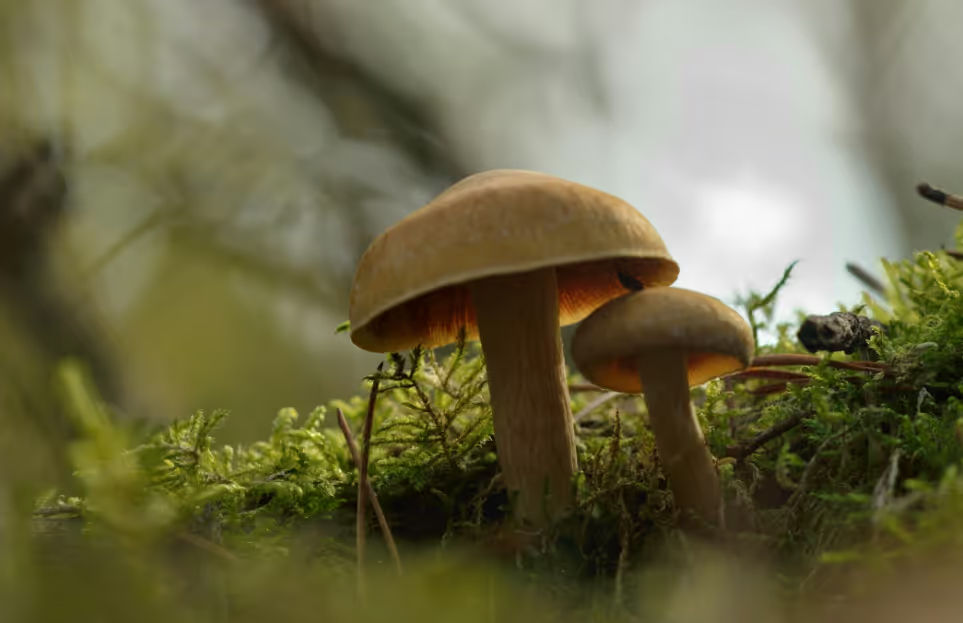
American evolutionary biologist Toby Kiers has been honored with the Tyler Prize for Environmental Achievement for pioneering research that reveals the complex, largely unseen world beneath our feet. Her work has brought global attention to the powerful underground systems that quietly support life on Earth.
Deep below forests, grasslands, and agricultural fields, vast fungal networks stretch through the soil. These microscopic threads form intricate trading partnerships with plant roots, exchanging nutrients and supporting plant growth. At the same time, they play a major role in regulating the planet’s climate by helping remove an estimated 13 billion tons of carbon from the atmosphere every year.
For decades, these fungal systems, known as Mycorrhizal networks, were largely overlooked or considered minor helpers to plants. Scientists once saw them as simple companions rather than recognizing them as one of the Earth’s most important biological infrastructures, quietly sustaining ecosystems from below ground.
Kiers’ research has helped change that perception. By mapping where these fungi exist across the globe through a project known as the Underground Atlas, she and her team have shed new light on underground biodiversity. Their work is providing critical knowledge that could guide conservation efforts aimed at protecting massive natural carbon reservoirs hidden in soil.
Plants contribute to this underground system by sending excess carbon into the soil. Mycorrhizal fungi absorb this carbon and, in the process, draw down roughly 13.12 billion tons of carbon dioxide annually—nearly one-third of the emissions produced by burning fossil fuels.
Kiers, who serves as a University Research Chair at Vrije Universiteit Amsterdam, often emphasizes how undervalued soil ecosystems are. In an interview, she pointed out that soil is frequently dismissed with negative terms such as “dirt.” In reality, she explains, even a small handful of soil contains a universe of life, teeming with organisms that sustain ecosystems.
Her fascination with fungi began at the age of nineteen when she successfully secured funding for a scientific expedition to Panama’s rainforests. Surrounded by towering trees and extraordinary biodiversity, she became intrigued by what might be happening beneath the forest floor.
One of her earliest breakthroughs came when she first observed an arbuscule through a microscope. These tiny, tree-shaped structures created by fungi penetrate plant cells and act as the exchange hubs where nutrients pass between plants and fungi. The delicate structure, she later recalled, was strikingly beautiful.
In 2011, Kiers published a landmark study in the journal Science revealing that mycorrhizal fungi operate much like traders in a complex marketplace. Rather than passively exchanging nutrients, these organisms appear to negotiate and adjust their behavior based on supply and demand.
The fungi’s thread-like filaments, often thinner than a human hair, deliver vital nutrients such as phosphorus and nitrogen to plants. In return, plants provide sugars and fats produced through photosynthesis.
Experiments conducted by Kiers and her team showed that fungi can move phosphorus from nutrient-rich areas of soil to places where it is scarce. By redistributing resources strategically, they secure more carbon from plants that need those nutrients the most. In effect, plants pay a higher “price” for resources that are harder to obtain.
Even more surprisingly, fungi can store or withhold nutrients to increase demand, a strategy that resembles economic tactics seen in financial markets. Despite lacking brains or nervous systems, these organisms appear capable of complex decision-making processes.
This raises intriguing scientific questions about how fungi process information. Researchers suspect that electrical signals traveling through fungal networks may play a role in coordinating these sophisticated exchanges.
Kiers’ recent work has pushed the field even further. Two studies published in the journal Nature have provided new tools to visualize this hidden ecosystem.
One study introduced a robotic imaging system that allows scientists to observe fungal networks as they grow, branch, and redistribute nutrients in real time. Another project mapped the global distribution of fungal species, offering one of the most detailed views yet of life beneath the soil.
The findings also revealed a concerning pattern. Many of the world’s richest hotspots of underground fungal diversity are located outside protected ecological zones, leaving these vital ecosystems vulnerable.
To address this gap, Kiers co-founded the Society for the Protection of Underground Networks (SPUN), an initiative dedicated to mapping fungal biodiversity and advocating for stronger conservation policies.
As part of the momentum surrounding the prize, which carries a $250,000 award, SPUN has launched a new program called Underground Advocates. The initiative aims to train scientists in legal and policy tools that can help safeguard fungal biodiversity worldwide.
Ultimately, Kiers hopes her work will change how people think about life on Earth. Rather than focusing only on what grows above the ground, she believes we must recognize the vast biological networks operating below the surface.
According to her, fungi are fundamental to life as we know it. The earliest ancestors of land plants lacked complex root systems, and it was their partnership with fungi that enabled them to move from water onto land, an evolutionary step that helped shape the planet’s ecosystems.
For questions or comments write to contactus@bostonbrandmedia.com
Source: NDTV



-v3.jpg)


-v3-02.jpg)