Stay informed with our newsletter.
.webp)


EN




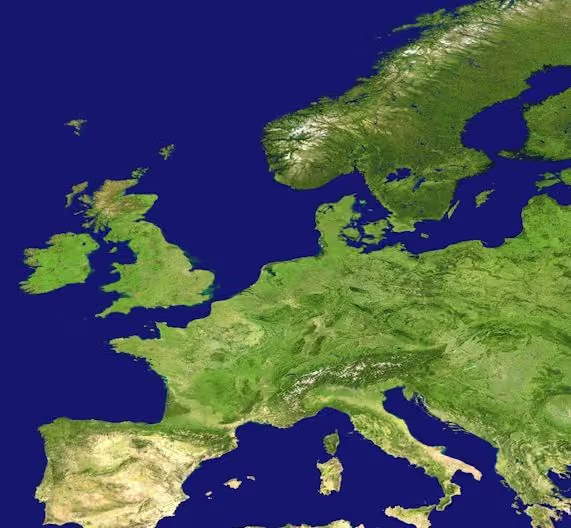
The European Union has unveiled plans to ban social media access for children under 13, reflecting growing concerns about online safety, privacy, harmful content, and the impact of digital platforms on young users. The proposal is aimed at creating stronger protections for children and placing greater responsibility on technology companies to verify users’ ages. If implemented, the measures could significantly reshape how minors access social media platforms across EU member states.

The European Union is preparing to introduce sweeping restrictions on children’s access to social media, including a proposed ban for users below the age of 13. European Commission President Ursula von der Leyen announced the initiative on Wednesday, signalling a tougher approach to how young people interact with digital platforms.
The proposal would establish common rules across all EU member states, rather than relying only on national measures. Several European countries have already introduced or considered restrictions for teenagers, reflecting a wider international movement aimed at reducing children’s exposure to the risks associated with social media.
Momentum for stricter controls has also grown outside Europe. Australia became the first country to prohibit social media access for people under 16 in December 2025, adding pressure on other governments to reconsider how technology companies serve younger audiences.
Under the EU’s proposed framework, children younger than 13 would not be permitted to use social media, while those under 15 would face limits on creating standard personal accounts. The measures are intended to establish clearer age boundaries and provide stronger safeguards for younger users.
For children aged 13 and 14, the EU is considering a more restricted form of access through what von der Leyen described as “mini accounts.” These accounts would operate under parental supervision and provide fewer features than regular social media profiles.
The proposed youth accounts would also come with a strict usage limit. Children using them could spend no more than one hour per day on social media, introducing a direct cap on daily screen time through these services.
The European Commission, which serves as the EU’s executive body, is also expected to introduce a new piece of legislation known as the Kids Act. The proposal would place greater responsibility on technology companies to demonstrate that their platforms are suitable and safe for younger users.
One of the most significant changes would be a reversal of the current burden of proof. Instead of regulators or families having to show that a platform poses risks to minors, social media companies themselves would be expected to provide evidence that their products and systems are safe for children and teenagers.
This approach could increase pressure on major technology platforms to review everything from age verification and privacy controls to algorithms, content recommendations and account features designed for younger audiences.
Von der Leyen also challenged the idea that governments have limited power when dealing with major technology companies. She stressed that Europe intends to take a more assertive role in determining the rules governing digital services.
Her message emphasized that technology companies would be expected to operate within standards set by European regulators, rather than defining the boundaries themselves.
If adopted, the proposals could represent one of the EU’s most significant steps yet toward reshaping the relationship between children, families and social media platforms. The measures would place greater emphasis on age-appropriate access, parental involvement and corporate accountability as concerns continue to grow over the influence of digital platforms on younger generations.
For questions or comments write to contactus@bostonbrandmedia.com
Source: CNN



-v3.jpg)


-v3-02.jpg)