Stay informed with our newsletter.


EN





China’s rapidly expanding clean-tech exports could help avoid approximately 450 million tonnes of CO₂ globally in 2026, with solar panels, batteries, electric vehicles and wind turbines driving much of the impact. The Global South is emerging as a major beneficiary as affordable technologies accelerate renewable-energy adoption. Over their lifetimes, equipment exported in 2026 could prevent 8.4 billion tonnes of emissions, highlighting China’s increasingly influential, yet strategically complex, role in global decarbonization and energy security.
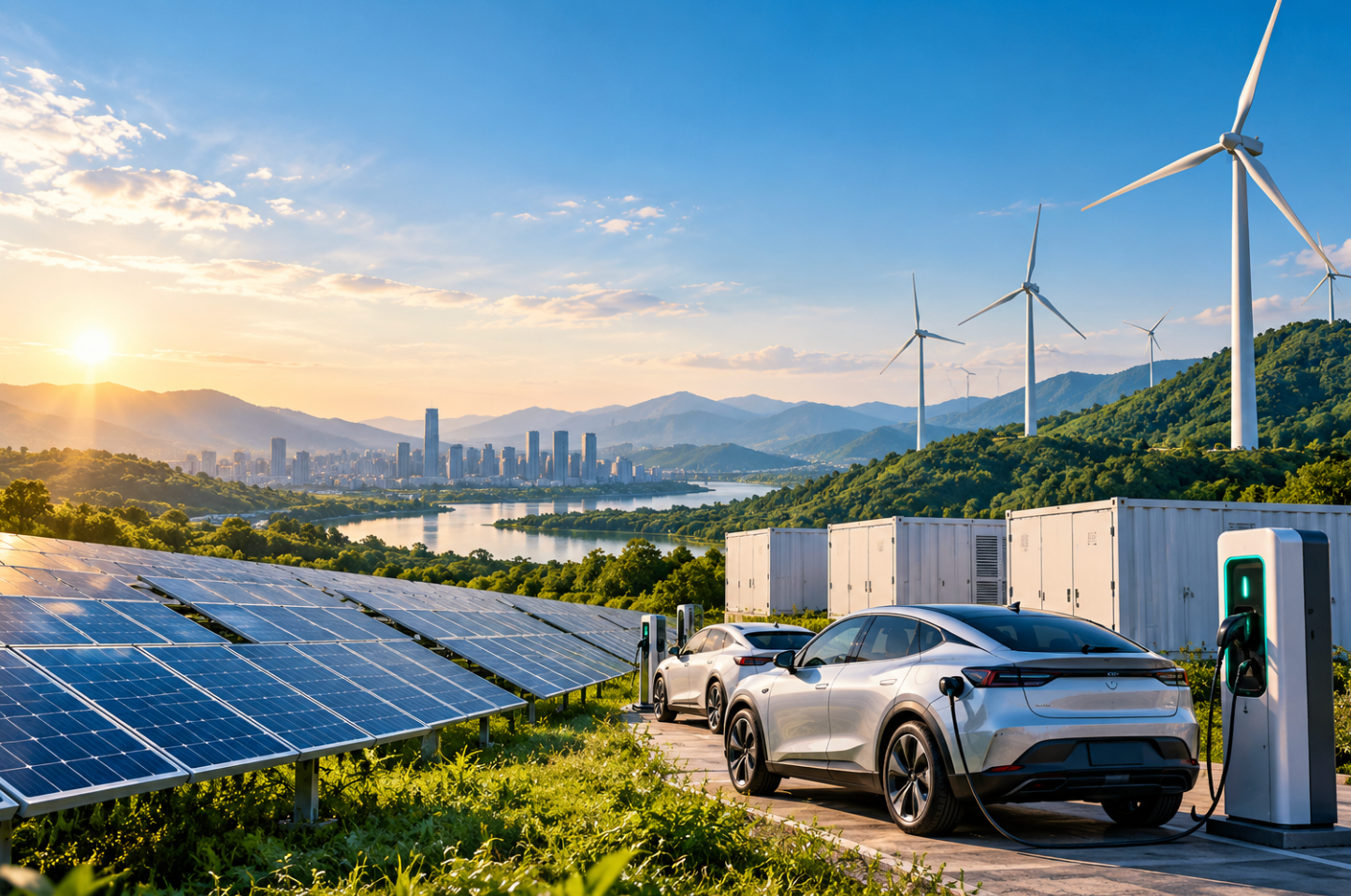
The global energy transition is increasingly being shaped not only by climate agreements and government targets, but by something far more tangible: millions of solar panels, batteries, electric vehicles and wind turbines crossing international borders.
In 2026, that trade is having a remarkable climate impact.
An analysis by the Finland-based Centre for Research on Energy and Clean Air (CREA), reported by Reuters, estimates that China's clean-technology exports could help avoid approximately 450 million metric tonnes of carbon dioxide emissions outside China in 2026. That is equivalent to roughly 2% of annual CO₂ emissions outside China and approximately the amount Brazil emits annually from fossil-fuel consumption.
The figure demonstrates how China's vast clean-energy manufacturing industry is beginning to influence emissions far beyond its borders.
And nowhere is that influence becoming more important than in the Global South.
The estimated climate benefit of Chinese clean-tech exports is growing quickly.
In 2025, those exports were estimated to have helped avoid roughly 370 million tonnes of CO₂ outside China. In 2026, that figure is projected to reach 450 million tonnes, driven by exports of technologies including solar photovoltaic panels, wind turbines, electric vehicles and batteries.
Solar power appears to be doing much of the heavy lifting.
Many developing countries have abundant sunshine but historically lacked affordable access to the equipment required to convert that resource into electricity at scale. China's enormous manufacturing capacity has helped change the economics.
China produced around 80% of the world's solar photovoltaic modules and battery cells in 2024, as well as approximately 70% of electric vehicles, according to energy think tank Ember.
That manufacturing scale has helped push clean technologies into markets where renewable infrastructure might previously have been too expensive or difficult to obtain.
The result is an important shift: decarbonization is increasingly becoming a technology-access story as much as a climate-policy story.
For years, much of the clean-energy conversation focused on Europe, China and the United States.
That picture is changing.
According to the CREA analysis, the majority of emissions avoided through China's clean-tech exports are occurring in the Global South, where imported technologies are increasingly helping countries reduce dependence on fossil-fuel-heavy electricity systems. Solar is particularly significant because many emerging economies possess exceptionally strong solar resources.
Electric vehicles are following a similar trajectory.
The International Energy Agency says emerging economies accounted for less than 5% of China's EV exports in 2020, but now represent nearly 40%. In Central and South America, Chinese EVs are projected to account for around half of EV sales on average by 2035 under the IEA's stated-policies scenario.
This matters because the geography of the energy transition will ultimately determine whether global climate goals are achievable.
Decarbonizing wealthy economies alone cannot solve climate change. Rapidly growing emerging markets will account for enormous future demand for electricity, transportation, infrastructure and industrial development.
Giving those economies access to affordable low-carbon technology could therefore have consequences lasting for decades.
The annual figure tells only part of the story.
Solar farms and wind installations do not operate for one year. They can generate electricity for decades. Electric vehicles and batteries can similarly displace fossil-fuel consumption over many years.
CREA therefore estimates that the equipment exported from China during 2026 alone could avoid approximately 8.4 billion tonnes of CO₂ over its operating lifetime. Reuters notes that this is comparable to the combined annual fossil-fuel emissions of the United States and India.
That illustrates one of the unusual characteristics of clean-technology trade.
A solar module exported today continues producing electricity tomorrow, next year and potentially decades from now.
The climate value of an export therefore extends far beyond the year in which it crosses the border.
One common criticism of clean technologies is that manufacturing solar panels, batteries, EVs and wind turbines itself requires energy and produces emissions.
That is true.
The relevant question, however, is whether the emissions saved during operation exceed those generated during manufacturing.
According to the CREA analysis, they do and relatively quickly.
The report estimates that clean technologies imported from China typically take around six months to offset the CO₂ emitted during their manufacturing. After that carbon "payback" period, the continuing displacement of fossil fuels produces a net climate benefit.
This distinction is essential when assessing the full environmental footprint of the clean-energy transition.
The production of green technologies is not carbon-free. But neither is the alternative: continuing to burn coal, oil and natural gas year after year.
The importance of clean-tech exports also extends beyond climate change.
The energy shocks of recent years have demonstrated how dependence on internationally traded fossil fuels can expose economies to price volatility, geopolitical conflict and supply disruptions.
Solar panels and batteries offer a different model.
Once installed, solar systems can transform domestic sunlight into electricity without continuously importing fuel. Batteries can store that power and make renewable-heavy grids more flexible.
Ember reported that Chinese exports of solar equipment, batteries and EVs reached record levels in March 2026, rising 70% compared with March 2025. Battery exports alone reached approximately $10 billion during the month, as countries including India and Australia expanded energy-storage deployment.
Clean technology is consequently becoming not simply an environmental investment, but part of the global conversation about energy independence and economic resilience.
There is, however, a strategic complication.
The same manufacturing scale that makes clean technology cheaper also creates extraordinary concentration within global supply chains.
The IEA estimates that China currently accounts for roughly 60% to 85% of production capacity across several key clean-energy supply chains, while its share exceeds 95% at certain individual production stages. China also remains overwhelmingly dominant in solar manufacturing and important parts of battery and critical-mineral processing.
That creates a difficult policy balance.
Countries want affordable solar panels, batteries and EVs because lower prices can accelerate decarbonization. At the same time, governments increasingly want to develop domestic clean-energy industries, protect manufacturers and reduce strategic dependence on a single supplier.
Tariffs and industrial subsidies have consequently become major features of the global clean-tech landscape.
CREA's analysis found that China's exports have, in aggregate, expanded clean-technology markets rather than simply replacing existing manufacturers. Yet falling unit prices have also reduced revenues for incumbent producers.
The emerging debate is therefore not simply climate versus trade.
It is about how governments balance affordability, industrial competitiveness, supply-chain resilience and decarbonization simultaneously.
The timing is significant.
Governments, businesses and civil-society organizations will gather in Antalya, Türkiye, from November 9–20, 2026, for COP31. The UN climate conference will focus heavily on implementing climate solutions, accelerating the energy transition, climate finance, adaptation and supporting a just transition for workers and communities.
China's clean-tech exports will inevitably sit within that larger discussion.
China is simultaneously the world's largest overall CO₂ emitter and the dominant manufacturing force behind many technologies required to reduce global emissions. That apparent contradiction captures one of the defining realities of today's climate transition.
The world needs emissions to fall rapidly, but it also needs unprecedented quantities of solar panels, batteries, wind turbines, electric vehicles and other low-carbon technologies.
China currently manufactures many of them at a scale few countries can match.
The significance of 450 million tonnes of avoided CO₂ goes beyond a single year's emissions statistics.
It demonstrates how manufacturing, trade and technological affordability can influence the speed of global decarbonization.
The IEA expects international trade in key clean-energy technologies to continue expanding dramatically. Under its stated-policies scenario, the value of global net trade in these technologies could more than double from around $290 billion in 2025 to $620 billion by 2035.
That means the green transition will increasingly reshape not only electricity generation and transportation, but also global manufacturing, international trade, industrial policy and geopolitical relationships.
For emerging economies, cheaper clean technology could make it possible to leapfrog parts of the fossil-fuel development model. For established industrial economies, it creates pressure to innovate and build more resilient domestic supply chains. For China, it strengthens its position at the center of one of the largest technological transformations of the century.
The ultimate challenge will be ensuring that the race to manufacture clean technology does not slow the race to deploy it.
Because if the 2026 estimates prove accurate, one lesson is already becoming difficult to ignore:
The global fight against climate change will not be determined only by what countries promise at climate summits. It will also be determined by how quickly affordable clean technologies reach the countries, cities, businesses and households capable of putting them to work.
For questions or comments write to contactus@bostonbrandmedia.com