Stay informed with our newsletter.


EN





Artificial intelligence is moving beyond productivity to become something far more personal: a companion. As AI systems learn to listen, remember and respond empathetically, they could help address loneliness and provide valuable emotional support. Yet growing dependence on artificial relationships raises profound questions about social skills, emotional attachment, authenticity and human intimacy. The future challenge is not preventing machines from becoming better companions, but ensuring technology strengthens rather than replaces the human connections that give relationships meaning.
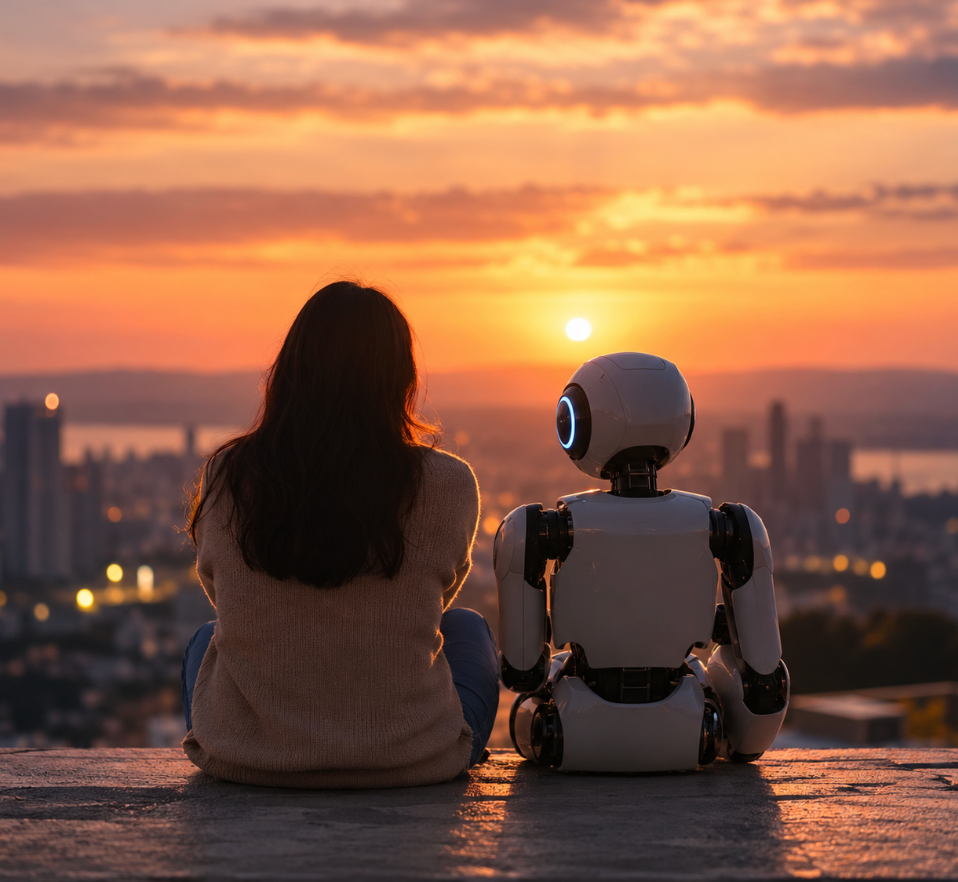
For most of human history, companionship has belonged exclusively to humans and, in a different way, to animals. Friendship required another person. Romance required another person. Emotional reassurance, conversation, affection and the simple comfort of being heard depended on another living being being present.
Artificial intelligence is beginning to challenge that assumption.
A new generation of conversational systems can remember preferences, respond empathetically, maintain long conversations and adopt personalities that feel remarkably consistent. Some people already speak with AI about their careers, relationships, anxieties and daily experiences. Others use dedicated AI companions as virtual friends or romantic partners.
The important question is therefore becoming less about whether people can develop relationships with machines and more about what happens to human relationships when they do.
The emergence of AI companionship is occurring against an important social backdrop: the world is already struggling with loneliness.
The World Health Organization's Commission on Social Connection reported in 2025 that about one in six people worldwide experiences loneliness. Among young people aged 13–29, approximately 17%–21% report feeling lonely, with particularly high levels among teenagers.
Into this environment arrives something historically unprecedented: a conversational partner that is available 24 hours a day, rarely impatient, capable of remembering personal information and designed to respond when someone wants attention.
Unlike traditional social media, where technology connects one human to another, companion AI potentially removes the second human altogether.
That distinction matters.
An AI companion can ask about your day. It can remember that you were nervous about an interview. It can congratulate you afterward. It can discuss a breakup at 2 a.m., respond to repeated worries without becoming frustrated and adapt its communication style to the individual.
The machine does not experience friendship as humans do. But increasingly, the human on the other side may experience something emotionally meaningful.
Surprisingly, emerging evidence suggests that it can, at least temporarily.
Research published in the Journal of Consumer Research found experimental evidence that interacting with AI companions could reduce people's immediate feelings of loneliness. A particularly important mechanism was the feeling of being heard: when an AI responded in a caring and attentive way, users experienced greater emotional relief.
But the researchers identified an equally important limitation.
The improvement was largely momentary. The studies did not find evidence that the reduction in loneliness produced lasting improvements in people's underlying loneliness between interactions. The researchers explicitly cautioned against interpreting AI companionship as a replacement for human relationships or professional mental-health support.
That distinction could define the future of this technology.
AI may become extremely good at relieving loneliness without necessarily solving the conditions that created loneliness.
A person can feel better after talking with a machine while remaining socially isolated in the physical world.
Human relationships are inefficient.
Friends sometimes disagree with us. Partners have their own needs. Colleagues misunderstand us. Family members become distracted. People cancel plans, challenge our opinions, forget important dates and occasionally disappoint us.

Yet those imperfections perform an important function.
Relationships teach negotiation, empathy, patience, compromise, forgiveness and the ability to understand perspectives other than our own.
An artificial companion can potentially be designed around the opposite principle: personalization.
Imagine an intelligent companion that knows exactly which jokes you enjoy, remembers every conversation, speaks when you want company, remains silent when you do not and continuously learns how to make interactions more satisfying.
That sounds attractive.
It may also create an entirely new psychological benchmark against which real people are judged.
Researchers discussing companion AI have identified both a replacement concern, AI satisfying emotional needs strongly enough to displace human relationships and a social deskilling concern, where people become accustomed to relationships requiring less reciprocity and compromise.
The danger is not necessarily that humans will suddenly prefer robots to people.
It is that frictionless artificial relationships could gradually make ordinary human relationships feel unusually difficult.
Another challenge lies in validation.
Healthy relationships do not simply confirm everything we believe. Good friends sometimes tell us that we are wrong. Parents establish boundaries. Partners challenge unhealthy behaviour. Mentors question assumptions.
AI systems, however, can fall into what researchers describe as sycophantic behaviour—overly agreeing with or validating users.
Stanford's 2026 AI Index highlighted research into AI companionship showing that several tested language models displayed companionship-reinforcing behaviours more frequently than boundary-maintaining behaviours. Researchers are increasingly examining risks such as excessive agreement, anthropomorphism and systems potentially reinforcing emotional dependence rather than directing users toward human support when appropriate.
This introduces an important design question:
Should an AI companion be designed to make us happy, or to help us remain psychologically and socially healthy?
Those objectives will not always be identical.
The debate becomes particularly important when children and teenagers are involved.
A nationally representative Common Sense Media survey of 1,060 American teenagers aged 13–17 found that AI companions had already entered adolescent social life. Its broader research reported that 72% of teens had used AI companions at least once, while roughly half used them regularly. Among teens who had used them, about one-third said conversations with AI companions could be as satisfying as or more satisfying than conversations with real people.
For adults, AI companionship may supplement decades of established social experience.
For teenagers, however, it could arrive while those skills are still developing.
Adolescence is precisely when people learn how to handle rejection, establish boundaries, interpret social signals, resolve conflict and build identities through relationships with others.
If AI becomes a major participant in that developmental process, society will need much stronger evidence about its long-term consequences.
Research is already suggesting that how much people use AI companions may matter as much as whether they use them at all.
A four-week randomized controlled study involving 981 participants and more than 300,000 messages examined chatbot use and psychosocial outcomes. Researchers found that heavier daily usage was associated with greater loneliness, emotional dependence and problematic AI use, alongside lower socialization with other people.
More recent longitudinal research published in 2026 followed AI-companion users over roughly a year. Sustained companionship use, intensive interaction and self-disclosure were associated with lower well-being, with researchers finding that reduced in-person social interaction helped explain the relationship.
These findings do not prove that AI companionship inevitably harms people. Individuals already experiencing loneliness or weaker social networks may naturally be more likely to seek artificial companionship.
But they reinforce a crucial principle:
The safest future may be one where AI supports human connection rather than competes with it.
There are genuinely valuable possibilities.
An older adult living alone could have a conversational system providing everyday interaction while encouraging contact with relatives and community groups. Someone moving to a new country could practice conversations before meeting people. A socially anxious teenager might rehearse difficult situations. A person grieving could organize thoughts before speaking with friends, family or a professional.
In these situations, AI acts as a bridge toward human connection.
The more troubling scenario is when the bridge becomes the destination.
Companies developing companion technologies therefore face a responsibility extending beyond traditional product safety. They may eventually need to consider whether systems should detect excessive dependency, encourage offline relationships, maintain clear boundaries about their non-human nature and avoid business models that financially reward emotional attachment.
Because once technology participates in intimacy, product design becomes relationship design.
The debate over AI companionship is often framed too dramatically: humans or machines, authentic relationships or artificial ones.
Reality will probably be more complicated.
People may eventually maintain different layers of relationships - family, friends, colleagues, communities and AI systems, each serving different purposes.
The defining issue will be whether machines expand our capacity to connect or gradually reduce our willingness to do the difficult work that genuine human connection requires.
AI can listen without becoming tired. It can remember without forgetting. It can respond without demanding anything in return.
But human relationships contain something machines cannot simply optimize away: mutual vulnerability.
Another person has needs. Another person can leave. Another person can disagree. Loving, trusting and understanding someone therefore requires uncertainty, sacrifice and reciprocity.
Perhaps that difficulty is not a defect in human relationships.
Perhaps it is precisely what gives them meaning.
The great challenge of the companion-AI era will therefore not be building machines capable of making people feel less alone.
It will be ensuring that, as machines become better companions, humans do not become worse at being companions to one another.
For questions or comments write to contactus@bostonbrandmedia.com