Stay informed with our newsletter.
.webp)


EN





Five major forces are reshaping global brand leadership in 2026. Chinese automakers are expanding rapidly overseas, Amazon is pushing 30-minute drone delivery, Starbucks is turning nostalgia into commercial momentum, Apple, Google and Samsung are embedding AI agents into everyday devices, and IKEA is entering the second-hand economy. Together, these trends show how leading brands are competing through speed, technology, emotional connection, global expansion and circular business models.
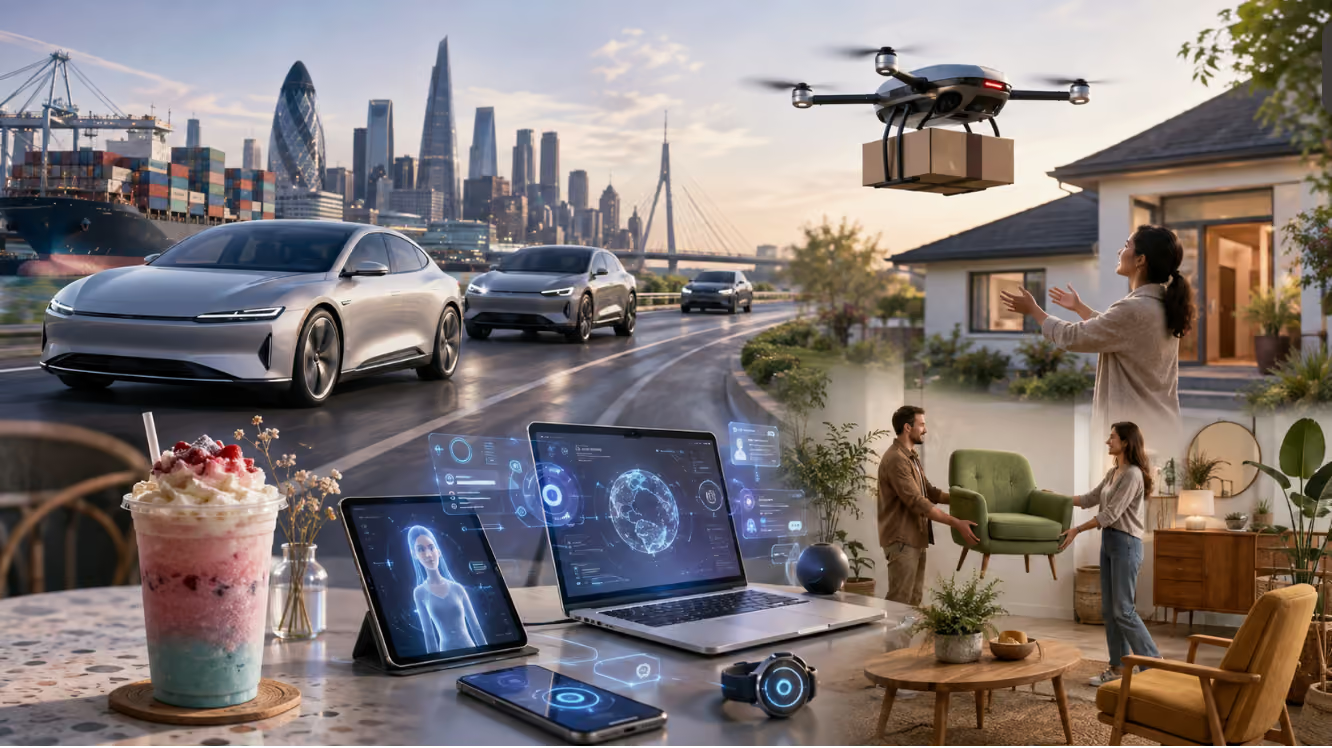
The world's biggest brands are entering a period in which competitive advantage is being redefined at extraordinary speed. Chinese automakers are expanding aggressively overseas, Amazon is attempting to make 30-minute drone delivery routine, Starbucks is monetising nostalgia, Apple, Google and Samsung are turning devices into AI assistants, and IKEA is moving directly into the second-hand economy.
Although these developments span very different industries, they reveal a common theme: leading brands are no longer competing only through products. They are competing through ecosystems, convenience, emotional connection, artificial intelligence and participation across the entire life cycle of a product.
Perhaps one of the most significant shifts in global branding is occurring in the automotive industry.
Chinese manufacturers including BYD, Chery and Geely are increasingly moving from being domestic competitors to becoming global automotive challengers.
China is already the world's largest vehicle exporter, and Reuters reported that Chinese vehicle exports surged 88% year-on-year in July 2026, even as domestic vehicle sales continued to weaken. Chinese brands are gaining particularly strong momentum across Europe, the UK, Brazil and other international markets.
Their progress is increasingly visible in Europe. Reuters reported that Chinese vehicles have reached around 16% of Europe's overall car market and nearly 25% of its EV segment. That represents a dramatic challenge to automotive groups that have historically dominated the region.
Rather than relying entirely on exports, Chinese companies are also embedding themselves inside overseas markets.
Chery announced plans for a UK research and development centre at UTAC Millbrook in Bedfordshire, initially focusing on chassis engineering and driver-assistance systems, with autonomous-driving and AI development expected later. Chinese manufacturers already account for approximately 15% of UK new-car registrations, compared with about 10% a year earlier.
Geely is pursuing an equally ambitious international strategy. The group is targeting approximately 600,000 annual European vehicle sales within two to three years, while its longer-term goal is for two-thirds of sales to come from outside China.
The automotive establishment is therefore facing more than an EV challenge. It is facing the emergence of a new generation of global brands with competitive pricing, rapid development cycles, advanced batteries, software and increasingly local manufacturing and R&D.
While automakers battle for international market share, Amazon is attempting to change something equally fundamental: how quickly consumers expect physical goods to arrive.
Amazon says its Prime Air drone network will expand to nearly 500 U.S. cities and towns by the end of 2026, representing roughly a sixfold expansion from its current footprint and putting the service within reach of tens of millions of customers.
Prime Air can deliver eligible purchases in as little as 30 minutes. Amazon says millions of products across groceries, electronics, cosmetics, medicines and household categories can potentially be delivered using drones.
Crucially, the service is becoming much broader than experimental deliveries. Amazon says more than 60% of the products customers most frequently purchase can meet its drone-delivery size requirements, generally items weighing five pounds or less. The company had already completed hundreds of thousands of drone deliveries during 2026 when announcing the expansion.
Amazon's wider logistics network underscores the scale of the ambition. In 2025, it delivered more than 13 billion items worldwide on the same day or next day, including more than eight billion in the United States.
The strategic implication is enormous: if 30-minute delivery moves from novelty to expectation, speed itself becomes part of the product.
Not every major brand trend depends on futuristic technology.
Starbucks demonstrated in August that bringing back a familiar product can generate as much excitement as creating something completely new.
The company revived its colourful Unicorn Frappuccino, originally launched in 2017, for a limited global return beginning August 15.
The result was remarkable.
Starbucks sold more than two million Unicorn Frappuccinos during the comeback weekend in its North American company-operated stores, helping produce its best North American company-operated sales weekend ever. August 15 also became the company's biggest Saturday sales day in that business.
The drink was simultaneously promoted across markets including the United States, Canada, Mexico, Asia-Pacific, Europe, the Middle East and North Africa.
The lesson extends beyond coffee.
Nostalgia is becoming a powerful commercial asset because established brands possess decades of products, characters, packaging, campaigns and experiences that younger consumers can discover while older customers rediscover them.
In an era of constant new launches, familiarity can itself become distinctive.
The technology industry's next battle is increasingly about something bigger than processing speed or camera quality.
Apple, Google and Samsung are attempting to turn personal devices from passive tools into proactive AI assistants capable of understanding context and completing tasks.
Apple's newly announced M6 is its first chip manufactured using a 2-nanometer process. It includes a dual 16-core Neural Engine delivering up to twice the peak compute of previous generations, while its GPU delivers nearly 30% more peak AI compute than M5. Apple is explicitly positioning the chip for on-device large language models and agentic AI workloads.
Google is pursuing the same shift through its Pixel ecosystem. The Pixel 11 series, powered by Tensor G6, has been designed around Gemini Intelligence. Google says Gemini can perform multistep activities across more than 40 apps, including tasks such as reservations, communication and personalised assistance.
Samsung's latest Galaxy Z Fold8 family similarly places agentic AI at the centre of the experience. Its software can, for example, identify when multitasking might be useful or help users search for hotels based on an image while they continue doing something else.
Consumer interest appears strong: Samsung said pre-orders for its 2026 Galaxy Z lineup increased by more than 30% compared with the previous generation.
The smartphone and computer are gradually evolving from devices users operate into systems that increasingly act on users' behalf.
A very different transformation is occurring in retail.
For decades, brands mainly generated revenue when customers bought new products. Resale frequently happened outside the original company's ecosystem through classified ads and third-party marketplaces.
IKEA is challenging that model.
The company has introduced IKEA Preowned, a digital marketplace enabling customers to buy and sell used IKEA furniture directly to one another.
Ingka Group reported that IKEA had launched its second-hand marketplace in three countries, with plans to scale the concept across Europe from FY2026. The initiative forms part of its broader circularity strategy, which also includes an ambition associated with €1 billion in circular investments.
This represents an important strategic change.
Instead of allowing the resale economy to exist entirely outside the brand, IKEA can remain connected to a product during its second, third or potentially fourth ownership cycle.
For consumers, resale offers lower prices. For brands, it can generate engagement, strengthen sustainability credentials and potentially introduce younger or more budget-conscious customers to the ecosystem.
These five developments may appear unrelated, but together they show how dramatically global brand strategy is evolving.
BYD, Chery and Geely are globalising manufacturing brands. Amazon is turning delivery speed into competitive infrastructure. Starbucks is monetising emotional memory. Apple, Google and Samsung are transforming hardware into AI agents. IKEA is extending its relationship with products beyond the first sale.
The world's strongest brands increasingly understand that consumers are not simply purchasing objects. They are buying time, convenience, intelligence, identity, experiences and value over a product's entire lifespan.
In 2026, the companies shaping the future are therefore not necessarily those launching the greatest number of new products.
They are the brands redefining what consumers expect a brand to do for them.
For questions or comments write to contactus@bostonbrandmedia.com



-v3.jpg)


-v3-02.jpg)