Stay informed with our newsletter.
.webp)


EN





British Columbia will shift to permanent daylight saving time after observing one final seasonal clock change this spring. The move aims to eliminate the biannual time adjustment, providing consistent daylight hours year-round. Officials say the decision is intended to align the province with key trading partners and improve convenience for residents and businesses. After the upcoming time change, clocks will no longer be set back in the fall.
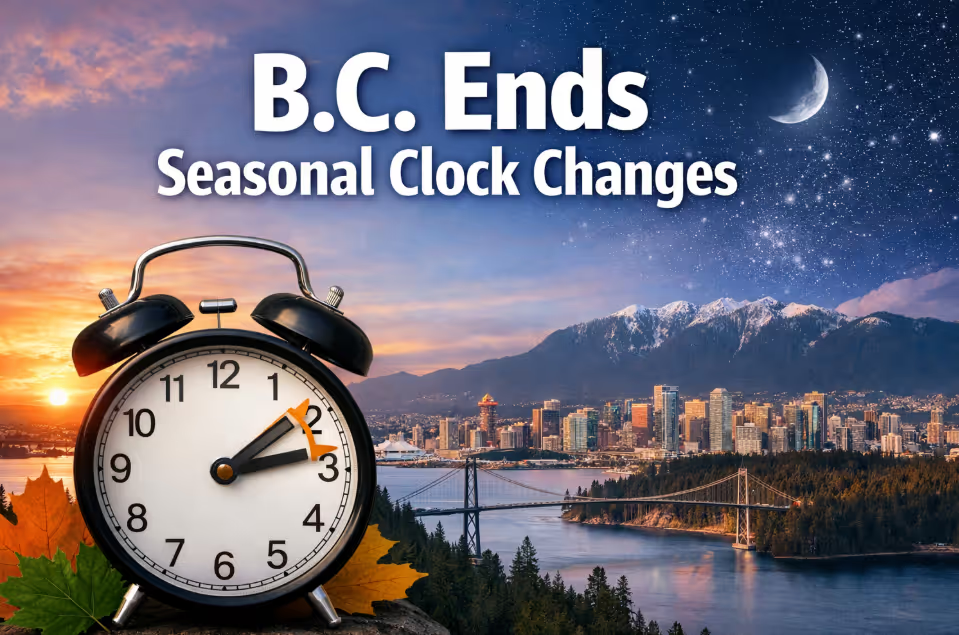
British Columbia is moving to permanent daylight saving time, making this Sunday’s one-hour jump forward the final clock adjustment the province will observe.
From then on, the twice-a-year ritual of changing clocks will come to an end, Premier David Eby confirmed.
With the shift, B.C. will share the same time year-round as Yukon and align with Alberta between November and March. During winter, the province will remain an hour ahead of Washington, Oregon, and California.
Eby argued that switching clocks twice annually disrupts daily routines. Children and pets wake at their usual times regardless of the adjustment, while parents and workers lose valuable sleep. The result, he noted, can include fatigue, health complaints, and even a spike in traffic accidents, consequences he described as unnecessary burdens on residents.
Attorney General Niki Sharma welcomed the change, saying it promises steadier, more predictable schedules. When November arrives, traditionally the moment clocks fall back, no adjustment will occur. Instead, B.C. will fully adopt Pacific Time, set seven hours behind Coordinated Universal Time.
Beginning in November 2026, the province will sit two hours behind Eastern Standard Time, shifting to a three-hour gap starting March 2027.
The groundwork for this transition was laid under former premier John Horgan, when legislation was passed to scrap seasonal clock changes. However, implementation stalled as B.C. sought coordination with U.S. west coast states to prevent cross-border business complications.
In 2020, Yukon residents made their final time adjustment after a strong public consultation supported permanent daylight saving time.
Eby acknowledged that B.C. had initially planned to move in step with American partners but suggested momentum south of the border had slowed. He pointed out that Yukon had already taken the leap and said B.C. is now choosing to act in its own interest rather than wait indefinitely.
Data from the Pew Research Center shows only about one-third of countries worldwide observe daylight saving time, with most located in Europe.
Within Canada, Saskatchewan stands apart by largely avoiding daylight saving time altogether, except for a handful of border communities.
Business groups have voiced concerns about the province acting independently. The Greater Vancouver Board of Trade warned that going it alone could complicate cross-border operations and deter investment. Its president and CEO, Bridgitte Anderson, described the move as an unnecessary distraction that may create logistical challenges for companies operating internationally.
The Canadian Federation of Independent Businesses echoed that sentiment, suggesting the timing of the announcement could catch small businesses off guard. The group argued that without broader coordination, confusion and disruption are likely. It also criticized the government’s broader fiscal policies, saying ending seasonal clock changes will not address deeper economic concerns facing small enterprises.
For questions or comments write to contactus@bostonbrandmedia.com
Source: globalnews



-v3.jpg)


-v3-02.jpg)