Stay informed with our newsletter.
.webp)


EN





AI and robotics are rapidly moving beyond experimentation into practical business applications, creating a new Machine Economy. Intelligent robots, humanoids and automated systems are transforming manufacturing, healthcare, logistics, retail and restaurants by improving efficiency, precision and productivity. Advances in artificial intelligence, computer vision and autonomous decision-making are enabling machines to perform increasingly complex tasks, while countries and companies worldwide compete to lead the next generation of robotics, automation and human-machine collaboration across the global economy.
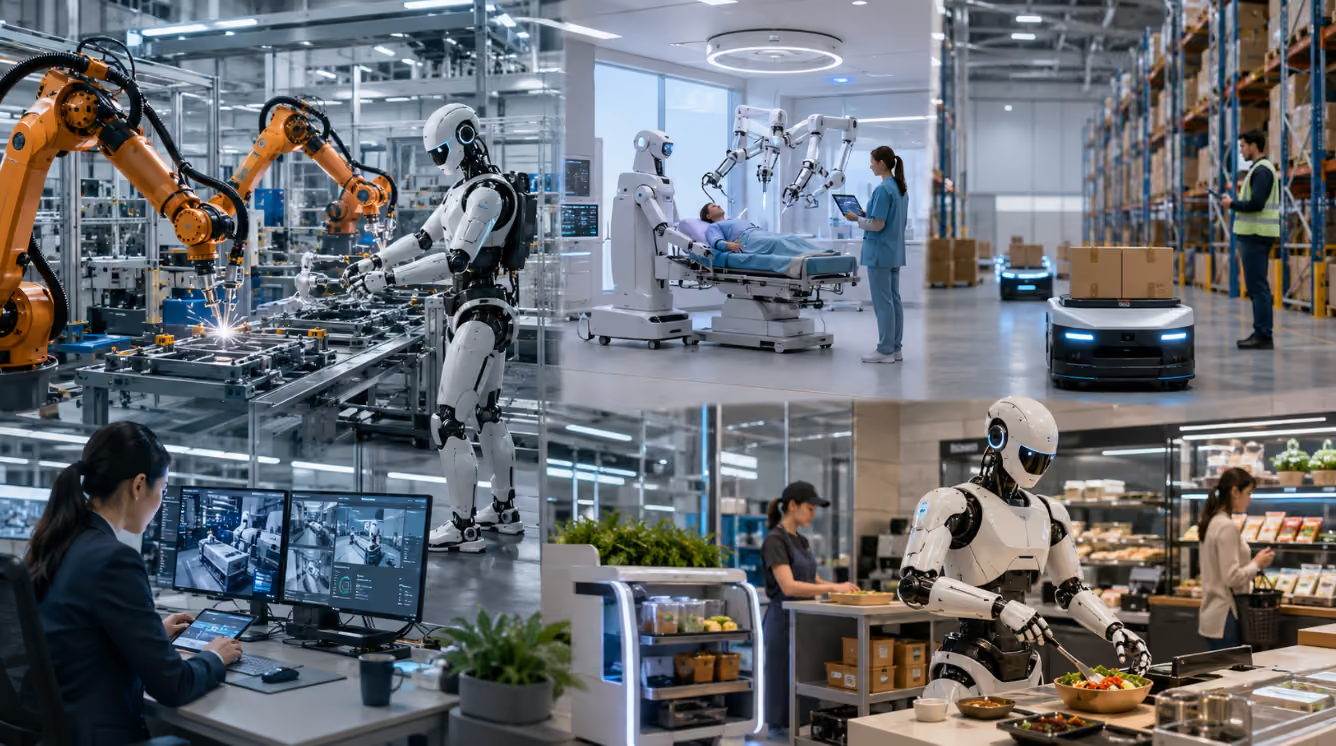
For decades, robots were associated mainly with fenced-off industrial arms performing repetitive jobs on automotive assembly lines. In 2026, that definition is rapidly becoming outdated. A new generation of machines, powered by artificial intelligence, computer vision, foundation models, advanced sensors and autonomous decision-making, is beginning to operate in factories, hospitals, warehouses, stores and restaurants.
This shift is creating what can increasingly be described as the Machine Economy: an economic system in which intelligent machines do more than automate fixed tasks. They can perceive their environment, make decisions, learn new activities and work alongside people.
The numbers show how far automation has already progressed. According to the International Federation of Robotics (IFR), 542,000 industrial robots were installed worldwide in 2024, more than double the annual number installed a decade earlier. The global operational stock reached approximately 4.66 million industrial robots, while the market value of industrial robot installations has climbed to a record $16.7 billion.
Traditional industrial automation works exceptionally well when environments and tasks remain predictable. AI is changing that equation.
Modern robots increasingly combine computer vision, machine learning, natural-language processing and generative AI, allowing them to identify objects, plan movements, respond to changing conditions and learn tasks that previously required extensive programming.
The IFR identifies AI and autonomy as one of the defining robotics trends of 2026. Generative and agentic AI can potentially move robotics away from rigidly programmed systems toward machines capable of adapting to more complex real-world environments.
This convergence is commonly called Physical AI, giving artificial intelligence the ability not only to generate text or analyze information, but to sense, move and act in the physical world.
Companies including NVIDIA, ABB, FANUC, KUKA, Yaskawa, Figure AI, Boston Dynamics, Agility Robotics and Universal Robots are developing different layers of this ecosystem, ranging from industrial robots and humanoids to the computing platforms and foundation models that provide their intelligence. NVIDIA, for example, is expanding its Isaac, Cosmos and GR00T platforms for training, simulating and operating intelligent robots.
Manufacturing is emerging as one of the strongest proving grounds for humanoid robots because factories already have measurable workflows, clearly defined productivity targets and significant demand for repetitive physical work.
BMW provides one of the clearest examples of the technology moving beyond a laboratory demonstration.
At BMW's Spartanburg plant in South Carolina, Figure AI's Figure 02 humanoid supported production of more than 30,000 BMW X3 vehicles during a ten-month deployment in 2025. It moved more than 90,000 components, accumulated roughly 1,250 operating hours and performed about 1.2 million steps, handling sheet-metal components used in the welding process. BMW is now working with the newer Figure 03 on logistics sequencing applications.
BMW has also brought humanoid experimentation to Germany through its Leipzig plant, demonstrating how Physical AI is beginning to cross from isolated pilots into multinational manufacturing strategies.
Another major contender is Boston Dynamics. In January 2026, the company unveiled the production version of its electric Atlas humanoid and said 2026 deployments were committed to Hyundai's Robotics Metaplant Application Center and Google DeepMind. Hyundai plans progressively broader industrial applications as the technology proves its safety and productivity.
If humanoids represent the emerging frontier, warehouse robotics is already a large commercial business.
Amazon announced in 2025 that it had deployed its one-millionth robot across its operations. Its robotic fleet assists with activities including stowing, picking, sorting and transporting products inside fulfillment facilities. Amazon has also developed DeepFleet, an AI foundation model designed to improve robotic fleet travel efficiency by approximately 10%.
Globally, logistics is the largest professional service-robot category. IFR data shows approximately 102,900 transportation and logistics robots were sold in 2024, representing more than half of professional service robot sales and an increase of 14%.
A particularly important business model is also gaining ground: Robotics-as-a-Service (RaaS). Rather than purchasing expensive machines upfront, businesses can rent or subscribe to robotics capacity. The IFR reported that the RaaS fleet grew 31% in 2024, making sophisticated automation more accessible to smaller companies.
Healthcare is becoming another major robotics growth market.
Worldwide sales of medical robots increased 91% in 2024 to around 16,700 units, according to IFR data. Sales of rehabilitation and non-invasive therapy robots increased 106%, demand for surgical robots grew 41%, and robots for diagnostics and medical laboratory analysis recorded particularly rapid growth.
One of the most established players is Intuitive Surgical. Approximately 3.15 million procedures were performed using da Vinci systems during 2025, an 18% increase from 2024, while the global installed base reached approximately 11,106 da Vinci surgical systems by year-end.
The significance extends beyond surgery. Robots can transport hospital supplies, automate laboratories, assist rehabilitation and potentially help healthcare systems respond to ageing populations and shortages of skilled workers.
Robotics is also moving closer to everyday consumers.
Retailers are connecting automation with AI-powered inventory management, fulfillment and distribution. Walmart, for example, is expanding automated fulfillment technology while using partners such as Symbotic, WITRON and Knapp for advanced warehouse and distribution systems. Its international supply chain is increasingly combining real-time AI with automation to predict demand and reposition inventory.
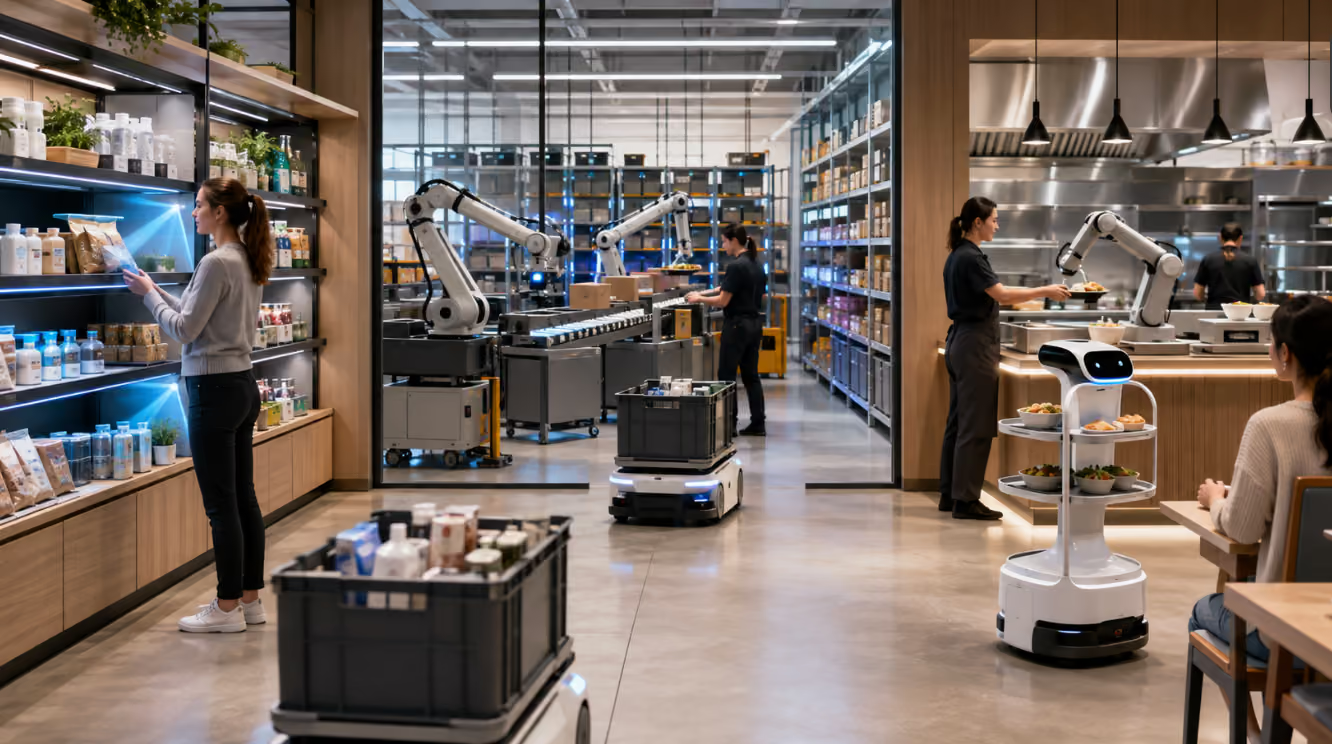
Restaurants are experimenting with a different class of machines: collaborative food-preparation robots.
Chipotle has tested Autocado, a system developed with Vebu that can cut, core and scoop an avocado in less than 30 seconds, allowing employees to focus on more complex preparation activities. The company has also tested Hyphen's automated makeline technology for digital bowl and salad orders.
The goal is increasingly not a restaurant without humans, but a restaurant where automation handles repetitive, time-consuming and physically demanding tasks.
The robotics race is also becoming an important measure of industrial competitiveness.
China is currently the world's largest industrial robot market, installing approximately 295,000 robots in 2024 - 54% of all new global deployments. Its operational industrial robot stock has surpassed two million units. Chinese manufacturers also captured 57% of their domestic market in 2024, illustrating China's shift from being primarily a robotics buyer to becoming a major robotics producer.
South Korea, however, remains the world's most robot-intensive manufacturing economy with approximately 1,220 industrial robots per 10,000 manufacturing employees, followed by Singapore with 818, China with 567, Germany with 449 and Japan with 446.
The United States remains particularly strong in AI research, software, robotics startups, warehouse automation and medical robotics. Preliminary IFR figures show U.S. industrial robot installations rose 11% to about 38,000 units in 2025.
Meanwhile, India is becoming an increasingly important automation market, installing a record 9,100 industrial robots in 2024, up 7%, and ranking sixth globally for annual installations.
The humanoid race is accelerating especially quickly in China. In August 2026, Reuters reported that Chinese manufacturers delivered more than 40,000 humanoid robots in the first half of the year, while companies including Unitree and XPeng are racing to commercialize embodied AI. XPeng's robotics operation raised more than $900 million in August and plans to build manufacturing capacity for its IRON humanoid.
Despite the excitement, humanoids are not yet a universal replacement for human labor. Reliability, battery life, dexterity, cycle times, maintenance costs, cybersecurity and workplace safety remain significant challenges.
The IFR specifically warns that humanoids must prove they can meet demanding industrial standards for reliability, productivity, safety and cost efficiency before mass deployment becomes economically compelling.
That distinction matters. The coming Machine Economy is unlikely to be defined simply by “humans versus robots.” Instead, businesses will increasingly redesign work around people, AI agents, specialized robots and autonomous machines working together.
The most important change is that AI is acquiring a physical presence.
After transforming software, search, finance, marketing and knowledge work, artificial intelligence is beginning to move boxes, assemble cars, assist surgeons, prepare food and operate machines.
That is what makes 2026 an important turning point. The robotics revolution is no longer principally about demonstrating what machines could eventually do.
It is increasingly about deciding where they can create measurable economic value today and that is the foundation of the emerging Machine Economy.
For questions or comments write to contactus@bostonbrandmedia.com



-v3.jpg)


-v3-02.jpg)