Stay informed with our newsletter.
.webp)


EN





The United Arab Emirates has become one of the first nations to make artificial intelligence education compulsory from kindergarten through graduation. The initiative is part of the country’s long-term strategy to prepare students for a technology-driven future and strengthen its position as a global innovation hub. As AI rapidly transforms industries and job markets worldwide, governments across the globe are closely watching the UAE’s education reform as they rethink curricula, digital literacy, and workforce readiness for future generations.
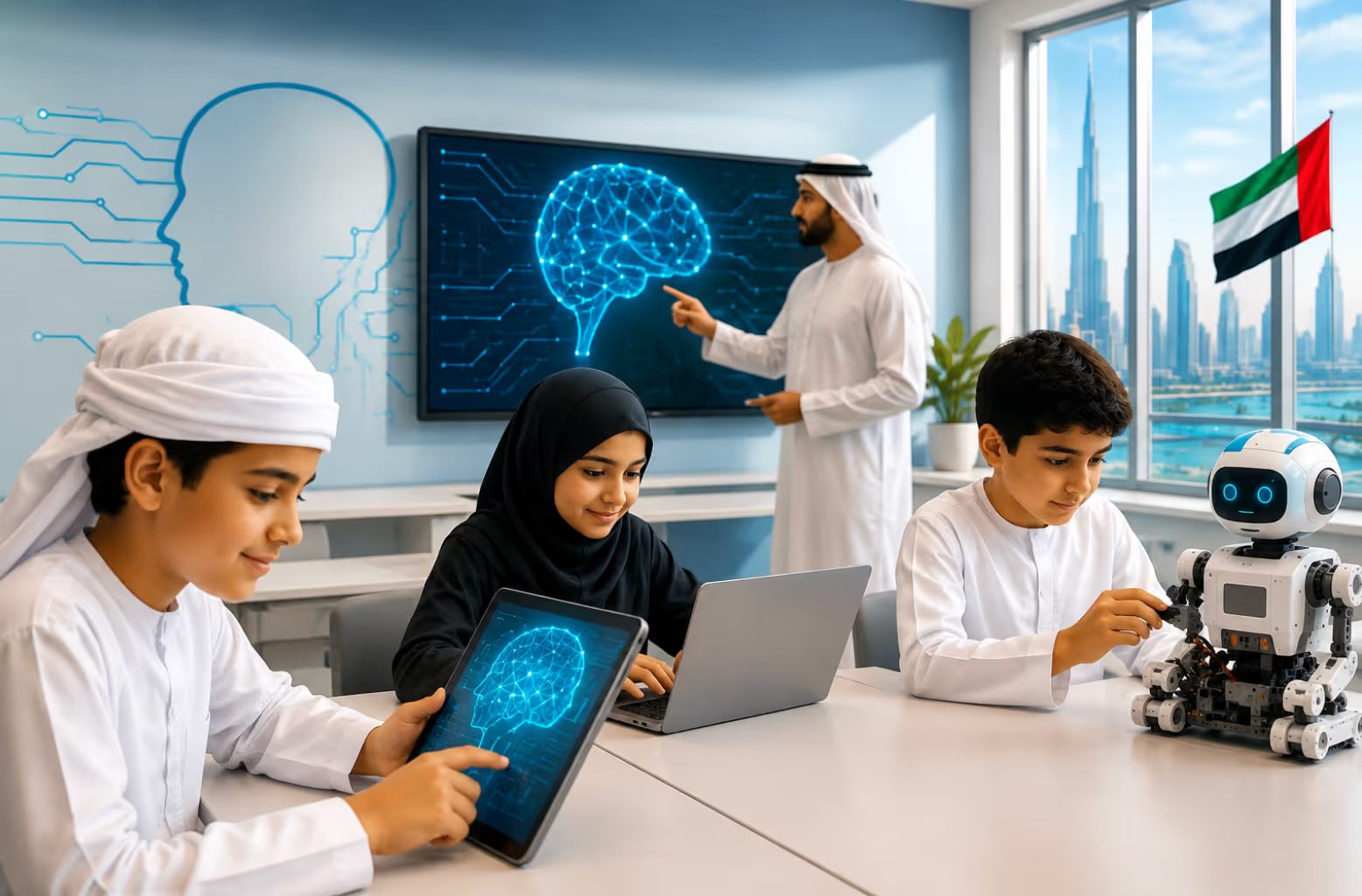
The United Arab Emirates has taken a major step toward preparing its younger generations for the digital economy by making artificial intelligence (AI) education compulsory across schools from kindergarten through graduation. The landmark decision positions the UAE among the first countries in the world to embed AI learning into the national curriculum at every stage of education, reflecting a broader global shift toward future-ready skills and technology-driven learning.
The move has drawn international attention from policymakers, educators, and technology leaders as governments around the world reconsider how schools should prepare students for a rapidly evolving labor market increasingly shaped by automation, machine learning, robotics, and data science.
The UAE’s decision is part of a wider long-term national vision aimed at transforming the country into a global leader in artificial intelligence, digital innovation, and advanced technologies. The country had already introduced the world’s first Minister of State for Artificial Intelligence in 2017 and launched the UAE National Strategy for Artificial Intelligence 2031, which seeks to integrate AI into education, healthcare, transportation, energy, and government services.
Under the new education policy, AI concepts will now be introduced progressively across age groups. Younger students will focus on digital literacy, logical thinking, and understanding how smart technologies work in everyday life. Older students will move into more advanced topics such as machine learning, coding, ethics in AI, data analysis, and automation systems.
Education experts say the UAE’s approach reflects a recognition that AI literacy may soon become as essential as mathematics or computer skills in the modern economy.
The global workforce is undergoing significant transformation as companies increasingly adopt AI-powered systems. According to estimates from international consulting firms and organizations such as the World Economic Forum, millions of jobs could be reshaped or partially automated over the next decade. At the same time, entirely new industries and career opportunities are expected to emerge in AI development, cybersecurity, robotics, healthcare technology, and digital infrastructure.
This has created growing pressure on governments to modernize school curricula.
Countries including China, Singapore, South Korea, and Finland have already experimented with coding, computational thinking, and AI awareness programs in schools. However, the UAE’s nationwide mandatory implementation across all education levels is viewed as one of the most comprehensive initiatives so far.
Analysts believe the policy could become a model for other nations seeking to balance economic competitiveness with educational reform.
One of the most notable elements of the UAE initiative is its emphasis not only on technical skills but also on ethical awareness. Students are expected to learn about responsible AI use, data privacy, algorithmic bias, misinformation, and the social impact of automation.
This comes at a time when governments globally are debating how AI should be regulated and integrated into society. The rapid rise of generative AI tools, including advanced chatbots and content-generation platforms, has triggered concerns around misinformation, academic integrity, cybersecurity risks, and job displacement.
By teaching students about both the opportunities and risks of AI from an early age, UAE authorities hope to create a generation that can use the technology responsibly while contributing to innovation.
The UAE’s education reforms also align closely with its economic diversification goals. Traditionally dependent on oil revenues, the country has spent years investing heavily in sectors such as fintech, renewable energy, smart cities, logistics, tourism, and advanced technology.
Officials view AI education as essential to creating a local talent pipeline capable of supporting future industries without relying entirely on imported expertise.
Technology companies and multinational firms operating in the Gulf region have welcomed the move, arguing that future economies will require workers who understand AI tools regardless of their profession. Experts increasingly believe that doctors, engineers, marketers, teachers, financial analysts, and government officials will all need at least foundational AI literacy in the coming years.
Educational institutions worldwide are also likely to watch the UAE experiment closely. If successful, the initiative could encourage broader curriculum reforms globally, particularly in regions seeking to compete in the digital economy.
The UAE’s decision reflects a growing international belief that education systems must evolve alongside technological progress. Traditional learning models centered only on memorization are increasingly being challenged by the need for creativity, adaptability, digital fluency, and analytical thinking.
While questions remain about teacher training, implementation quality, and long-term outcomes, the UAE’s ambitious policy signals a major shift in how nations may approach education in the age of artificial intelligence.
As AI continues reshaping industries, economies, and societies, the UAE has positioned itself at the forefront of a global educational transformation, one that may ultimately redefine what it means to prepare students for the future.
For questions or comments write to contactus@bostonbrandmedia.com



-v3.jpg)


-v3-02.jpg)