Stay informed with our newsletter.
.webp)


EN





Brand trust has become a decisive business asset in a marketplace filled with choice, scrutiny, and instant public feedback. Customers increasingly evaluate not only what a company sells, but whether it communicates honestly, delivers consistently, protects their interests, and acts responsibly. Trust grows through reliable experiences, transparency, responsive service, and credible action during challenges. Organizations that measure sentiment, satisfaction, retention, and advocacy can strengthen reputation while building deeper relationships that support loyalty and long-term resilience.

In an environment where consumers can compare dozens of alternatives within minutes, brand trust has become one of the most valuable competitive assets a business can build.
Price matters. Product quality matters. Convenience matters. But increasingly, customers are also asking deeper questions:
Can I rely on this company?
Will it deliver what it promises?
Is its communication honest?
Will it protect my interests?
Does its behavior match what it claims to stand for?
Those questions affect both the first purchase and every interaction that follows.
The 2026 Edelman Trust Barometer Special Report on brands demonstrates the commercial importance of trust. In its survey of 17,688 respondents across 15 countries, 88% said trusting a brand was an important or critical purchase criterion, essentially equal to value at 88% and quality at 89%.
Trust, therefore, is not simply a reputational benefit. It is part of the buying decision itself.
Customers rarely develop deep trust because of one advertisement.
Trust is built gradually through repeated experiences.
A brand makes a promise through marketing. The product must support that promise.
A salesperson sets an expectation. Operations must deliver it.
The website communicates a policy. Customer service must honor it.
A company talks about customer care. Customers must experience that care when something goes wrong.
This is why consistency across touchpoints is fundamental.
Important trust-building elements include:
Reliable product and service quality
Consistent brand messaging
Transparent communication
Responsive customer support
Responsible use of customer information
Ethical business practices
Keeping commitments
When these elements reinforce one another, credibility grows.
When they conflict, customers notice.
Modern consumers have more visibility into organizations than previous generations did.
Reviews, social media discussions, employee commentary, news coverage, creator opinions, customer videos, and online communities can challenge a company's public narrative almost instantly.
Attempting to appear perfect is therefore less valuable than communicating credibly.
Transparency does not mean sharing everything. It means being honest about what matters.
Businesses can strengthen transparency by making pricing understandable, explaining policies clearly, acknowledging limitations, communicating delays promptly, explaining how personal information is used, and avoiding exaggerated claims.
Transparency becomes especially important when expectations are not met.
This article uses Patagonia as a case study in purpose-led brand trust, highlighting its environmental positioning, repair initiatives, sustainable practices, and communication around environmental responsibility.
The strategic lesson is not that every company needs to copy Patagonia’s mission.
It is that customers are more likely to believe a stated purpose when they can see evidence of it in business decisions and customer experiences.
A sustainability message becomes more credible when supported by operational practices.
A customer-first promise becomes more believable when policies favor customer interests.
A claim about quality becomes stronger when the business stands behind its product.
Brand purpose has the greatest credibility when words and actions align.
No organization can eliminate mistakes.
Orders are delayed. Technology fails. Products sometimes disappoint. Employees make errors. Operational disruptions occur.
Customers often judge a brand not simply by whether something went wrong, but by how the organization responded.
Silence can increase uncertainty.
Deflection can create frustration.
Slow communication allows speculation to fill the information gap.
A strong response usually begins with clear acknowledgment of the problem, timely information, accountability, practical assistance, and realistic expectations about what happens next.
The airline example in the supplied July material illustrates this principle: during an operational disruption, frequent updates, compensation, and explanation can help restore confidence more effectively than leaving customers without information.
Good crisis communication does not erase a failure, but it can demonstrate competence, honesty, and respect.
Another important development is that trust does not exist only between a brand and an individual customer.
It is influenced by networks.
Edelman’s 2026 research found that consumers are becoming more selective about whom they trust, while familiar and trusted voices can influence how people view organizations. The global Trust Barometer reported, for example, that among people who trust relevant influencers, recommendations from those trusted voices could lead some consumers to reconsider companies they previously distrusted.
This has implications for brands.
A company’s reputation is increasingly shaped by customers, employees, experts, creators, communities, and other third parties, not solely by corporate communications.
That makes authentic advocacy far more valuable than manufactured visibility.
Trust may appear emotional, but organizations can observe useful indicators.
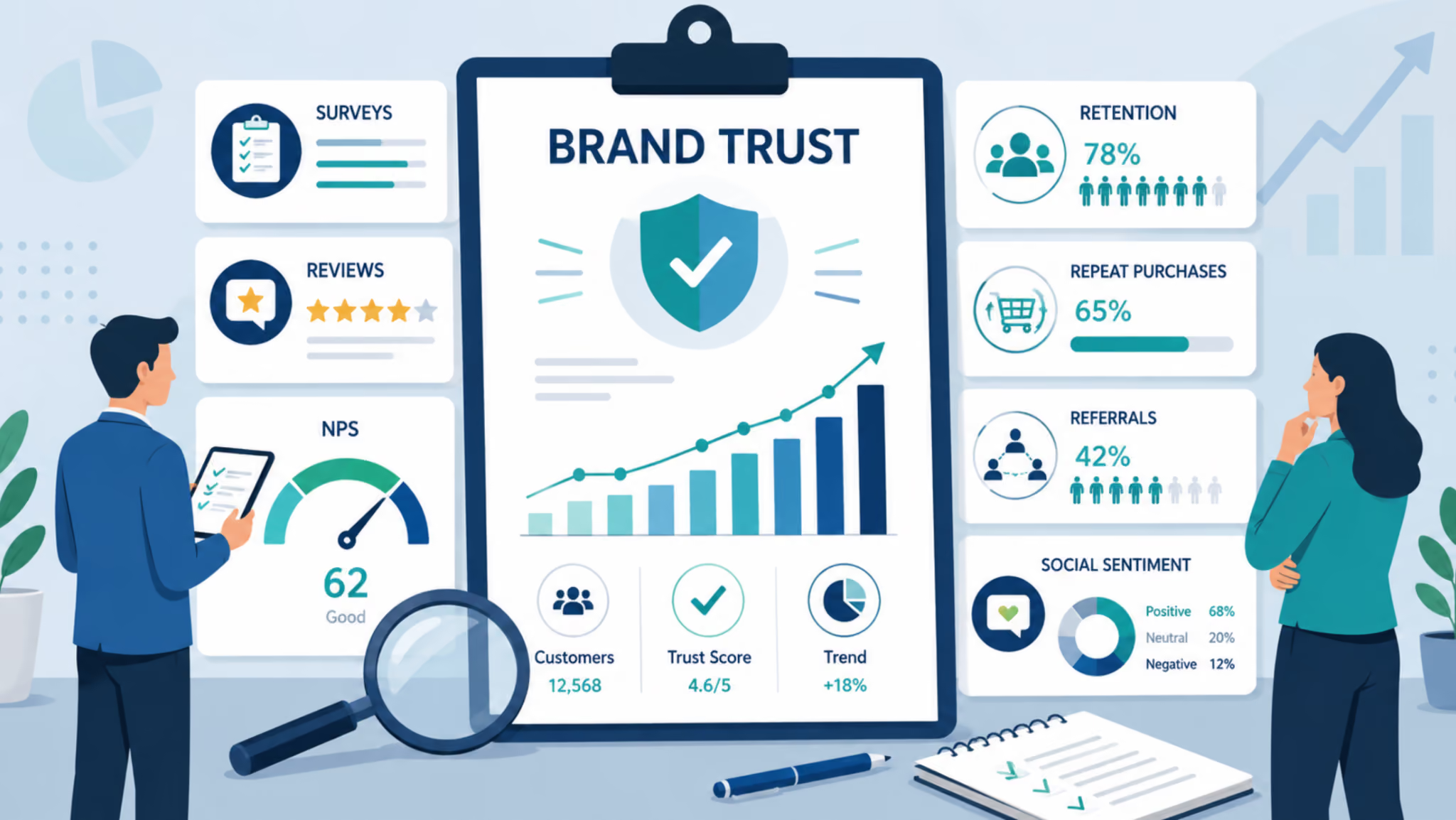
This recommends monitoring:
Net Promoter Score (NPS)
Customer Satisfaction (CSAT)
Customer retention
Referral rates
Online reviews
Brand sentiment
These should not be viewed individually.
A strong NPS with declining retention deserves investigation.
High customer satisfaction combined with poor public sentiment may indicate that different audience groups have different experiences.
Increasing referrals may suggest growing advocacy even before broader awareness measures change.
Quantitative metrics should also be combined with qualitative research: customer interviews, complaint analysis, review themes, open-ended survey responses, and conversations with frontline employees.
The goal is to understand not just whether trust is changing, but why.
Marketing departments may manage brand messaging, but the entire organization creates the brand experience.
Finance affects billing transparency.
Operations affect reliability.
Technology affects ease of use.
Customer support affects recovery when something fails.
Leadership behavior affects reputation.
Employees affect the human experience of the brand.
This is why brand trust cannot be created by communications alone.
Advertising can introduce a promise.
Only consistent organizational behavior can prove it.
When consumers trust a company, they are more willing to continue the relationship, recommend it, consider new products, and give the brand an opportunity to resolve occasional problems.
Conversely, once trust is repeatedly damaged, promotions alone may struggle to restore the relationship.
The strongest organizations therefore approach trust as a long-term business asset, not a short-term marketing message.
They communicate clearly.
They deliver consistently.
They acknowledge mistakes.
They listen to customers.
They align stated values with actual behavior.
Most importantly, they understand that brand trust is created gradually through thousands of interactions.
A powerful brand is ultimately a collection of promises.
Trust is what exists when customers believe those promises will be kept.
For questions or comments write to contactus@bostonbrandmedia.com



-v3.jpg)


-v3-02.jpg)