Stay informed with our newsletter.
.webp)


EN





The LEGO Group is combining nearly a century of heritage with record financial growth, technological innovation and global expansion. Revenue reached DKK 41.9 billion in the first half of 2026, while consumer sales increased 22%. From LEGO SMART Play and major entertainment partnerships to sustainable materials and new manufacturing capacity, the company continues to reinvent physical play. Its strategy demonstrates how an iconic brand can remain culturally relevant while preparing for a more digital and sustainable future.
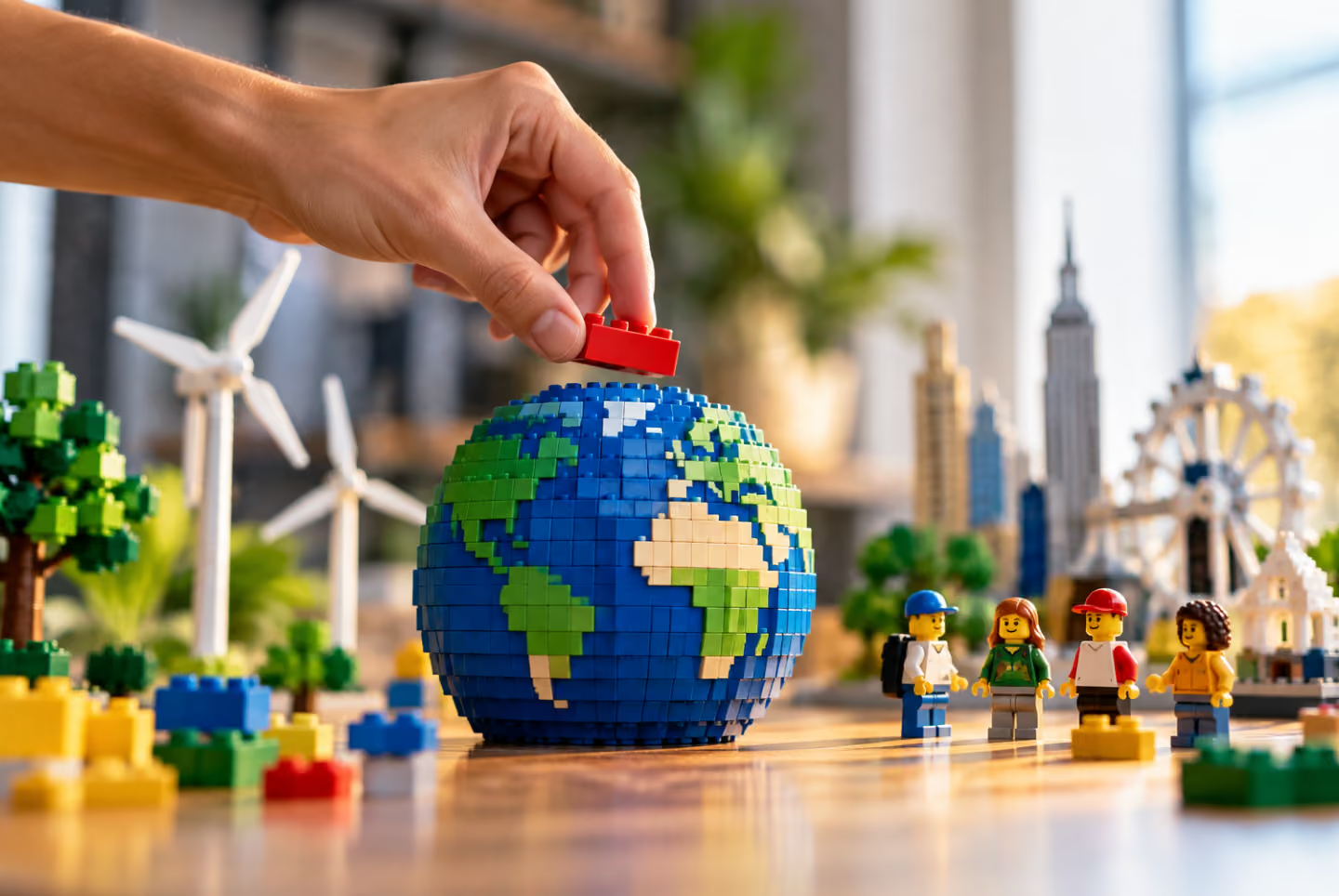
Few companies have managed to remain culturally relevant across generations as successfully as The LEGO Group. What began in 1932 as a small carpenter’s workshop in Billund, Denmark, has developed into one of the world’s leading manufacturers of play materials, with a brand that now extends across physical toys, entertainment, gaming, education, retail experiences and increasingly sophisticated digital technology.
Founded by Ole Kirk Kristiansen, the company takes its name from the Danish words “leg godt,” meaning “play well.” The modern LEGO brick was introduced in 1958, establishing an interlocking system that remains at the heart of the company almost seven decades later. The business remains privately held and family-controlled, with KIRKBI A/S owning 75% and the LEGO Foundation owning 25%.
Yet LEGO’s story in 2026 is not simply one of heritage. The company is currently experiencing some of the strongest financial growth in its history.
On August 25, 2026, The LEGO Group reported a remarkable first half of the year. Revenue increased 21% year-on-year to a record DKK 41.9 billion, compared with DKK 34.6 billion during the first half of 2025. On a constant-currency basis, revenue growth reached an even stronger 26%.
Consumer sales increased 22%, while operating profit climbed 22% to DKK 10.9 billion. Net profit grew even faster, rising 32% to DKK 8.6 billion. The company also reported that it continued to grow significantly ahead of the wider global toy market, enabling LEGO to gain additional market share.
These figures follow an exceptional 2025. Full-year revenue for 2025 increased 12% to DKK 83.5 billion, while consumer sales grew 16%. Operating profit rose 18% to DKK 22 billion, and net profit increased 21% to DKK 16.7 billion.
Perhaps most significantly, LEGO grew more than twice as fast as the overall toy market in 2025, when the market itself expanded by about 7%.
This demonstrates that LEGO’s performance is not simply benefiting from greater spending on toys. It is actively increasing its share of the market.
One explanation for LEGO’s growth is the extraordinary breadth of its product strategy.
In 2025, the company launched its largest product portfolio to date, with more than 860 products, around half of which were new. Popular ranges included LEGO City, LEGO Technic, LEGO Star Wars, LEGO Icons and LEGO Botanicals.
During just the first six months of 2026, another 330-plus new products were launched. Strong-selling themes included LEGO Speed Champions, Botanicals, Technic, Icons and Star Wars.
This portfolio illustrates an important evolution in LEGO’s business model: LEGO is no longer marketed exclusively as a children's toy.
Products such as LEGO Botanicals, complex Technic models, architectural builds and collectible entertainment sets have broadened LEGO’s appeal among adult builders. At the same time, partnerships with globally recognised entertainment and sporting properties continue to introduce the brand to new audiences.
Recent collaborations have included Formula 1, Star Wars, Pokémon, the FIFA World Cup 2026 and KPop Demon Hunters. LEGO’s Formula 1 partnership was supported by activations at more than 20 Grand Prix events during 2025, providing the company with another bridge between physical play and global popular culture.
Perhaps LEGO’s most important technological development in years arrived in 2026.
The company introduced LEGO SMART Play, an interactive platform designed to make physical LEGO creations react to how children play with them, importantly, without requiring a screen.
At the centre of the system is the LEGO SMART Brick, which incorporates technology allowing LEGO creations to respond interactively while remaining compatible with the existing LEGO System in Play. LEGO describes it as one of the most significant developments to its play system since the introduction of the minifigure in 1978.
The platform debuted commercially in March 2026 through LEGO Star Wars and has since expanded into properties including LEGO Pokémon.
The significance goes beyond adding electronics to a toy. LEGO is attempting to merge digital responsiveness with open-ended physical creativity, rather than simply moving children's play onto another screen.
That distinction could become increasingly valuable as parents, educators and technology companies debate how children's digital experiences should develop.
LEGO’s greatest long-term challenge may come from the material that made its success possible: plastic.
The company has committed to substantially increasing renewable and recycled materials while maintaining the safety, durability and precision expected of LEGO bricks.
By 2025, 52% of the materials purchased to manufacture LEGO bricks and elements came from renewable and recycled sources, compared with 33% in 2024. The company has already tested more than 600 recycled and renewable materials while searching for alternatives that meet its demanding production standards.
The company is experimenting across multiple material types. More than 900 transparent LEGO elements contain 20% recycled material derived from waste generated during artificial-marble worktop production. Flexible botanical and accessory elements are being produced using material containing 89% renewable content derived from Brazilian sugarcane.
LEGO has also introduced selected tyres using recycled fishing nets, ropes and engine oil. These newer tyres contain 34% recycled material, demonstrating how previously discarded materials can potentially enter a highly controlled manufacturing system.
LEGO increased its overall sustainability investment by 20% in 2025 compared with 2024, while maintaining a science-based target of reducing absolute greenhouse-gas emissions 37% by 2032 compared with 2019 and reaching net-zero emissions by 2050.
Strong demand also requires considerably greater production capacity.
During 2025, LEGO opened a new factory and regional distribution centre in Vietnam, continued developing a factory and distribution centre in Virginia, United States, and expanded existing manufacturing facilities in Hungary, Mexico and China. The company invested DKK 9.2 billion during 2025, largely in new factories and capacity expansion.
Expansion has continued in 2026, with DKK 4.6 billion invested in factories and existing facilities during the first six months alone.
LEGO has simultaneously expanded beyond conventional retail. In February 2026, the company completed the acquisition of 29 LEGO and LEGOLAND Discovery Centres across nine countries from Merlin Entertainments. These destinations collectively attract approximately five million visitors annually, giving LEGO greater direct control of experiential interactions with consumers.
What makes The LEGO Group particularly noteworthy today is the combination of heritage and reinvention.
Its basic product principle is almost seven decades old, yet the business surrounding that brick is continuously changing. LEGO has transformed itself into an ecosystem spanning toys, entertainment franchises, gaming, digital experiences, education, experiential destinations, sophisticated technology and sustainability research.
The company now employs around 34,000 people, while continuing to invest heavily in product development, manufacturing capacity, digital technology and environmental transformation.
Most importantly, LEGO has demonstrated that an established company does not necessarily need to abandon its core product to remain relevant.
With first-half 2026 revenue reaching a record DKK 41.9 billion, consumer sales rising 22%, more than 330 new products launched in six months, major global partnerships expanding its cultural reach, and over half of its purchased brick-making materials now attributed to renewable and recycled sources, The LEGO Group is simultaneously delivering commercial growth and rebuilding significant parts of its business for the future.
Nearly a century after Ole Kirk Kristiansen began making toys in Billund, LEGO’s competitive advantage remains remarkably similar: take something simple, continually rebuild it, and discover what it can become next.
For questions or comments write to contactus@bostonbrandmedia.com



-v3.jpg)


-v3-02.jpg)