Stay informed with our newsletter.
.webp)


EN




OpenAI and Samsung are deepening cooperation on next-generation semiconductors and enterprise AI as computing infrastructure becomes central to the global artificial intelligence race. Samsung and SK Hynix are already key memory partners for OpenAI's Stargate initiative, while OpenAI is developing custom processors and using AI in chip design. The partnership reflects a broader shift from general-purpose chatbots toward specialized applications in semiconductors, financial services and life sciences, making hardware increasingly critical to future AI growth.
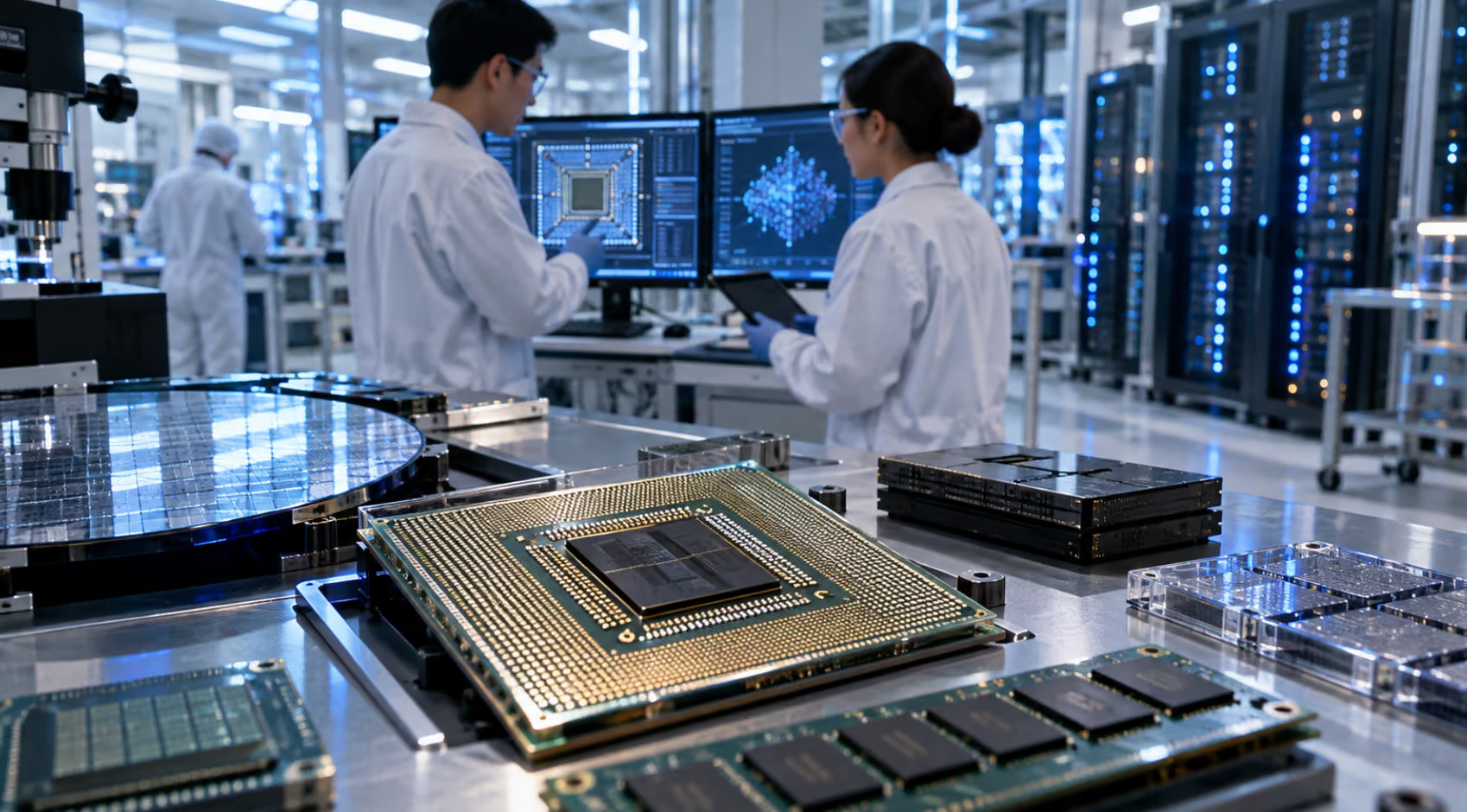
Artificial intelligence is moving into a new phase where software, semiconductors and massive computing infrastructure are becoming inseparable. One of the clearest signs of that transition is the deepening relationship between OpenAI and Samsung Electronics, two companies positioned on opposite but increasingly interconnected sides of the AI economy.
OpenAI said on September 9 that it is working more closely with Samsung on next-generation semiconductor development, while the companies are also expanding cooperation around enterprise artificial intelligence. The development comes as OpenAI pushes beyond general-purpose conversational AI toward specialized applications in areas including chip design, financial services and life sciences.
The relationship is significant because the next stage of the AI race is increasingly being determined not only by who develops the most capable models, but also by who can secure the computing infrastructure required to run them.
For years, the public AI competition centered primarily on models: which company had the most capable chatbot, the strongest reasoning system or the best generative tools.
That competition is changing.
As AI models become larger and are deployed across more businesses, the demand for computing resources has risen dramatically. Advanced systems require enormous amounts of processing capacity, high-bandwidth memory, networking equipment, storage and electricity.
OpenAI Korea General Manager Harrison Kim said in Seoul that the company had made significant progress working with Samsung on next-generation chips, although detailed technical specifications were not disclosed. Samsung is simultaneously becoming an important enterprise user of AI systems, with OpenAI describing it as one of the world's major adopters of ChatGPT across functions including research and development, marketing and sales.
The cooperation therefore goes beyond a conventional supplier relationship.
Samsung can provide semiconductor expertise, while OpenAI brings advanced AI models that can increasingly help design, test and optimize the chips themselves.
OpenAI has already demonstrated that it wants greater control over the hardware underlying its AI systems.
Earlier in 2026, the company unveiled its first custom AI processor, known as Jalapeño, developed with semiconductor company Broadcom. The processor is designed primarily for AI inference, the computing process used when an already-trained model responds to prompts and performs tasks.
Reuters reported that the chip was designed in roughly nine months, with OpenAI using its own artificial intelligence tools during the development process. Manufacturing is being handled by TSMC, the world's largest contract chipmaker.
That creates an intriguing feedback loop.
AI is increasingly being used to design the chips that will run future AI.
OpenAI Chief Financial Officer Sarah Friar said the company's experience using its own models to help develop Jalapeño demonstrated how AI could accelerate complex engineering workflows. The chip reached the "tape-out" stage, when a finalized semiconductor design is sent for manufacturing, within nine months.
That experience is one reason OpenAI now sees semiconductor design itself as an important enterprise AI market.
Processing chips are only part of the AI infrastructure challenge.
Advanced accelerators also depend heavily on high-performance memory, particularly as models must rapidly move enormous amounts of data while training or generating responses.
This makes South Korea especially important.
Samsung Electronics and SK Hynix are two of the world's largest memory manufacturers, and both have already agreed to support OpenAI's massive Stargate infrastructure program.
In October 2025, OpenAI announced strategic partnerships with Samsung and SK under Stargate. The companies said they would work toward increasing production of advanced memory, targeting as much as 900,000 DRAM wafer starts per month to support future OpenAI infrastructure requirements.
Samsung separately said OpenAI's projected memory demand could reach up to 900,000 DRAM wafers per month, with Samsung contributing high-performance, energy-efficient memory as well as capabilities spanning logic chips, foundry manufacturing and advanced chip packaging.
That scale demonstrates just how hardware-intensive the AI industry is becoming.
The Samsung partnership sits within a much larger OpenAI infrastructure strategy.
Stargate was created to dramatically expand the computing capacity available for advanced AI. OpenAI has previously outlined a target involving $500 billion of investment and 10 gigawatts of planned computing capacity.
By late 2025, OpenAI said announced U.S. Stargate sites were already approaching or exceeding $400 billion in planned investment, with several gigawatts of infrastructure in development.
Infrastructure projects on that scale require enormous quantities of processors, memory, networking equipment and advanced packaging.
That is why partnerships with manufacturers such as Samsung, SK Hynix, Broadcom and TSMC are becoming strategically important to OpenAI's long-term ambitions.
AI leadership increasingly depends on physical supply chains as much as algorithms.
At the same time, OpenAI is attempting to broaden its role beyond consumer chatbots.
Friar said the company is focusing more heavily on industry-specific AI applications, including financial services, life sciences and semiconductor design, as businesses increasingly demand systems capable of delivering measurable economic results.
This is an important change in the AI market.
The first wave of generative AI adoption often involved employees experimenting with chatbots for writing, summarization, research or coding.
The next wave is likely to involve AI embedded directly into core business processes.
In finance, AI could help analyze complex datasets, automate compliance workflows or support risk modelling.
In life sciences, advanced models can potentially assist researchers working on drug discovery, molecular analysis and scientific research.
And in semiconductor development, AI may shorten design cycles by helping engineers analyze circuit layouts, test architectures and identify potential improvements.
Samsung's role is particularly interesting because the company can participate on both sides of the equation.
It can supply memory, semiconductor manufacturing expertise and advanced packaging, while simultaneously integrating AI tools throughout its own global operations.
Samsung has permitted employees in parts of its Device eXperience business to use platforms including ChatGPT, Google's Gemini and Anthropic's Claude, reflecting the growing use of generative AI inside major corporations.
OpenAI also reported that its ChatGPT Enterprise user base in South Korea increased 28-fold over the previous year, illustrating the speed at which corporate AI adoption is expanding in one of the world's most technologically advanced economies.
The partnership also arrives during a historic expansion in AI semiconductor investment.
Broadcom recently raised its forecast for AI chip revenue to approximately $115 billion in fiscal 2027 and around $230 billion in fiscal 2028, demonstrating expectations for continued explosive infrastructure demand.
Meanwhile, companies including Google, Amazon, Meta and OpenAI are developing or commissioning customized AI processors rather than depending entirely on general-purpose accelerators.
This does not necessarily mean established chip leaders will lose their position. Instead, the AI hardware market is becoming larger, more specialized and more diversified.
Different workloads may increasingly use different combinations of processors, memory, networking systems and custom accelerators.
The deepening OpenAI-Samsung relationship illustrates where the technology industry is heading.
AI competition is no longer simply OpenAI versus another model developer.
It increasingly involves an entire technology stack:
AI models. Custom processors. Memory chips. Advanced packaging. Data centers. Energy infrastructure. Enterprise software.
Companies capable of coordinating those layers will have significant advantages as AI moves deeper into the global economy.
OpenAI's expanding semiconductor ambitions show that the company wants greater influence over the computing foundation behind its models. Samsung, meanwhile, has an opportunity to position itself as one of the indispensable hardware partners powering that expansion.
The larger message is clear: the next chapter of artificial intelligence will be built as much in semiconductor fabs and data centers as in software laboratories.
And as AI moves from answering questions to designing chips, analyzing financial systems and assisting scientific research, partnerships such as OpenAI and Samsung's could become central to determining who controls the infrastructure of the AI era.
For questions or comments write to contactus@bostonbrandmedia.com



-v3.jpg)


-v3-02.jpg)