Stay informed with our newsletter.
.webp)


EN





Europe is accelerating efforts to build greater independence in space, driven by growing geopolitical tensions, concerns over reliance on non-European satellite systems and the strategic importance of secure communications. At the center of the effort is IRIS², an expanded European satellite constellation expected to begin launches in 2029. Alongside Galileo, Copernicus and the Ariane 6 launcher, the initiative is designed to strengthen Europe’s ability to communicate, navigate, observe Earth and maintain critical services without excessive dependence on foreign infrastructure.
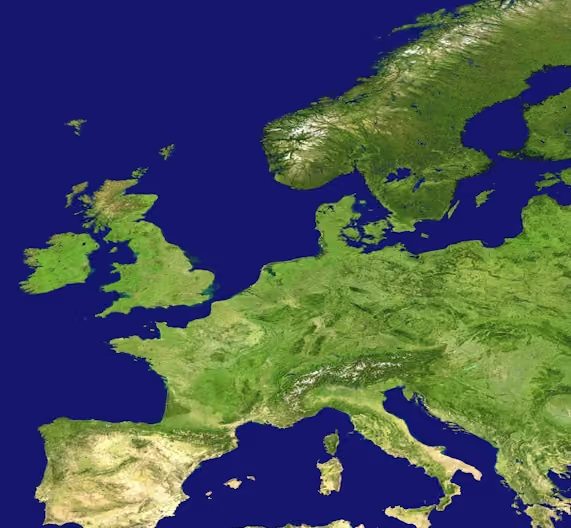
Europe is entering a new phase in its space ambitions, driven by a growing recognition that satellite technology is no longer simply a tool for scientific exploration. Satellites have become critical infrastructure supporting communications, navigation, weather forecasting, agriculture, defense, disaster response and economic activity. As competition between major space powers grows, European governments are increasingly focused on ensuring that the continent can maintain access to essential satellite services without becoming overly dependent on foreign systems.
The push for greater satellite independence comes at a time when the global space industry is undergoing rapid transformation. The United States remains a dominant force, while China continues to expand its space capabilities and private companies are deploying increasingly large satellite constellations. At the same time, the war in Ukraine has demonstrated how important satellite communications and Earth observation can be during military and geopolitical crises.
For Europe, the issue is therefore closely connected to both economic security and national security. Dependence on external providers for critical space-based services can create vulnerabilities, particularly during periods of geopolitical tension. European policymakers increasingly see independent access to space and satellite infrastructure as an essential component of the continent's strategic autonomy.
One of Europe's most important assets is its Galileo satellite navigation system. Developed as Europe's independent alternative to systems such as America's GPS, Galileo provides highly accurate positioning and timing services to users around the world. The system has become a major part of Europe's space infrastructure and demonstrates the strategic importance of maintaining independent capabilities.
Navigation, however, is only one part of the equation. Europe is also seeking greater independence in secure communications, Earth observation and satellite-based connectivity. The European Union's IRIS² initiative is designed to strengthen secure connectivity through a multi-orbit satellite constellation. The project is intended to provide secure communications for European governments while also supporting broader connectivity requirements.
Secure communications have become particularly important as governments increasingly rely on digital infrastructure. Military forces, emergency services, government agencies and critical industries all require reliable communication networks. Satellites can provide connectivity when terrestrial infrastructure is damaged, overloaded or unavailable, making them an important part of national resilience.
Earth observation is another strategic priority. Satellites can monitor forests, oceans, agricultural land, atmospheric conditions and natural disasters. They can also provide information relevant to security and defense. Europe's Copernicus program has established a major Earth observation capability, giving European institutions and governments access to extensive environmental and geographic data.
The growing importance of satellite infrastructure is also changing the relationship between governments and the private sector. Europe has traditionally relied heavily on established aerospace companies and government-backed programs. However, the emergence of commercial space companies is creating new opportunities for faster innovation and lower-cost satellite deployment.
Small satellites and reusable launch technologies are helping to reduce the cost of accessing space. Satellite manufacturers are increasingly able to produce spacecraft in larger numbers, while commercial launch providers are developing more flexible launch options. These developments could help Europe expand its satellite capabilities more quickly than would have been possible under traditional space programs.
Yet Europe faces significant challenges in its effort to build greater independence. One of the biggest is competition. American companies have moved rapidly in areas such as satellite internet, launch services and reusable rockets. Companies such as SpaceX have demonstrated how large satellite constellations can be deployed at unprecedented scale, while China's state-backed space program continues to make major advances.
Europe must therefore balance its desire for technological sovereignty with the realities of a highly competitive global market. Building independent capabilities can require substantial investment, particularly when technologies must be developed domestically rather than purchased from established international suppliers.
Launch capability is another important issue. Europe has long recognized the strategic importance of independent access to space, but maintaining competitive launch services has become increasingly difficult as the global launch market changes. The rapid development of reusable rockets has significantly altered the economics of satellite launches, placing pressure on traditional European launch systems.
European policymakers and space companies are consequently exploring ways to make the continent's launch industry more competitive. New launch companies are emerging, while established aerospace organizations are working on next-generation rockets and technologies. The objective is not simply to launch satellites but to ensure that Europe can deploy critical spacecraft when needed without relying entirely on foreign launch providers.
The security dimension makes this particularly urgent. In a crisis, access to satellite communications, navigation and Earth observation could become strategically important. If a country or region depends heavily on infrastructure controlled by another power, its ability to operate independently could be constrained.
The growing militarization of space is also influencing European policy. Satellites are increasingly being considered part of national and collective defense infrastructure. European governments are investing in space-based surveillance, secure communications and systems designed to protect satellites from interference.
At the same time, Europe is becoming more aware of the risks posed by space debris and congestion in Earth's orbit. As thousands of satellites are launched into low Earth orbit, managing traffic and preventing collisions is becoming increasingly important. Any strategy for satellite independence must therefore include not only the ability to build and launch satellites but also the ability to monitor and protect the orbital environment.
Climate change is adding another layer to Europe's satellite ambitions. Earth observation satellites provide crucial information about rising temperatures, melting ice, changing oceans, wildfires, deforestation and extreme weather. As governments seek more accurate climate data, independent satellite capabilities can help Europe maintain reliable access to information needed for environmental policy and disaster management.
The economic opportunities are equally significant. The European space sector supports thousands of highly skilled jobs and contributes to technological development across telecommunications, manufacturing, software, artificial intelligence and advanced materials. Investments in satellite infrastructure can therefore generate benefits beyond the space industry itself.
Europe's ambition is not necessarily to isolate itself from international cooperation. Instead, the objective is increasingly about ensuring that Europe has the ability to act independently when strategic interests require it. Partnerships with the United States and other spacefaring nations will remain important, but European policymakers want those partnerships to be based on choice rather than dependence.
The coming years will determine how successfully Europe can achieve this balance. Building an independent satellite ecosystem requires sustained funding, technological innovation, industrial capacity and coordination between European institutions and individual countries. It also requires a willingness to compete in a rapidly evolving commercial space market.
The stakes are high. Satellites have moved from being specialized scientific instruments to becoming essential infrastructure for modern societies. Communications, navigation, climate monitoring, defense and emergency response increasingly depend on reliable access to space-based systems.
Europe's push for satellite independence is therefore about more than space exploration. It is part of a broader effort to strengthen technological sovereignty and ensure that critical infrastructure remains under European control. As global competition in space intensifies, the ability to build, launch, operate and protect satellites could become an increasingly important measure of strategic independence.
For Europe, the message is clear: control of space infrastructure increasingly means control over the systems that support life, security and economic activity on Earth. The continent's satellite ambitions are consequently becoming not just a matter of technological progress, but a central element of Europe's future security and global competitiveness.
For questions or comments write to contactus@bostonbrandmedia.com



-v3.jpg)


-v3-02.jpg)