Stay informed with our newsletter.
.webp)


EN




AI is reshaping education through AI tutors, virtual teachers and personalised learning systems that adapt lessons to individual student needs. From K–12 classrooms and homework support to university learning and test preparation, AI is making education more flexible and accessible. At the same time, it is raising important questions about academic integrity, privacy and the role of teachers, highlighting a future where human educators remain essential while AI strengthens personalised learning and support.
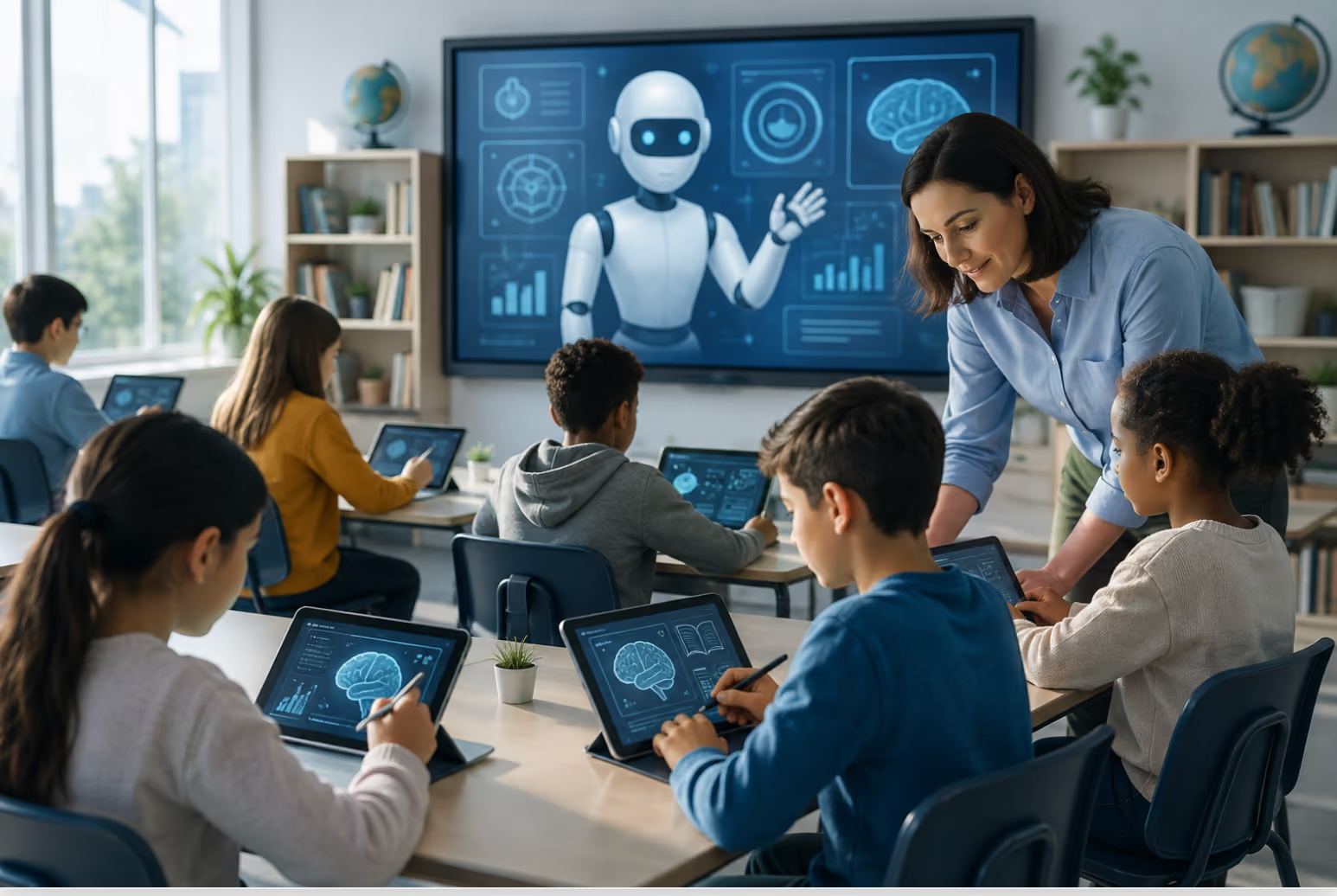
Artificial intelligence is moving rapidly from being a controversial classroom tool to becoming part of the education infrastructure itself. AI tutors can explain difficult concepts at midnight, personalised learning systems can adjust lessons to a student's ability, and teachers can use AI to create exercises, lesson plans and feedback in minutes. At universities, meanwhile, students increasingly use generative AI for research, revision, writing support and assessment preparation.
The transformation is already visible. A 2026 survey by the UK's Higher Education Policy Institute found that 95% of surveyed undergraduates use AI in at least one way, while 94% use generative AI to support assessed work. Some 68% said AI skills are essential for succeeding in today's world, yet only 48% felt teaching staff were helping them develop those skills for their future careers.
The question facing education is therefore changing. It is no longer simply, "Should students use AI?" It is becoming, "How should humans and AI divide the work of learning?"
Traditional classrooms are built around practical limitations. One teacher may be responsible for 20, 30 or even more students, each learning at a different speed.
AI potentially changes that equation.
An intelligent tutoring system can identify that one student understands multiplication but struggles with fractions, while another has mastered both and needs more advanced work. Instead of assigning everyone exactly the same exercise, AI can continuously adjust difficulty, explanations, examples and practice questions according to individual performance.
This creates something education systems have wanted for decades: personalised tutoring at scale.
A student struggling with algebra could ask an AI tutor to explain the same equation several different ways without embarrassment. A child learning English could request simpler vocabulary. An advanced student could move ahead rather than waiting for the rest of the class.
There is emerging evidence that well-designed systems can help. A randomized controlled study published in Scientific Reports in 2025 compared a carefully designed AI tutor with active-learning classroom instruction in a college physics course. Researchers found that students using the AI tutor learned significantly more in less time and reported feeling more engaged and motivated.
But there is an important distinction: a pedagogically designed AI tutor is not the same thing as asking a general chatbot to complete homework.
Private tutoring has historically been limited by cost, geography and availability. AI dramatically lowers those barriers.
Platforms such as Khan Academy's Khanmigo are designed to act more like tutors than answer machines. Instead of immediately solving a mathematics problem, an AI tutor can ask questions, provide hints and encourage the student to reason toward the solution. Khan Academy says its approach is intended to support learners when they are stuck rather than replace teachers or the practice required for genuine learning.
AI tutoring can be especially useful for homework, language learning, mathematics, science, writing practice and test preparation.
Students preparing for an examination could generate unlimited practice questions, request explanations for incorrect answers and create revision plans targeting weak areas.
That changes tutoring from an occasional service into something potentially available 24 hours a day.
However, unrestricted convenience creates another danger: students can ask AI to do the thinking instead of helping them think.
The difference between AI-assisted learning and AI-assisted avoidance may come down to how the technology is designed and how students are taught to use it.
One of the most promising models may not involve replacing educators at all.
Stanford researchers tested an AI system called Tutor CoPilot that provided suggestions to human tutors while they were helping students with mathematics. In a randomized trial involving roughly 1,000 students, students working with AI-assisted tutors were four percentage points more likely to achieve topic mastery. Among students working with lower-rated tutors, the improvement reached nine percentage points.
That suggests a powerful alternative future:
AI does not replace the tutor. AI gives the tutor additional expertise.
The same principle could eventually extend to classroom teachers by helping them identify misconceptions, develop differentiated activities, prepare materials and understand where individual students need intervention.
Higher education may be experiencing the fastest transformation.
The 2026 HEPI research shows AI use among students has become close to universal. Students use the technology for summarising material, generating ideas, understanding difficult topics, improving writing and preparing assignments. Almost half said AI had improved their student experience, particularly by saving time and offering immediate academic support.
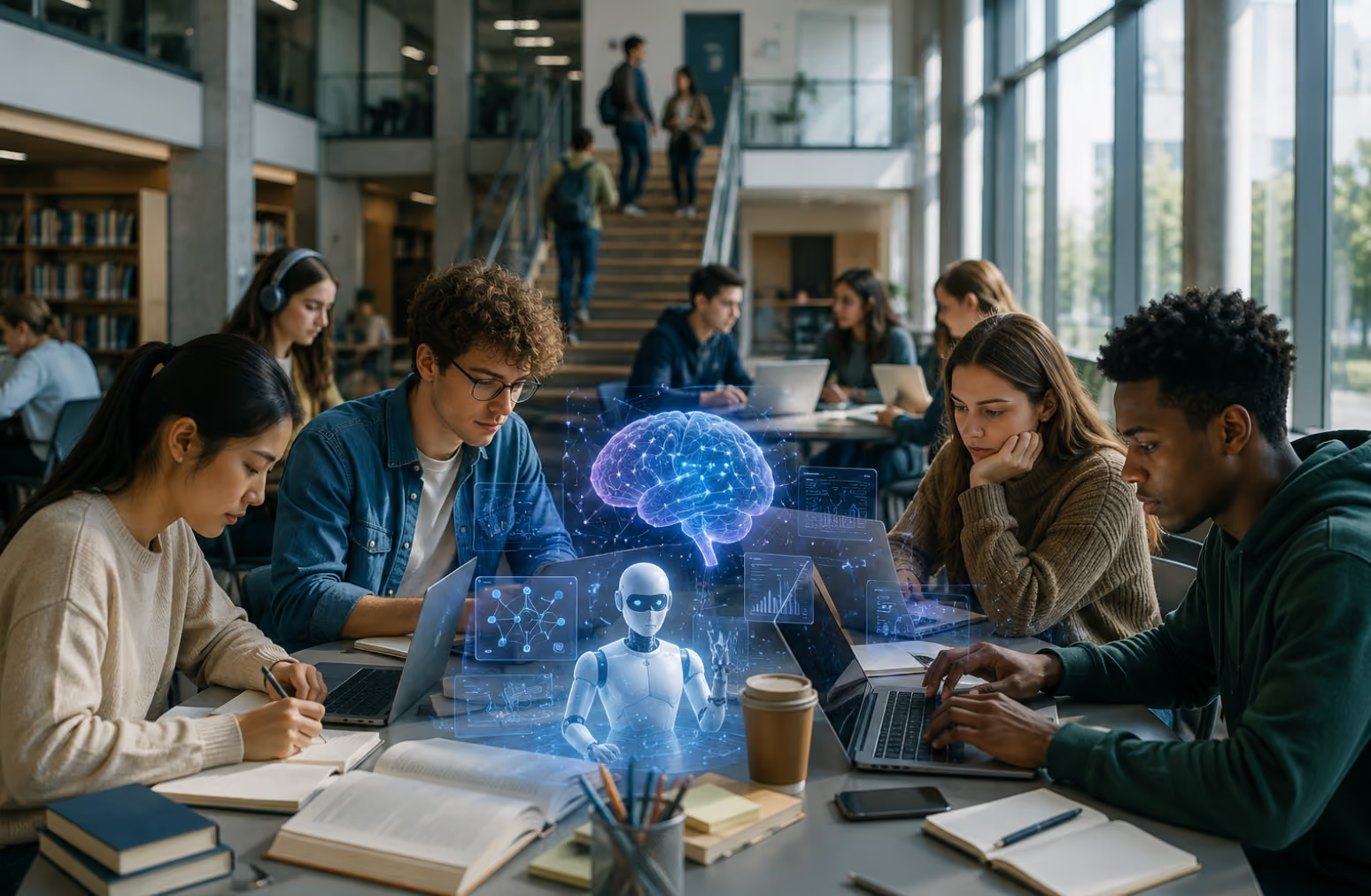
This is forcing universities to rethink assessment.
If an AI system can produce a conventional essay, universities must ask whether submitting an essay alone still demonstrates that a student understands the subject.
Future assessment could increasingly emphasize oral examinations, presentations, classroom problem-solving, project work, source verification, practical demonstrations and explaining the reasoning behind an answer.
AI may therefore change not only how students learn but what schools and universities consider evidence of learning.
The concept of an AI teacher goes further than tutoring.
Generative AI can already explain lessons conversationally, create quizzes, answer questions and adapt material. Combined with voice and digital-avatar technology, AI instructors could theoretically deliver interactive lessons in multiple languages.
Some experimental schools are already exploring education models in which AI-driven academic instruction occupies part of the school day while human educators concentrate on projects, communication, teamwork and life skills.
But calling such systems "teachers" may overstate what they can currently do.
A teacher does far more than transfer information.
Teachers detect frustration. They motivate reluctant learners. They recognise bullying. They understand family circumstances. They resolve arguments. They inspire curiosity, teach responsibility and sometimes notice that something is wrong before anybody else does.
Education is both an intellectual process and a human relationship.
That matters particularly for younger children.
The strongest model for the AI classroom may therefore be human-led, AI-supported education.
AI is particularly well suited to:
Humans should remain central to judgment, mentorship, emotional development, safeguarding, ethical decisions, classroom culture, creativity, collaboration and meaningful assessment.
The need for human educators is unlikely to disappear. UNESCO estimates that the world needs 44 million additional primary and secondary teachers by 2030 to achieve universal education goals. AI could help those teachers work more effectively, but teacher shortages should not become an excuse to substitute machines for relationships that children need.
AI education also carries serious challenges.
Models can produce incorrect information confidently. Bias in training data can affect answers. Student information creates privacy and data-protection concerns, particularly involving children. Premium AI systems could also widen educational inequality if wealthy schools receive sophisticated personalised tutors while poorer students receive inferior or no access.
Academic integrity remains another challenge.
Students need to learn when AI use is legitimate, when it must be disclosed and when using it undermines the purpose of an assignment.
Schools are beginning to respond. By August 2026, 37 U.S. states had issued guidance relating to AI in education, according to an Associated Press review, while some school systems are moving from blanket bans toward teaching students how to evaluate AI-generated information, recognise bias and protect their privacy.
That shift may be crucial.
The defining education skill of the AI era may not simply be knowing how to use artificial intelligence.
It may be knowing when to use it, when to question it and when not to use it at all.
A successful classroom of the future could give every student an AI tutor while preserving a human teacher at its centre. AI might diagnose learning gaps, provide personalised exercises and handle routine feedback, allowing teachers to spend more time mentoring students, leading discussions and developing the skills machines struggle to reproduce.
The biggest opportunity is not an AI classroom without teachers. It is a classroom where technology makes exceptional teaching and personalised learning available to far more people.
The future of education, therefore, is unlikely to be human versus artificial intelligence.
It will be determined by how intelligently we combine the two.
For questions or comments write to contactus@bostonbrandmedia.com



-v3.jpg)


-v3-02.jpg)