Stay informed with our newsletter.
.webp)


EN





Nissan is accelerating the launch of its Rogue Hybrid to compete more aggressively with the Toyota RAV4 and Honda CR-V in the growing hybrid SUV market. The move comes as Rogue sales face pressure and consumer demand for fuel-efficient vehicles increases. Nissan’s new e-Power technology is expected to offer improved efficiency and performance. However, limited initial supplies could restrict availability, making the Rogue Hybrid’s early market impact difficult to predict.
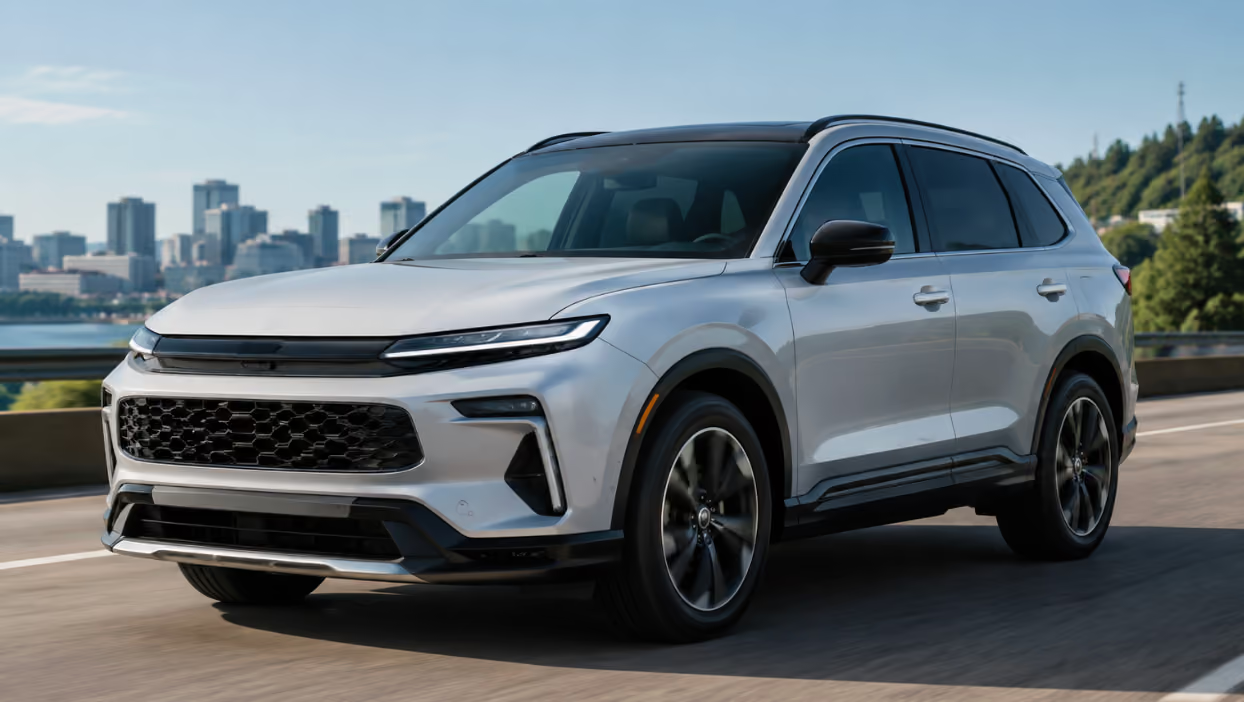
Nissan is accelerating the arrival of its much-anticipated Rogue Hybrid, bringing the electrified compact SUV to U.S. customers earlier than originally planned as the automaker attempts to regain ground against the Toyota RAV4 and Honda CR-V. The move reflects growing pressure on Nissan’s best-known crossover, whose sales have weakened while consumer demand for fuel-efficient hybrid SUVs continues to rise.
The new Rogue Hybrid is now expected to reach U.S. dealerships in November 2026, following a second acceleration of its launch schedule. Nissan had previously moved the model forward to January 2027 from a mid-2027 target. The latest push demonstrates how urgently the company wants a stronger presence in the increasingly competitive hybrid crossover market.
The timing is significant. The Toyota RAV4 has moved to a hybrid-only lineup for 2026, while the Honda CR-V already offers an established hybrid option. Nissan, meanwhile, has lacked a conventional hybrid version of its Rogue in the U.S. market, leaving one of its most important nameplates at a disadvantage as buyers increasingly consider electrified powertrains.
Toyota has also faced supply challenges while transitioning to the redesigned 2026 RAV4. Production of the new RAV4 Hybrid began at Toyota’s Kentucky plant in June, adding capacity to manufacturing operations in the United States.
Honda has benefited from strong CR-V demand as well. The CR-V reportedly led U.S. light-vehicle sales during the first half of 2026, helped by strong demand and supply constraints affecting some competitors.
For Nissan, therefore, the Rogue Hybrid is more than another model introduction. It represents an attempt to protect one of its most important vehicle lines while attracting customers who might otherwise choose Toyota or Honda.
The urgency becomes clearer when Nissan’s recent Rogue performance is considered.
U.S. Rogue sales fell 11% in 2025 to 217,896 vehicles, marking a second consecutive annual decline. Its share of the compact crossover segment dropped to 7.6%, reportedly the lowest level since 2009.
That deterioration is particularly important because the Rogue has historically been one of Nissan’s strongest-selling models. Losing momentum in such a high-volume segment can have a significant impact on the automaker’s overall U.S. performance.
Nissan now hopes that an efficient hybrid powertrain can reverse that trajectory.
Instead of simply copying the conventional hybrid formula used by many competitors, Nissan is bringing its third-generation e-Power technology to the Rogue.
The system is designed around electric motors that drive the vehicle, while a gasoline engine primarily works as a generator to recharge the battery. Unlike a traditional hybrid arrangement, the gasoline engine is not the primary mechanism driving the wheels under normal operation.
Nissan believes the approach can deliver an experience closer to an electric vehicle while avoiding some of the concerns associated with fully electric ownership, particularly charging and driving range.
The company is positioning the system around three major attributes: efficiency, performance and refinement. Nissan executives have described the new hybrid as smoother, quicker and quieter, suggesting the automaker wants the Rogue to compete on more than fuel economy alone.
That could prove important because the hybrid SUV market has become increasingly sophisticated. Consumers are no longer necessarily choosing hybrids simply because they use less fuel. Acceleration, cabin comfort, technology, practicality and driving refinement are all becoming part of the decision.
The biggest challenge for Nissan may not be consumer interest. It could be availability.
The first Rogue Hybrid vehicles will be imported from Japan, rather than produced in the United States. Nissan reportedly plans to send only one or two vehicles to each of its roughly 1,050 U.S. dealerships in November.
That means the initial launch will be deliberately limited.
Supply is expected to increase to approximately 6,000 vehicles by March, when Nissan plans to expand the lineup with two additional trims.
The restricted launch reflects the reality of fast-tracking a vehicle. Nissan may be able to accelerate the timing of the introduction, but manufacturing capacity and logistics cannot necessarily be expanded at the same speed.
For customers, that could mean limited inventory and potentially difficult access to the new hybrid during the first few months.
Despite the constrained launch, Nissan has ambitious expectations.
The company expects the hybrid version to become the dominant variant of the Rogue relatively quickly. By the middle of 2027, Nissan projects that hybrid models could account for about 30% of Rogue sales, with approximately 60% of those hybrid buyers coming from outside the Nissan brand.
That second figure is particularly important.
Winning existing Nissan customers may help stabilize Rogue sales, but attracting buyers from Toyota, Honda and other brands is what could genuinely expand Nissan’s market share.
The challenge is that the RAV4 and CR-V have already built substantial reputations in the hybrid segment.
Toyota's 2026 RAV4 represents a particularly strong competitor because the redesigned model has moved entirely to electrified powertrains, with hybrid and plug-in hybrid versions replacing conventional gasoline models.
Toyota began producing the new RAV4 Hybrid in Kentucky in June 2026, supported by approximately $2 billion in investments announced for the plant over the previous two years.
However, Toyota's transition has not been completely smooth. Reports have pointed to strong demand and insufficient supply during the rollout of the redesigned RAV4, creating growing customer waitlists in some markets.
This creates an unusual opening for Nissan: Toyota has the established hybrid reputation, but even Toyota is struggling to supply enough RAV4s.
Honda's CR-V is equally important to Nissan's strategy.
The 2026 CR-V Hybrid delivers EPA-rated fuel economy of up to 43 mpg city and 36 mpg highway in front-wheel-drive form, according to Honda's official comparison data. The CR-V also offers up to 76.5 cubic feet of cargo capacity, giving it a strong practical advantage in the compact SUV category.
Nissan therefore needs the Rogue Hybrid to deliver a compelling combination of fuel efficiency, driving performance, interior comfort and technology rather than simply adding a hybrid badge.
The accelerated Rogue Hybrid launch illustrates the changing priorities of the U.S. auto market.
Hybrids have become an important middle ground for consumers who want better fuel economy without committing completely to an electric vehicle. That has made the compact crossover segment one of the most important battlegrounds for electrification.
Nissan is now trying to close a gap that Toyota and Honda have spent years building.
The company has moved the Rogue Hybrid launch forward twice, embraced its distinctive e-Power technology and set an aggressive target for attracting customers from rival brands. But the initial rollout will be constrained by limited supply, meaning Nissan must carefully balance speed, availability and customer demand.
The Rogue Hybrid may arrive later than many competitors, but Nissan is clearly determined not to remain on the sidelines.
If the vehicle delivers the efficiency, quietness and performance Nissan promises and if production can eventually catch up with demand, it could become a crucial product in the company's U.S. recovery strategy.
For now, however, the message is clear: Nissan is moving fast, but Rogue Hybrid buyers may have to move just as quickly to get one.
For questions or comments write to contactus@bostonbrandmedia.com



-v3.jpg)


-v3-02.jpg)