Stay informed with our newsletter.
.webp)


EN





Dubai’s Roads and Transport Authority is studying an integrated underground transport system designed to move passengers, goods and services as the emirate prepares for rapid population growth and increasing mobility demand. The concept forms part of Dubai’s broader vision for three-dimensional transportation across land, air and underground networks. Alongside expanding metro infrastructure, autonomous vehicles and air taxis, underground mobility could help reduce surface congestion, improve logistics efficiency and reshape how Dubai moves in the decades ahead.
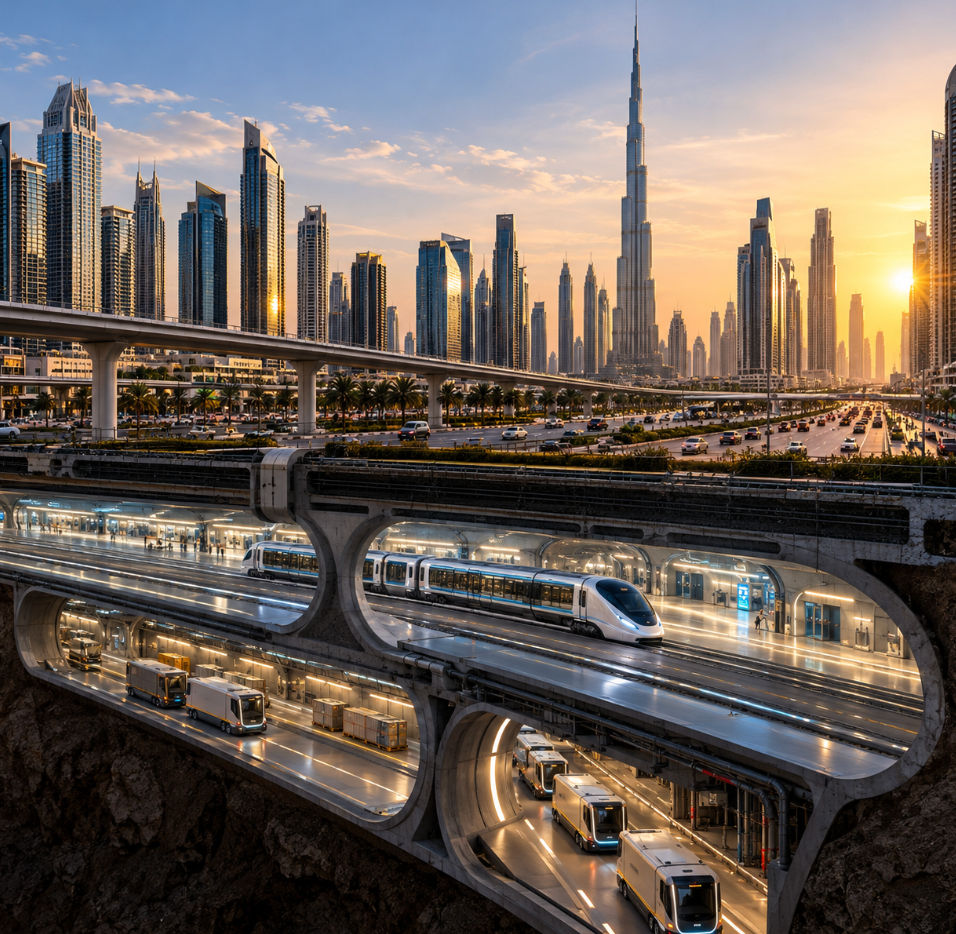
Dubai’s Roads and Transport Authority is exploring an ambitious underground mobility network as the emirate prepares for rapid population growth, rising transport demand and a new era of three-dimensional urban transportation.
Dubai, a city internationally recognized for its futuristic architecture, advanced infrastructure and ambitious urban development, is preparing to take its transportation revolution beneath the ground. The Dubai Roads and Transport Authority (RTA) has revealed that it is studying an integrated underground transportation system designed to move passengers, goods and services, potentially transforming how people and businesses navigate the rapidly expanding emirate.
The initiative represents another significant development in Dubai’s ambition to become a global leader in smart mobility, sustainable infrastructure and next-generation urban transportation.
The announcement was made on October 13, 2026, by Mattar Al Tayer, Director-General and Chairman of the Board of Executive Directors of RTA, during the Mohammed bin Rashid Leadership Forum.
According to Al Tayer, Dubai is exploring a transportation ecosystem operating across three interconnected dimensions: land, air and underground. The proposed underground network would complement existing roads, metro services, autonomous vehicles and emerging aerial mobility solutions.
While the project remains under study, its potential implications extend beyond passenger transportation to include urban logistics, commercial deliveries, infrastructure efficiency and long-term economic development.
Dubai’s rapid population growth and expanding economic activities are creating increasing pressure on its transportation infrastructure.
According to figures presented by Al Tayer, Dubai currently experiences approximately 11 million journeys every day, equivalent to roughly 7,000 trips every minute.
The emirate's daytime population has reached approximately six million people, and authorities anticipate that this figure could double to more than 12 million by 2040.
Such growth would significantly increase demand for passenger mobility, freight transportation, commercial deliveries and essential services.
Dubai's residential population reached approximately 4.58 million by the end of 2025, reflecting annual growth of around 7.5%.
These figures highlight the importance of developing transportation infrastructure capable of supporting economic expansion without creating unsustainable congestion.
Rather than relying exclusively on additional highways and conventional public transport, Dubai is investigating how underground infrastructure could provide new transportation capacity while making more efficient use of limited urban space.
One of the most distinctive aspects of the proposed network is its potential to accommodate both passengers and goods.
Traditional underground transportation systems primarily focus on moving commuters through metro networks and railway tunnels. Dubai's latest proposal considers a broader approach that could eventually integrate passenger movement, freight distribution and service transportation.
An underground logistics network could potentially allow goods to move between commercial districts, distribution centers and other strategic locations without relying entirely on surface roads.
For businesses, this could create opportunities to improve delivery efficiency, supply-chain reliability and transportation predictability.
It could also reduce conflicts between passenger traffic and commercial vehicles in densely populated areas.
For example, dedicated underground freight routes could theoretically support the movement of retail merchandise, commercial supplies and other goods between designated logistics hubs.
However, RTA has not yet confirmed the proposed network's routes, technical specifications, operating model or freight-handling capabilities.
The extent to which underground passenger and freight systems would share infrastructure also remains undetermined.
Nevertheless, the concept reflects a growing recognition that future cities must manage not only how people travel but also how goods and essential services move through increasingly complex urban environments.
The underground initiative forms part of Dubai's broader strategy to develop a transportation network operating across three dimensions.
At ground level, authorities are expanding public transportation while introducing autonomous mobility technologies.
Dubai has established a target of making 25% of all transportation journeys autonomous by 2030, reflecting its commitment to reducing dependence on conventional driving.
In the air, the emirate is advancing plans for electric air taxis, designed to provide alternative connections between selected destinations.
Underground transportation represents the third dimension, potentially creating additional capacity beneath heavily developed districts.
Together, these initiatives could support a more flexible mobility ecosystem in which passengers choose between roads, railways, autonomous vehicles, aerial services and underground connections.
The long-term objective is to improve accessibility while reducing travel delays and strengthening transportation efficiency.
Al Tayer emphasized that Dubai's mobility strategy is fundamentally about anticipating future requirements rather than waiting for existing infrastructure to become overwhelmed.
Dubai's latest underground ambitions build upon existing transportation initiatives, including the Dubai Loop project.
In February 2026, RTA signed a strategic partnership agreement with The Boring Company to advance an underground passenger transportation network.
According to RTA, the project's initial phase involves a 6.4-kilometer route featuring four stations, connecting Dubai's financial district with Dubai Mall.
The proposed full network would extend approximately 22.2 kilometers, incorporating 19 stations connecting major commercial and residential destinations, including the Trade Centre, financial districts and Business Bay.
The project aims to improve mobility in high-density areas while minimizing disruption to existing roads and utility infrastructure.
Importantly, the newly announced integrated underground transport study should not automatically be interpreted as an expansion of Dubai Loop. RTA has not established whether the two initiatives will share infrastructure or operate independently.
Dubai's underground ambitions are emerging alongside major investments in its existing metro network.
The Dubai Metro Gold Line, approved in 2026, represents an investment of approximately AED 34 billion ($9.3 billion).
The project will extend 42 kilometers across 18 stations, becoming Dubai's first fully underground metro line.
It is scheduled to begin construction following the tender and contract-award process, with inauguration targeted for September 9, 2032.
Meanwhile, the Dubai Metro Blue Line is being developed across approximately 30 kilometers and 14 stations, serving nine major districts.
Dubai's existing public transportation network continues to experience substantial demand.
During the first half of 2026, public transportation, shared mobility services and taxis collectively recorded approximately 348.1 million passenger journeys, averaging nearly 1.9 million riders daily.
Dubai Metro accounted for 39.2% of total ridership, highlighting the importance of rail transportation in the emirate's mobility strategy.
Underground transportation could also contribute to Dubai's broader sustainability objectives.
By potentially shifting certain passenger journeys and commercial deliveries away from congested roads, underground networks could help reduce surface traffic and improve transportation reliability.
If powered by low-emission electricity and operated efficiently, such systems could also support cleaner urban mobility.
However, the environmental benefits would depend on several factors, including construction emissions, energy consumption, passenger demand, freight volumes and operational efficiency.
Underground construction requires substantial engineering resources, making comprehensive environmental and economic assessments essential.
Additional challenges include ventilation, emergency evacuation, maintenance accessibility, groundwater management and integration with existing utilities.
Consequently, the project's long-term success will depend on whether its transportation benefits justify its construction and operating costs.
An integrated underground network could create opportunities across construction, engineering, logistics, technology and infrastructure investment.
Advanced tunneling equipment, automated transportation systems, digital traffic management and intelligent logistics platforms could become important components of such infrastructure.
Dubai's broader transportation modernization also creates opportunities for companies specializing in artificial intelligence, robotics, autonomous systems and smart-city technologies.
Al Tayer has highlighted RTA's ambition to develop 100 artificial intelligence products, reinforcing the authority's emphasis on technological innovation.
An efficient underground system could eventually strengthen commercial connectivity and improve access to business districts, potentially supporting productivity and investment.
Nevertheless, the economic impact remains prospective until the authority publishes detailed project plans, feasibility findings and implementation timelines.
Dubai's exploration of an integrated underground transportation system reflects a fundamental shift in how major cities are approaching future mobility.
With millions of daily journeys, a rapidly expanding population and increasing commercial activity, the emirate faces the challenge of accommodating growth while maintaining transportation efficiency.
Its emerging strategy combines autonomous ground transportation, aerial mobility, expanded metro infrastructure and potentially integrated underground passenger and freight networks.
Although the latest underground proposal remains at the feasibility-study stage, it demonstrates Dubai's willingness to investigate unconventional infrastructure solutions.
If technically feasible and economically sustainable, the initiative could eventually help redefine how passengers, goods and services move through one of the world's fastest-evolving urban centers.
Dubai's next transportation breakthrough may not rise above its skyline. It may emerge beneath the streets that connect the city.
For questions or comments write to contactus@bostonbrandmedia.com



-v3.jpg)


-v3-02.jpg)